Qualified Income Trust In Texas
Description

Get your form ready online
Our built-in tools help you complete, sign, share, and store your documents in one place.
Make edits, fill in missing information, and update formatting in US Legal Forms—just like you would in MS Word.
Download a copy, print it, send it by email, or mail it via USPS—whatever works best for your next step.
Sign and collect signatures with our SignNow integration. Send to multiple recipients, set reminders, and more. Go Premium to unlock E-Sign.
If this form requires notarization, complete it online through a secure video call—no need to meet a notary in person or wait for an appointment.
We protect your documents and personal data by following strict security and privacy standards.

Make edits, fill in missing information, and update formatting in US Legal Forms—just like you would in MS Word.

Download a copy, print it, send it by email, or mail it via USPS—whatever works best for your next step.

Sign and collect signatures with our SignNow integration. Send to multiple recipients, set reminders, and more. Go Premium to unlock E-Sign.

If this form requires notarization, complete it online through a secure video call—no need to meet a notary in person or wait for an appointment.

We protect your documents and personal data by following strict security and privacy standards.
Looking for another form?









How to fill out Qualified Income Miller Trust?
It’s clear that you cannot transform into a legal expert instantly, nor can you learn how to swiftly create a Qualified Income Trust in Texas without possessing a specialized skill set.
Assembling legal documents is a lengthy undertaking that demands particular knowledge and abilities. So why not entrust the creation of the Qualified Income Trust in Texas to the professionals.
With US Legal Forms, one of the most comprehensive collections of legal templates, you can locate everything from court documents to templates for internal corporate communications. We recognize the significance of compliance and conformity with federal and state regulations. That’s why, on our site, all forms are region-specific and current.
You can access your documents again from the My documents section at any time. If you’re a returning customer, you can simply Log In, and locate and download the template from the same section.
No matter the purpose of your documents—whether they are financial, legal, or personal—our website has you covered. Try US Legal Forms now!
- Find the document you require using the search bar at the top of the website.
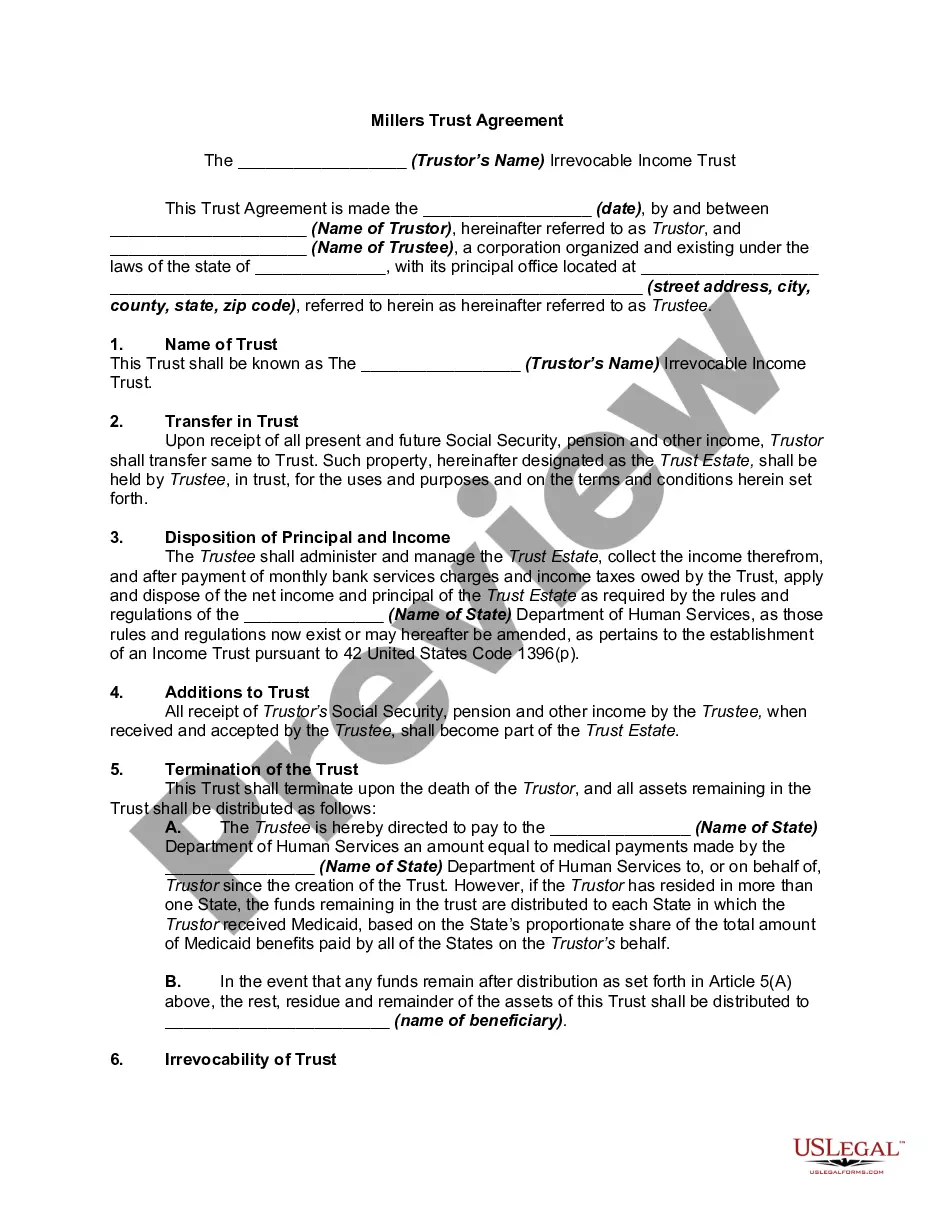
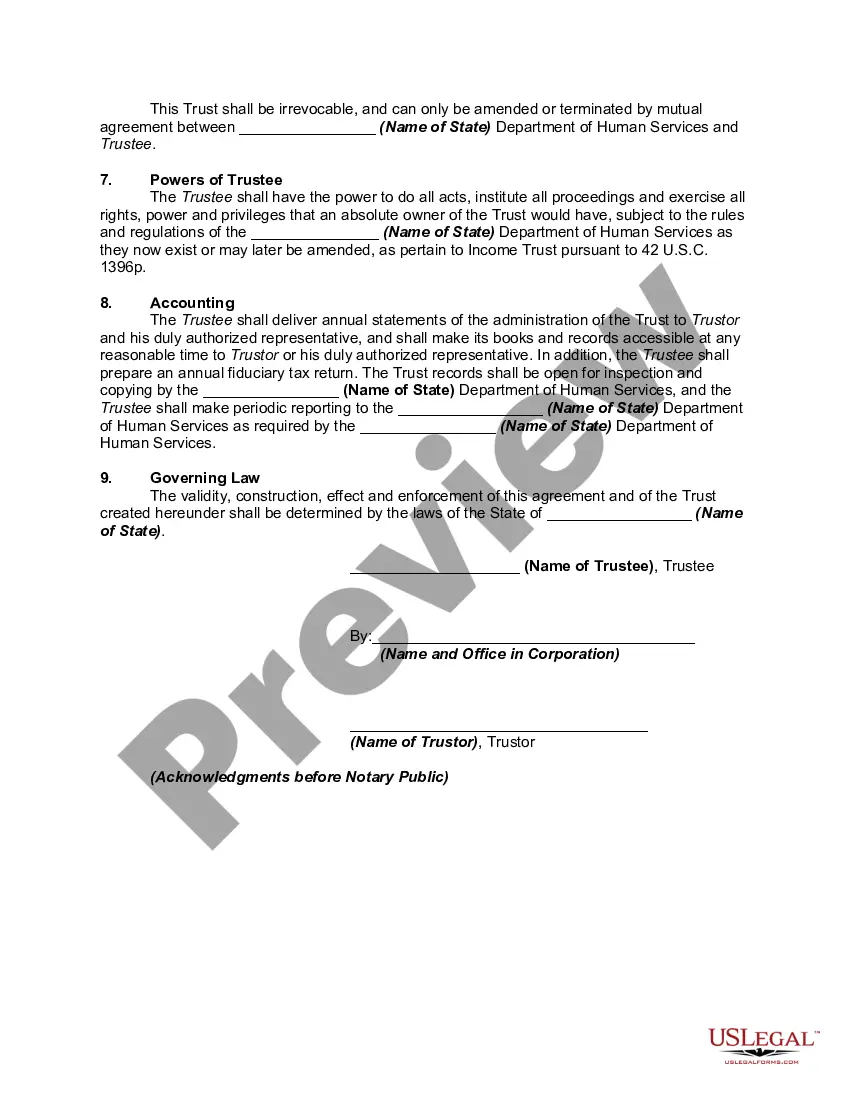
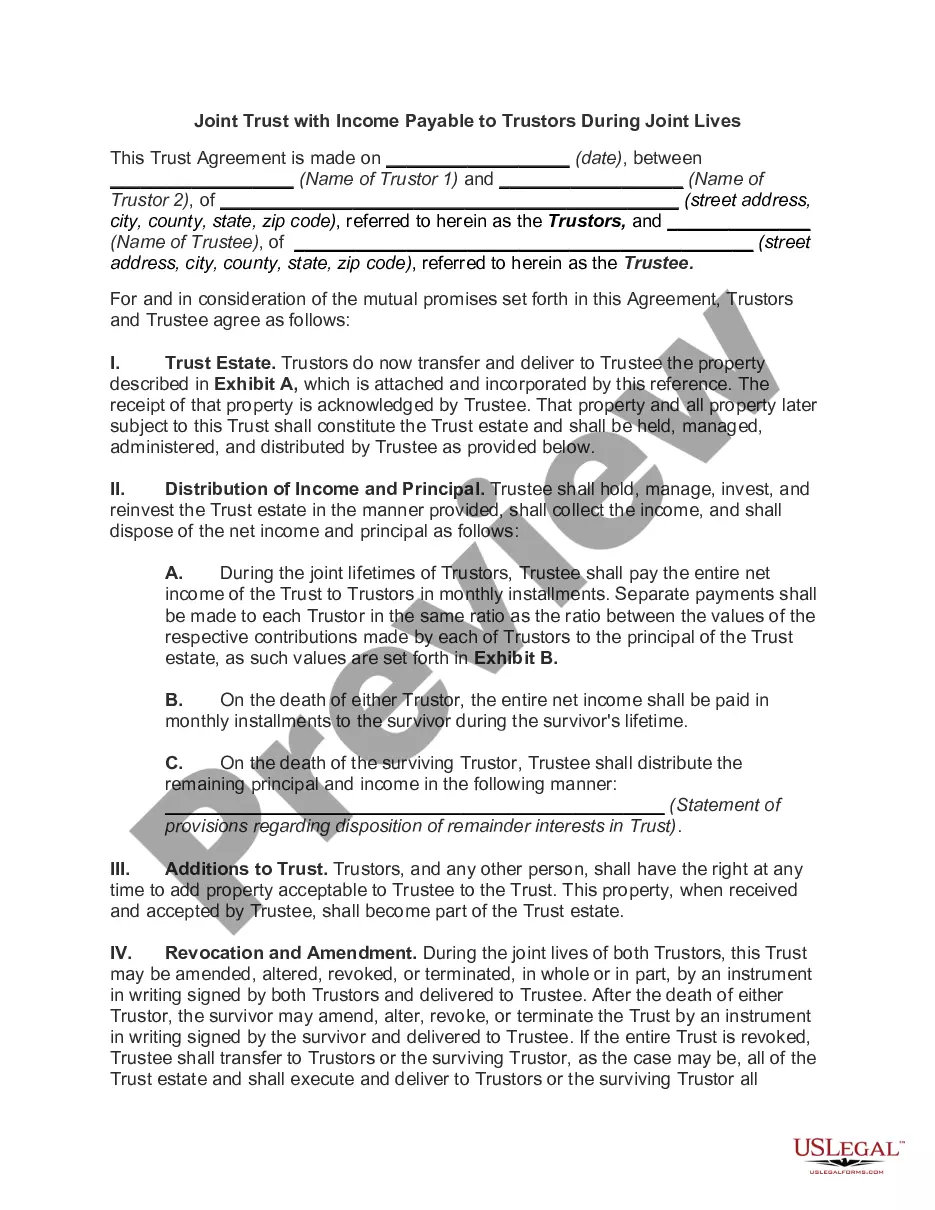
- Preview it (if this option is available) and examine the supporting description to ascertain if the Qualified Income Trust in Texas meets your needs.
- Restart your search if you need another document.
- Sign up for a free account and select a subscription plan to acquire the document.
- Click Buy now. Once the transaction is completed, you can receive the Qualified Income Trust in Texas, fill it out, print it, and send it by mail to the appropriate parties or organizations.
Form popularity
FAQ
In Texas, a Qualified Income Trust works by collecting income that surpasses the Medicaid limit and allowing you to use it for qualified expenses instead. The trust must be irrevocable and have a specific language that complies with state regulations. When structured correctly, the income deposited into the trust does not count against your eligibility for Medicaid. For detailed assistance in setting up and understanding your QIT, US Legal Forms can provide valuable tools and information.
A Qualified Income Trust in Texas is specifically designed to help individuals qualify for Medicaid services while managing their income. It allows you to set aside income that exceeds Medicaid eligibility limits, thus enabling you to still receive necessary medical support. The trust ensures that your excess income does not disqualify you from these essential benefits. With the right resources, like those offered by US Legal Forms, you can navigate the process smoothly.
To set up a Qualified Income Trust in Texas, you need to choose a trustee and create a formal trust document. This document outlines how the trust will operate, including the beneficiaries and how funds will be distributed. After establishing the trust, you can fund it with your income, ensuring you meet the eligibility criteria for Medicaid. For a streamlined process, consider using US Legal Forms, which provides the necessary templates and guidance for setting up your QIT effectively.
A Miller Trust, or qualified income trust in Texas, is crucial for individuals whose income exceeds Medicaid limits. This trust allows you to redirect excess income to qualify for Medicaid assistance for long-term care services. Engaging with a platform like USLegalForms can simplify the process of creating a Miller Trust, ensuring you are well-prepared and compliant with all legal requirements.
Funds held in a qualified income trust in Texas can be used for various essential expenses. These include medical bills, housing costs, and other everyday living expenses that are necessary for the beneficiary’s well-being. This versatility enables individuals to manage their finances better while still being eligible for Medicaid support.
To establish a qualified income trust in Texas, the trust must be irrevocable and set up exclusively for the benefit of the individual applying for Medicaid. Additionally, the income deposited into the trust should solely be used for specific expenses, such as medical care and living costs. Understanding these requirements is essential to ensure compliance with Texas Medicaid regulations.
A qualifying trust in Texas, commonly called a qualified income trust, is a financial tool designed to help individuals qualify for Medicaid. It allows excess income to be deposited into a trust, enabling access to necessary health services without exceeding Medicaid's income limits. This trust helps individuals manage income effectively while ensuring eligibility for crucial benefits.
A qualified income trust in Texas allows individuals to set aside income to qualify for Medicaid benefits. By placing excess income into the trust, beneficiaries can meet the income limits set by Medicaid. This arrangement ensures individuals can receive necessary medical assistance while preserving some of their income for living expenses.
While it is not strictly necessary to hire a lawyer to set up a Miller trust, consulting with an attorney can simplify the process. A qualified income trust in Texas, also known as a Miller trust, has specific requirements that must be met. Legal assistance can help ensure that everything is done correctly, potentially saving you time and trouble in the long run.
Funds from a qualified income trust in Texas can be used for a variety of expenses crucial for maintaining quality of life. This includes medical expenses, insurance premiums, and certain care costs that Medicaid does not cover. By using QIT funds appropriately, individuals can manage their healthcare needs while benefiting from state assistance.