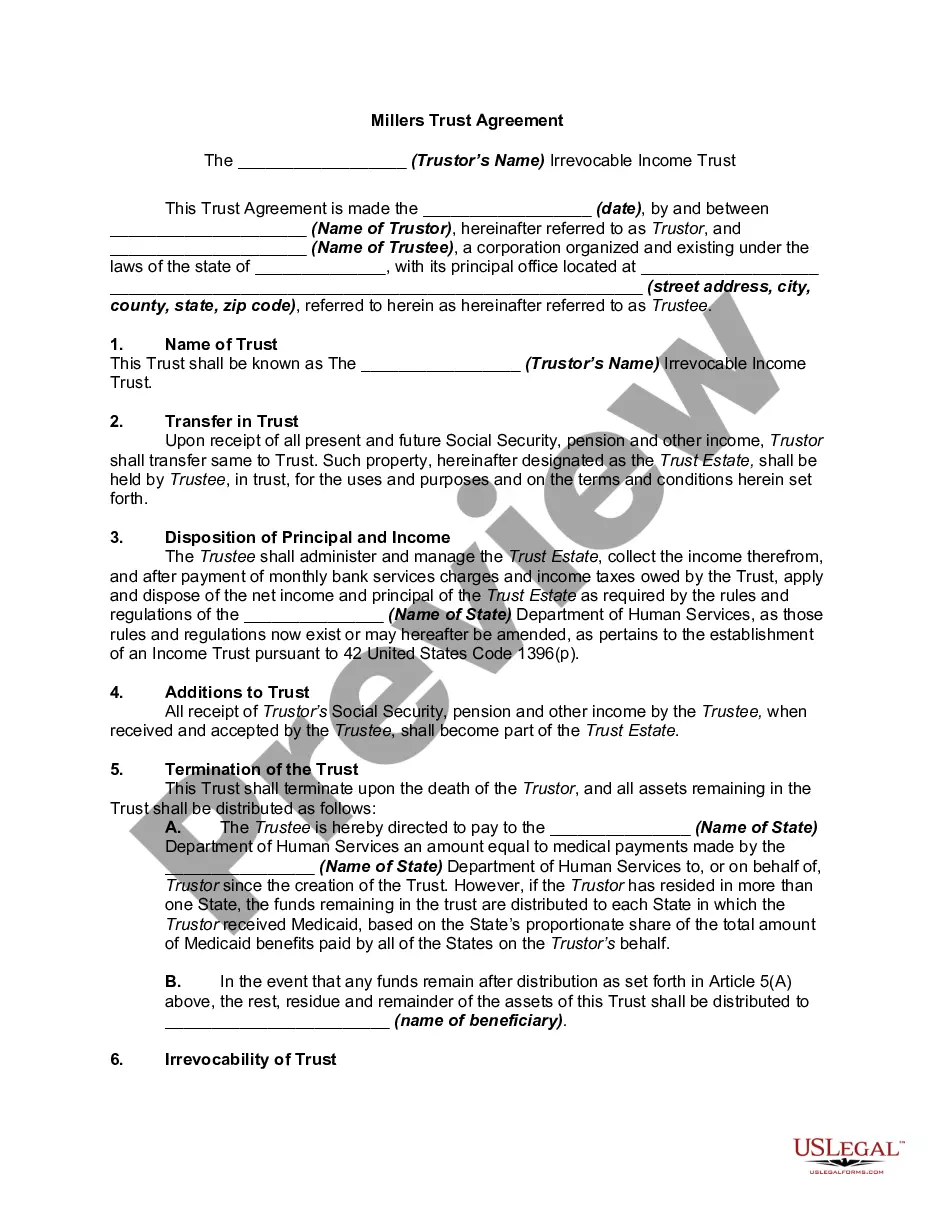
Medicaid Qualifying Trust For Historic Preservation
Description

Get your form ready online
Our built-in tools help you complete, sign, share, and store your documents in one place.
Make edits, fill in missing information, and update formatting in US Legal Forms—just like you would in MS Word.
Download a copy, print it, send it by email, or mail it via USPS—whatever works best for your next step.
Sign and collect signatures with our SignNow integration. Send to multiple recipients, set reminders, and more. Go Premium to unlock E-Sign.
If this form requires notarization, complete it online through a secure video call—no need to meet a notary in person or wait for an appointment.
We protect your documents and personal data by following strict security and privacy standards.

Make edits, fill in missing information, and update formatting in US Legal Forms—just like you would in MS Word.

Download a copy, print it, send it by email, or mail it via USPS—whatever works best for your next step.

Sign and collect signatures with our SignNow integration. Send to multiple recipients, set reminders, and more. Go Premium to unlock E-Sign.

If this form requires notarization, complete it online through a secure video call—no need to meet a notary in person or wait for an appointment.

We protect your documents and personal data by following strict security and privacy standards.
Looking for another form?







How to fill out Qualified Income Miller Trust?
Creating legal documents from the ground up can occasionally be overwhelming.
Certain situations may require extensive research and substantial financial investment.
If you’re seeking a simpler and more affordable method of preparing the Medicaid Qualifying Trust for Historic Preservation or any other document without unnecessary complications, US Legal Forms is always available to assist you.
Our online inventory of over 85,000 current legal documents encompasses nearly every aspect of your financial, legal, and personal matters.
However, before rushing to download the Medicaid Qualifying Trust for Historic Preservation, consider these recommendations: Review the form preview and descriptions to ensure you've located the correct document. Verify that the template you choose meets the standards of your state and county. Select the most appropriate subscription option for purchasing the Medicaid Qualifying Trust for Historic Preservation. Download the form, then complete, sign, and print it out. US Legal Forms has established a strong reputation with over 25 years of expertise. Join us today and make document completion a hassle-free and efficient process!
- With just a few clicks, you can swiftly obtain state- and county-specific forms meticulously prepared by our legal experts.
- Utilize our platform whenever you need dependable services to quickly locate and download the Medicaid Qualifying Trust for Historic Preservation.
- If you’re familiar with our site and have already established an account, simply Log In to your account, choose the form, and download it or re-download it anytime from the My documents section.
- No account? No worries. Setting one up takes only a few minutes, and navigating the catalog is straightforward.
Form popularity
FAQ
To legally protect your assets from Medicaid, consider establishing a Medicaid qualifying trust for historic preservation. This strategy allows you to safeguard your property while remaining eligible for Medicaid benefits. Consulting a legal expert can provide insights about the best methods for asset protection. Implementing these strategies early can help secure your financial future while preserving your legacy.
Certain assets are exempt from Medicaid recovery, including your primary home, personal items, and specific types of trust funds. The Medicaid qualifying trust for historic preservation may also offer additional protections for historic properties. Understanding these exemptions helps in planning your estate effectively. A consultation with an estate planning attorney can clarify which assets may be safeguarded.
To protect your assets from Medicaid's look back period, you can create a Medicaid qualifying trust for historic preservation. This type of trust allows you to place assets in a protected format, making them less susceptible to Medicaid's review. It is crucial to plan ahead and consult with a professional to ensure that your trust aligns with your financial needs and goals. Taking these proactive steps can help secure your assets while qualifying for benefits.
Medicaid usually examines bank accounts for the same 5-year look back period. They look for patterns of asset transfers or withdrawals that could indicate attempts to hide assets prior to applying for benefits. This process ensures that assets are disclosed fully. Establishing a Medicaid qualifying trust for historic preservation can also streamline how your assets are viewed during this scrutiny.
Yes, Medicaid typically conducts a 5-year look back to evaluate your financial history before qualifying you for benefits. This means that they review any asset transfers or financial changes made during that period. If you transferred assets for less than their market value, it may affect your eligibility. Using a Medicaid qualifying trust for historic preservation can help manage your assets effectively within this timeframe.
Avoiding the Medicaid 5-year lookback period can be tricky, but a Medicaid qualifying trust for historic preservation is one potential solution. By transferring assets into this trust, you may start the process of protecting your assets without triggering penalties. However, it is essential to act well before you need Medicaid, as this strategy requires careful planning to comply with regulations. Consulting with uslegalforms can provide guidance on the proper setup to navigate this challenge.
One disadvantage of a Medicaid qualifying trust for historic preservation is the potential for complexity in setup and management. Setting up this trust may require legal assistance, which can incur additional costs. Additionally, if the trust is not structured properly, it may not provide the intended benefits regarding Medicaid eligibility. Understanding these factors can help you make informed decisions.
Yes, you can use a Medicaid qualifying trust for historic preservation to help meet Medicaid eligibility requirements. This type of trust allows you to preserve your assets while ensuring that you qualify for Medicaid benefits. By placing your assets into this trust, you can protect them from being counted against the Medicaid resource limits. It's crucial to work with a legal expert to set up the trust correctly.
Putting your home in a trust, specifically a Medicaid qualifying trust for historic preservation, can offer some level of protection from Medicaid claims. However, it is essential to structure the trust properly and meet specific guidelines. Consulting with a specialist or using resources from US Legal Forms can help ensure that your trust is set up to effectively protect your assets while complying with Medicaid rules.
The cheapest way to set up a trust often involves using online platforms like US Legal Forms, which provide user-friendly templates and guidance. By utilizing these resources, you can create a Medicaid qualifying trust for historic preservation without incurring high legal fees. This approach minimizes costs while ensuring your trust meets legal standards.