Employ Law With Foreign Employees
Description

Get your form ready online
Our built-in tools help you complete, sign, share, and store your documents in one place.
Make edits, fill in missing information, and update formatting in US Legal Forms—just like you would in MS Word.
Download a copy, print it, send it by email, or mail it via USPS—whatever works best for your next step.
Sign and collect signatures with our SignNow integration. Send to multiple recipients, set reminders, and more. Go Premium to unlock E-Sign.
If this form requires notarization, complete it online through a secure video call—no need to meet a notary in person or wait for an appointment.
We protect your documents and personal data by following strict security and privacy standards.

Make edits, fill in missing information, and update formatting in US Legal Forms—just like you would in MS Word.

Download a copy, print it, send it by email, or mail it via USPS—whatever works best for your next step.

Sign and collect signatures with our SignNow integration. Send to multiple recipients, set reminders, and more. Go Premium to unlock E-Sign.

If this form requires notarization, complete it online through a secure video call—no need to meet a notary in person or wait for an appointment.

We protect your documents and personal data by following strict security and privacy standards.
Looking for another form?








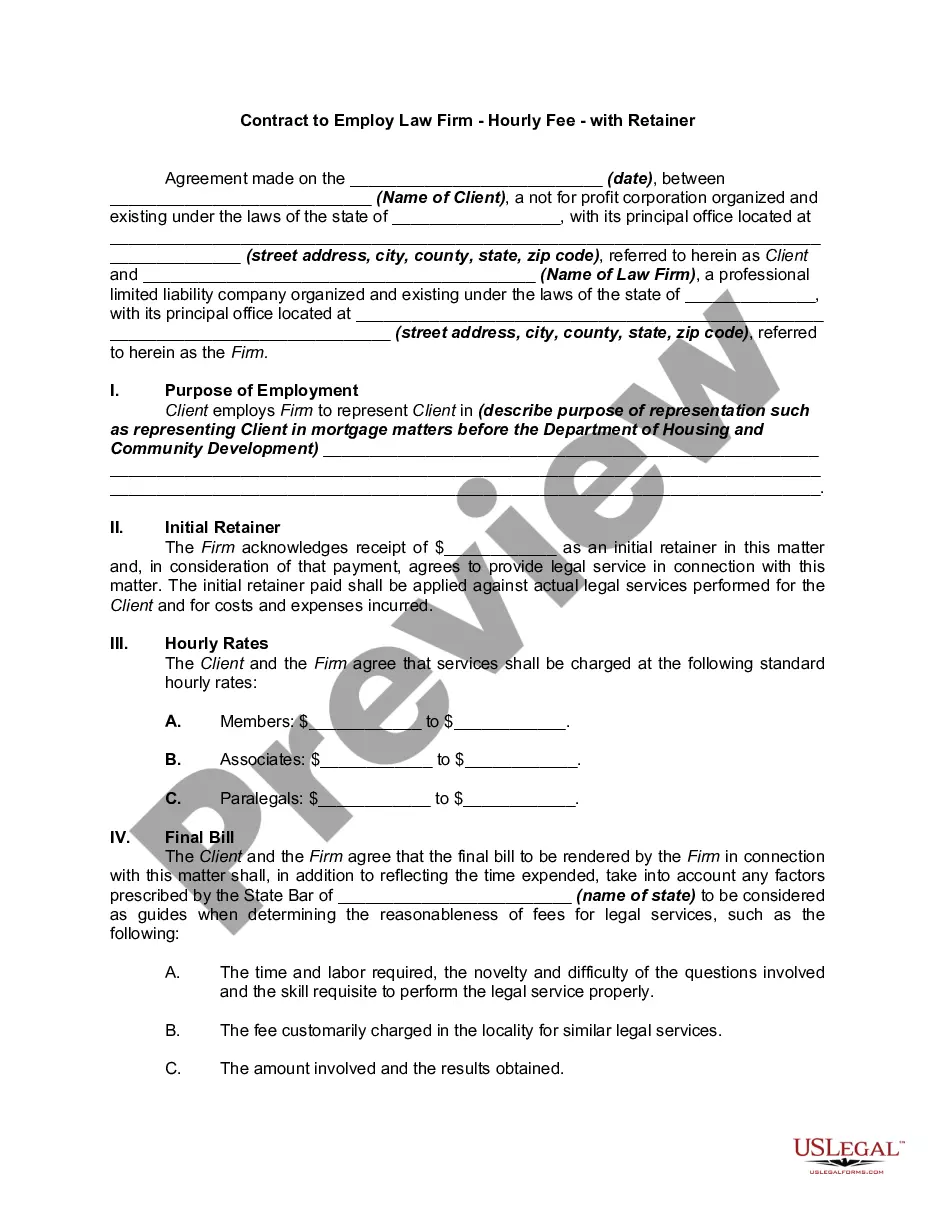
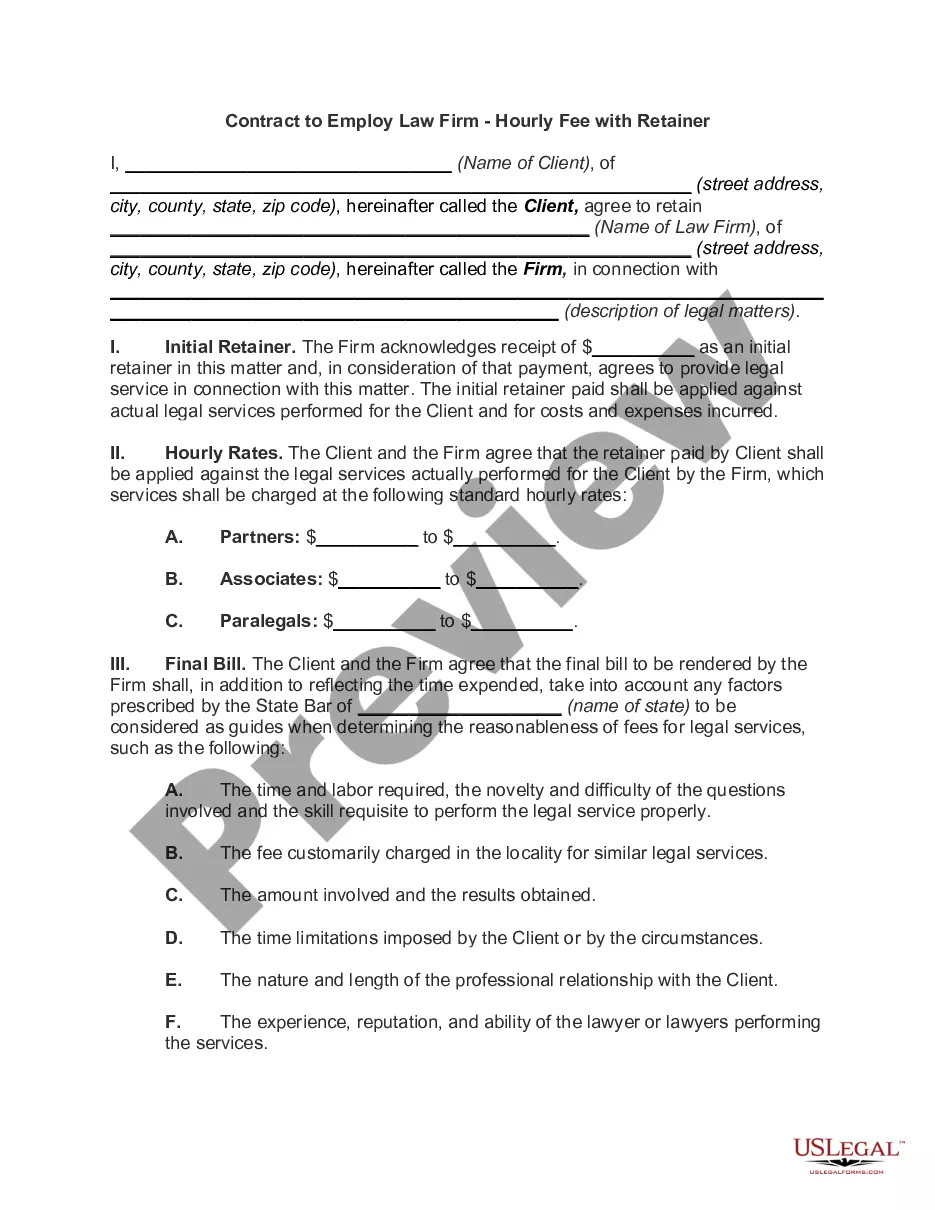
How to fill out Contract To Employ Law Firm - Hourly Fee - With Retainer?
Creating legal documentation from the ground up can occasionally be daunting.
Certain situations may require extensive research and significant financial expenditure.
If you’re looking for an easier and more budget-friendly approach to drafting Employ Law With Foreign Employees or any other paperwork without unnecessary obstacles, US Legal Forms is always readily accessible.
Our online library of over 85,000 current legal documents covers nearly every aspect of your financial, legal, and personal matters. With just a few clicks, you can swiftly access state- and county-specific forms meticulously prepared for you by our legal experts.
Examine the form preview and descriptions to ensure you are on the correct document. Ensure the chosen form complies with the statutes and regulations of your jurisdiction. Select the appropriate subscription plan to purchase the Employ Law With Foreign Employees. Download the file, then complete, authenticate, and print it. US Legal Forms prides itself on a flawless reputation and over 25 years of experience. Join us today and make document management easy and efficient!
- Utilize our website whenever you need dependable services that enable you to easily find and download the Employ Law With Foreign Employees.
- If you’re familiar with our site and have already registered an account with us, just Log In, find the form and download it or retrieve it at any later time from the My documents section.
- Not signed up yet? No problem. It requires minimal time to create an account and browse the collection.
- Before directly downloading Employ Law With Foreign Employees, remember to follow these suggestions.
Form popularity
FAQ
An employer can hire a non-U.S. citizen by following the relevant employ law with foreign employees. It’s important to ensure that the non-citizen has the required work authorization. For assistance and to simplify the legal processes involved, platforms such as uslegalforms can be beneficial.
You must first request certification from DOL before submitting your I-129 petition to USCIS. For H-1B nonimmigrants, a Labor Condition Application, and for H-2A and H-2B nonimmigrants, an Application for Temporary Employment Certification must be filed in ance with DOL instructions.
Take this opportunity to clarify the position's duties, responsibilities, schedule, tools, work methods and other expectations, and to validate the worker's understanding. If the latter is not yet fluent in the local language, be sure to use simple, unambiguous vocabulary.
The answer is yes ? US companies can hire international workers legally. However, in most cases, hiring a remote team cannot be done as a direct employee unless the company has a legal entity in the worker's country of residence. But there is another option: hiring them as contractors.
Federal U.S. employment laws generally apply only to those employees who work in the United States or its territories. There are a few exceptions though, as the following four major U.S. employment laws have some application abroad: Title VII of the Civil Rights Act. The Age Discrimination in Employment Act (ADEA).
The provisions of the Fair Labor Standards Act (FLSA) regarding minimum wage and overtime requirements do not apply to any employee whose services during the workweek are performed in a workplace within a foreign country or within territory under the jurisdiction of the United States, except for the following: Puerto ...