Statement Of Purpose For Mba
Description
Get your form ready online
Our built-in tools help you complete, sign, share, and store your documents in one place.
Make edits, fill in missing information, and update formatting in US Legal Forms—just like you would in MS Word.
Download a copy, print it, send it by email, or mail it via USPS—whatever works best for your next step.
Sign and collect signatures with our SignNow integration. Send to multiple recipients, set reminders, and more. Go Premium to unlock E-Sign.
If this form requires notarization, complete it online through a secure video call—no need to meet a notary in person or wait for an appointment.
We protect your documents and personal data by following strict security and privacy standards.

Make edits, fill in missing information, and update formatting in US Legal Forms—just like you would in MS Word.

Download a copy, print it, send it by email, or mail it via USPS—whatever works best for your next step.

Sign and collect signatures with our SignNow integration. Send to multiple recipients, set reminders, and more. Go Premium to unlock E-Sign.

If this form requires notarization, complete it online through a secure video call—no need to meet a notary in person or wait for an appointment.

We protect your documents and personal data by following strict security and privacy standards.
Looking for another form?








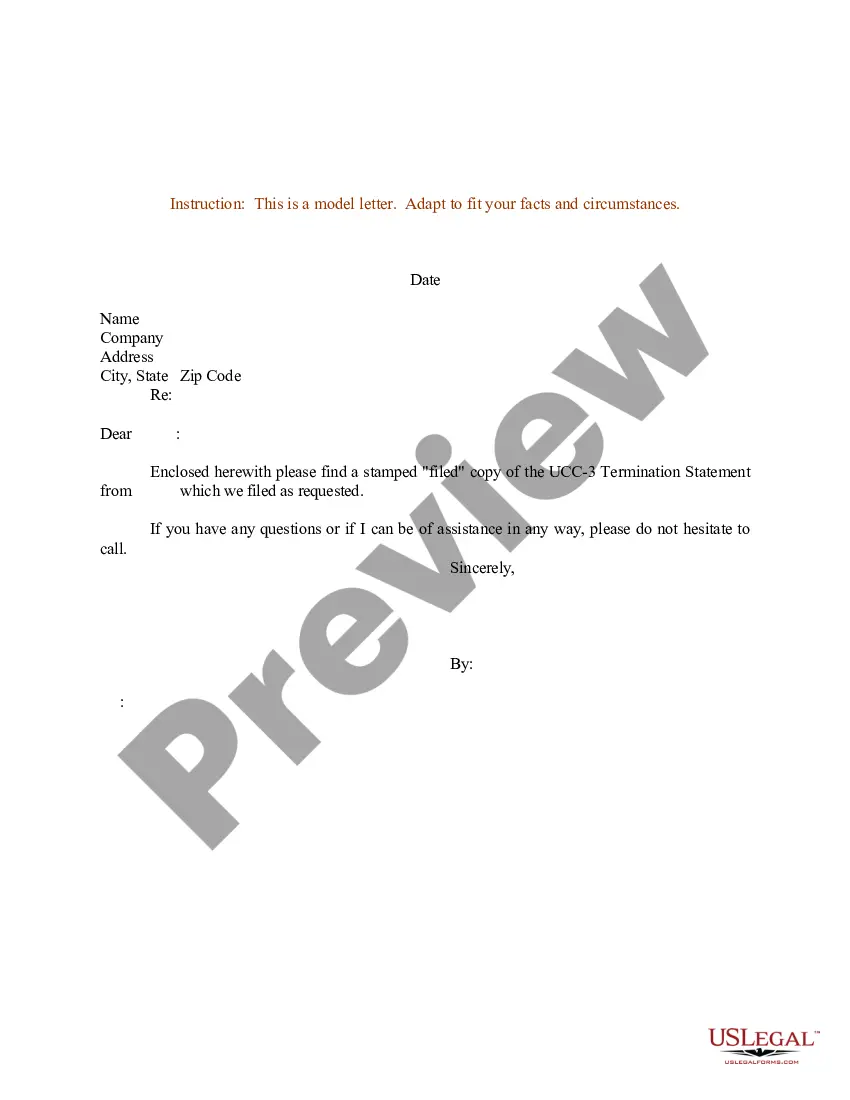
How to fill out Sample Letter For UCC-3 Termination Statement?
Whether for corporate intents or for personal issues, everyone must confront legal matters at some stage in their life.
Filling out legal documents necessitates meticulous attention, starting with selecting the appropriate template.
With an extensive US Legal Forms catalog available, you don’t need to waste time searching for the right template across the internet. Utilize the library’s straightforward navigation to find the correct document for any circumstance.
- Locate the template you require using the search box or catalog navigation.
- Review the document's details to confirm it matches your situation, state, and county.
- Click on the document's preview to view it.
- If it is the incorrect document, return to the search option to find the Statement Of Purpose For Mba template you need.
- Obtain the document if it fulfills your criteria.
- If you already possess a US Legal Forms account, click Log in to access previously saved documents in My documents.
- If you do not have an account yet, you can purchase the document by clicking Buy now.
- Choose the correct pricing plan.
- Fill out the profile registration form.
- Select your payment method: utilize a credit card or PayPal account.
- Choose the file format you desire and download the Statement Of Purpose For Mba.
- Once it has been downloaded, you can complete the document using editing software or print it out to fill it in manually.
Form popularity
FAQ
Writing a statement of purpose for MBA involves a few key steps. Start by outlining your main themes, like your academic background, work experience, and career aspirations. Ensure each section seamlessly connects and builds on the previous one, creating a cohesive narrative that clearly articulates why you want to pursue this degree and how you plan to apply the knowledge gained.
An MBA statement of interest typically emphasizes your specific interests in business studied in connection to your career. For instance, you could highlight your passion for entrepreneurship and how that drives your desire to learn from a particular program. Craft your narrative to convey your enthusiasm and how the program will support your journey.
An example of a statement of purpose for a master's in business administration might include a description of your career achievements, a summary of your leadership experiences, and your vision for the future. For instance, you could discuss a project where you led a team and the skills you gained that prepare you for further study. This provides a solid foundation for your application, showcasing your readiness for advanced business studies.
To write a compelling statement of purpose for MBA, structure your document clearly. Start with an introduction, followed by a discussion of your academic and professional background, your ambitions, and why you are applying to that particular program. It is also useful to highlight how the program aligns with your career goals.
Begin your statement of purpose for MBA with a strong opening that captures the reader's attention. You might consider starting with a personal story, an impactful quote, or a thought-provoking question. This initial hook sets the tone for your narrative, encouraging admissions committees to read further.
The ideal length for a statement of purpose for MBA programs is usually between 500 and 1,000 words. It is important to be concise while covering all necessary points. Aim for clarity and focus on your experiences, goals, and motivations. This approach ensures that your statement is engaging and informative.
A good example of a statement of purpose for MBA includes a clear introduction explaining why you are pursuing the degree, anecdotal evidence of your skills and ambitions, and a conclusion that ties together your future goals with the advantages the MBA offers. Remember to personalize your statement, showcasing your individual story and perspectives.
The best statement of purpose for MBA combines personal storytelling with professional insights. It illustrates your journey, emphasizing how your experiences shaped your decision to pursue an MBA. Such a statement is well-structured, articulate, and tailored to reflect your unique viewpoint and ambitions.
A statement of academic purpose for MBA focuses on your academic interests and the specific areas of the business field you wish to explore. It often includes your research experience, academic coursework, and how these experiences align with your career goals. This statement should reflect a deep understanding of the subject matter and your commitment to contributing to the field.
Typically, a statement of purpose for MBA should range from 500 to 1,000 words, depending on the program's requirements. It's essential to check with the specific institution for their guidelines. Keeping your writing concise yet comprehensive will help you effectively communicate your experiences and goals.