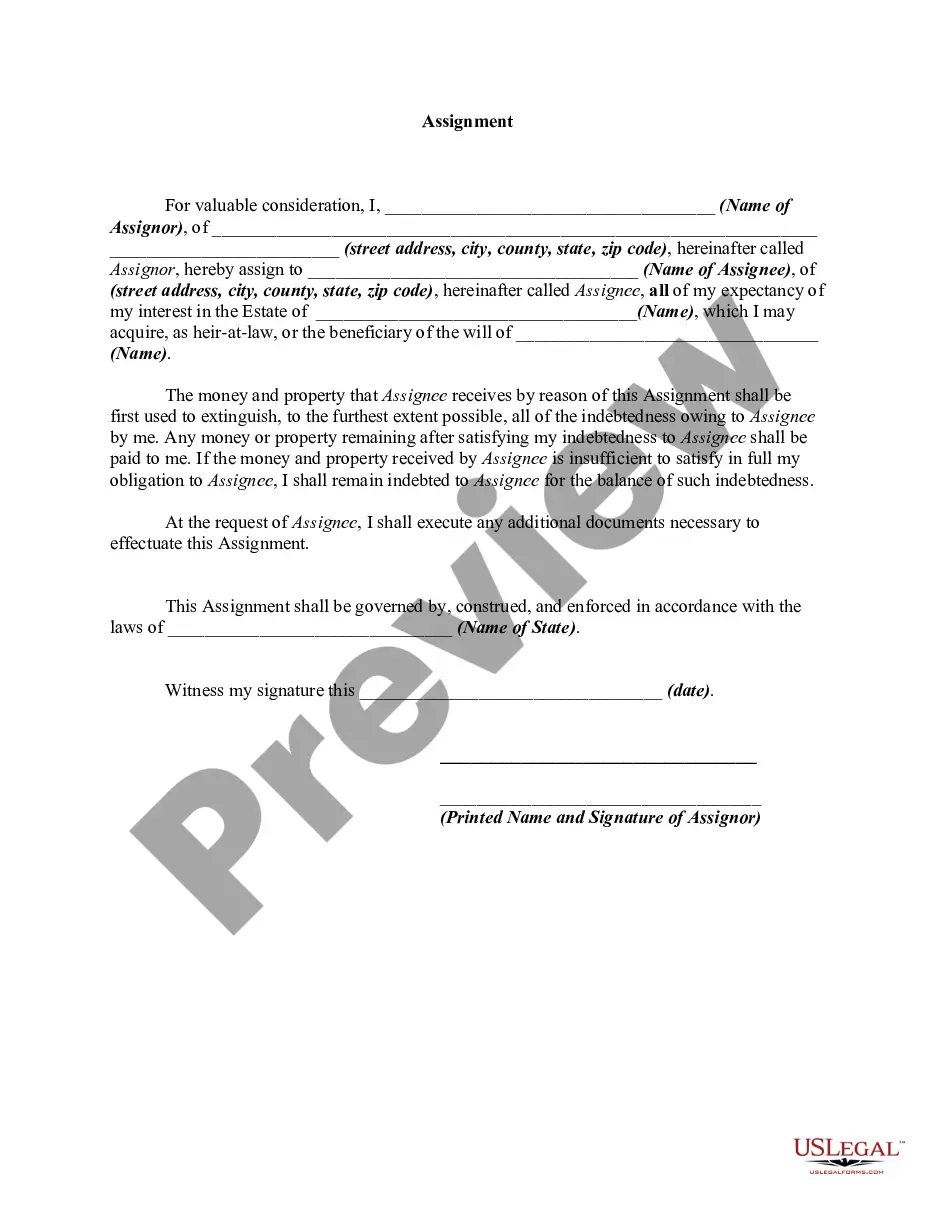
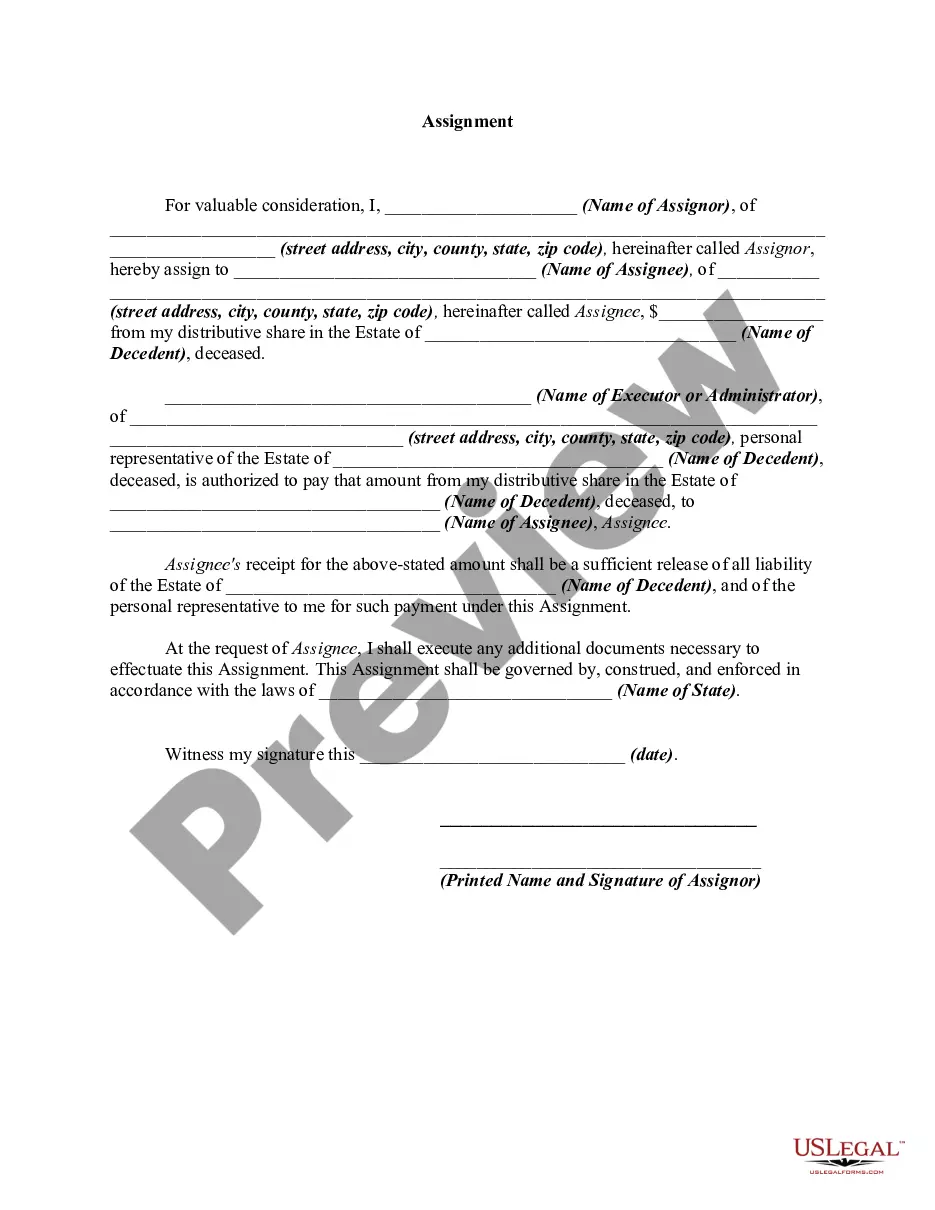
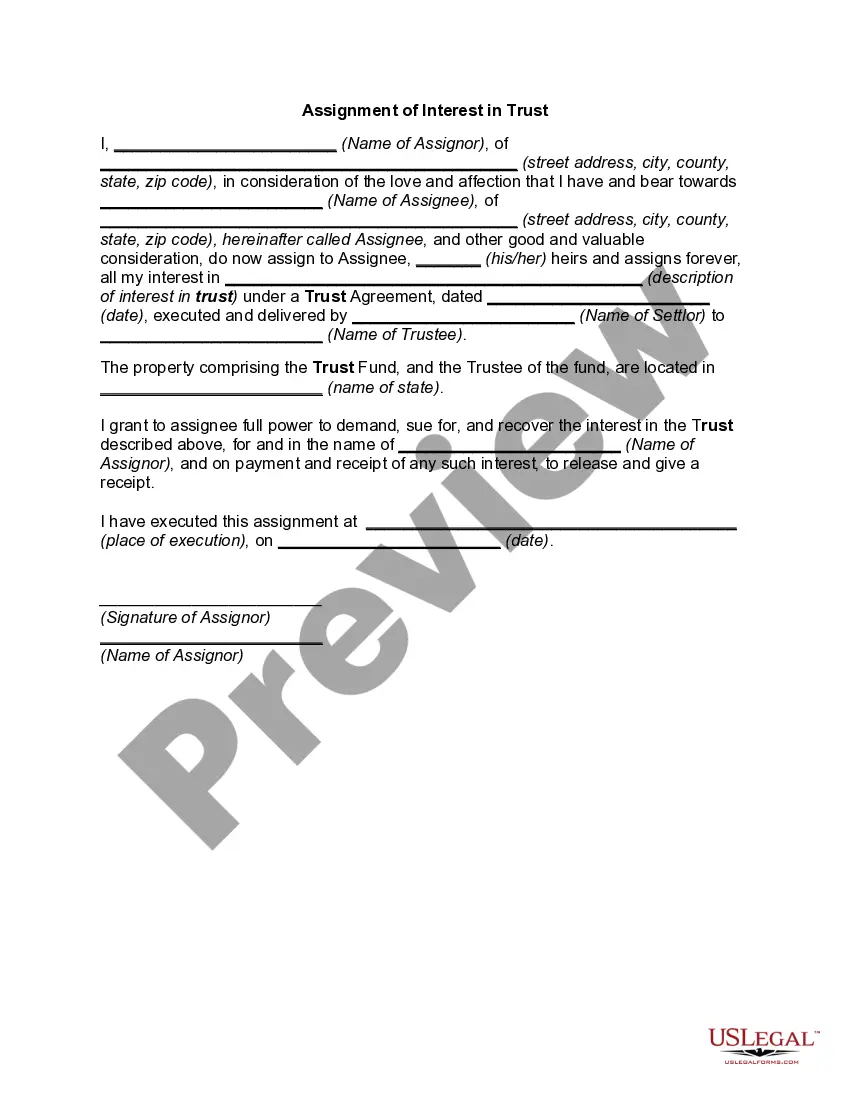
Assignment All Sample Formula
Description
Get your form ready online
Our built-in tools help you complete, sign, share, and store your documents in one place.
Make edits, fill in missing information, and update formatting in US Legal Forms—just like you would in MS Word.
Download a copy, print it, send it by email, or mail it via USPS—whatever works best for your next step.
Sign and collect signatures with our SignNow integration. Send to multiple recipients, set reminders, and more. Go Premium to unlock E-Sign.
If this form requires notarization, complete it online through a secure video call—no need to meet a notary in person or wait for an appointment.
We protect your documents and personal data by following strict security and privacy standards.

Make edits, fill in missing information, and update formatting in US Legal Forms—just like you would in MS Word.

Download a copy, print it, send it by email, or mail it via USPS—whatever works best for your next step.

Sign and collect signatures with our SignNow integration. Send to multiple recipients, set reminders, and more. Go Premium to unlock E-Sign.

If this form requires notarization, complete it online through a secure video call—no need to meet a notary in person or wait for an appointment.

We protect your documents and personal data by following strict security and privacy standards.
Looking for another form?

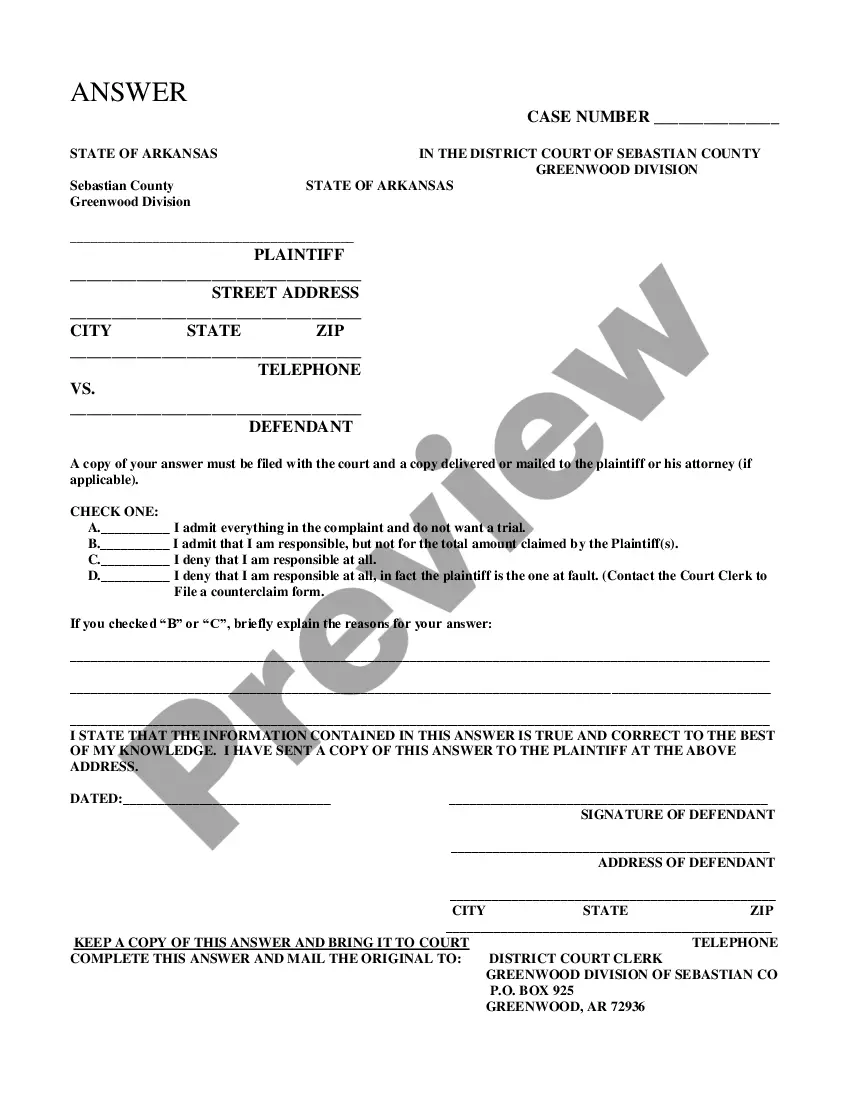





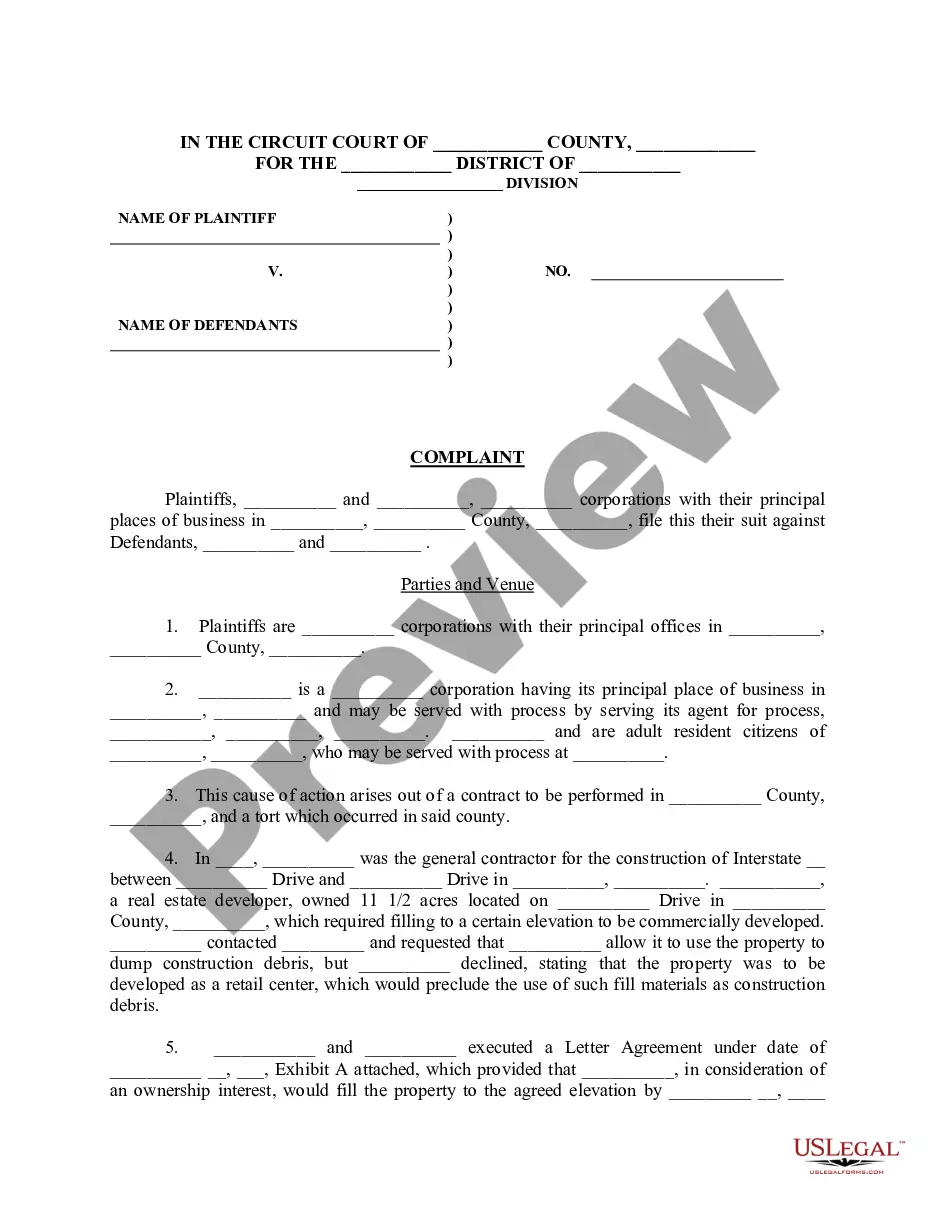

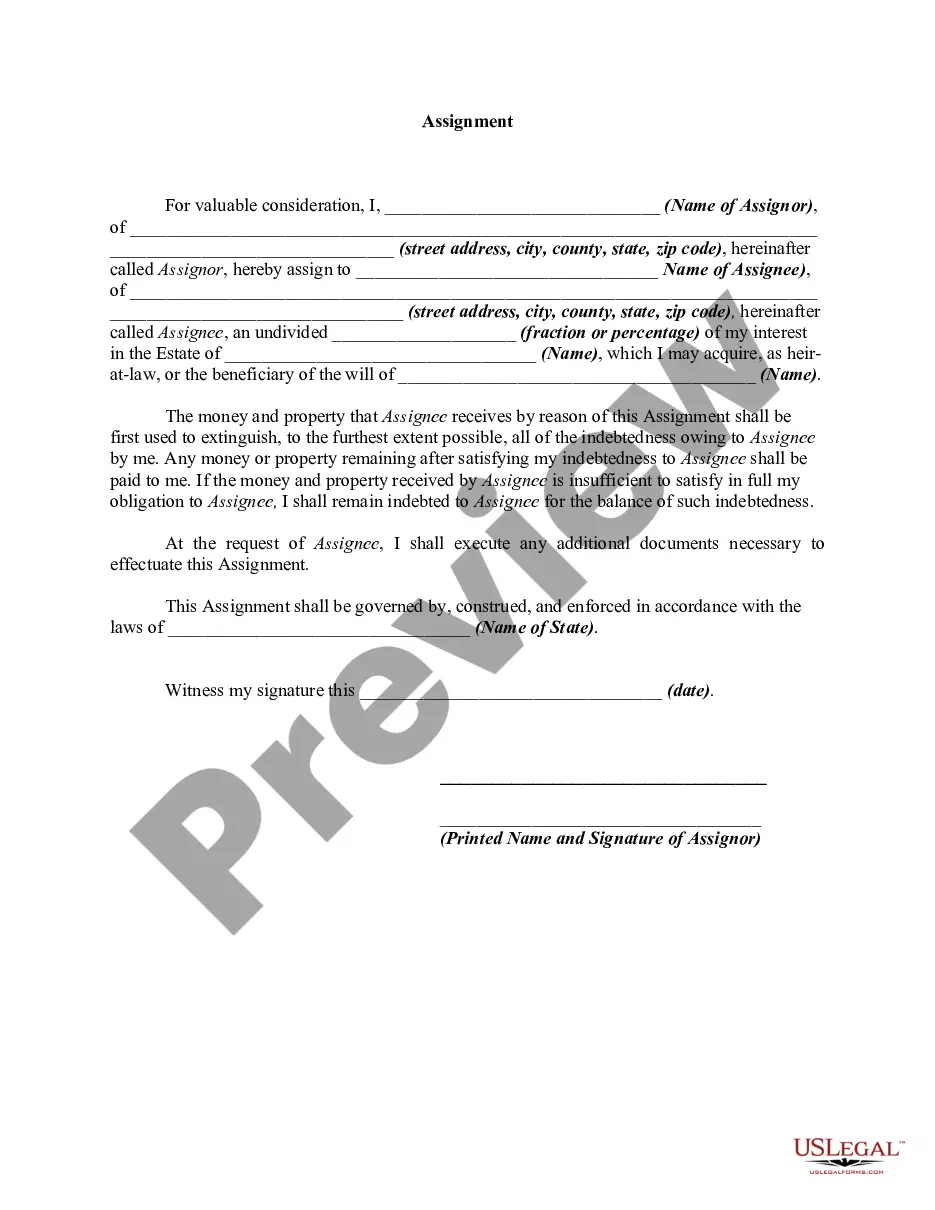
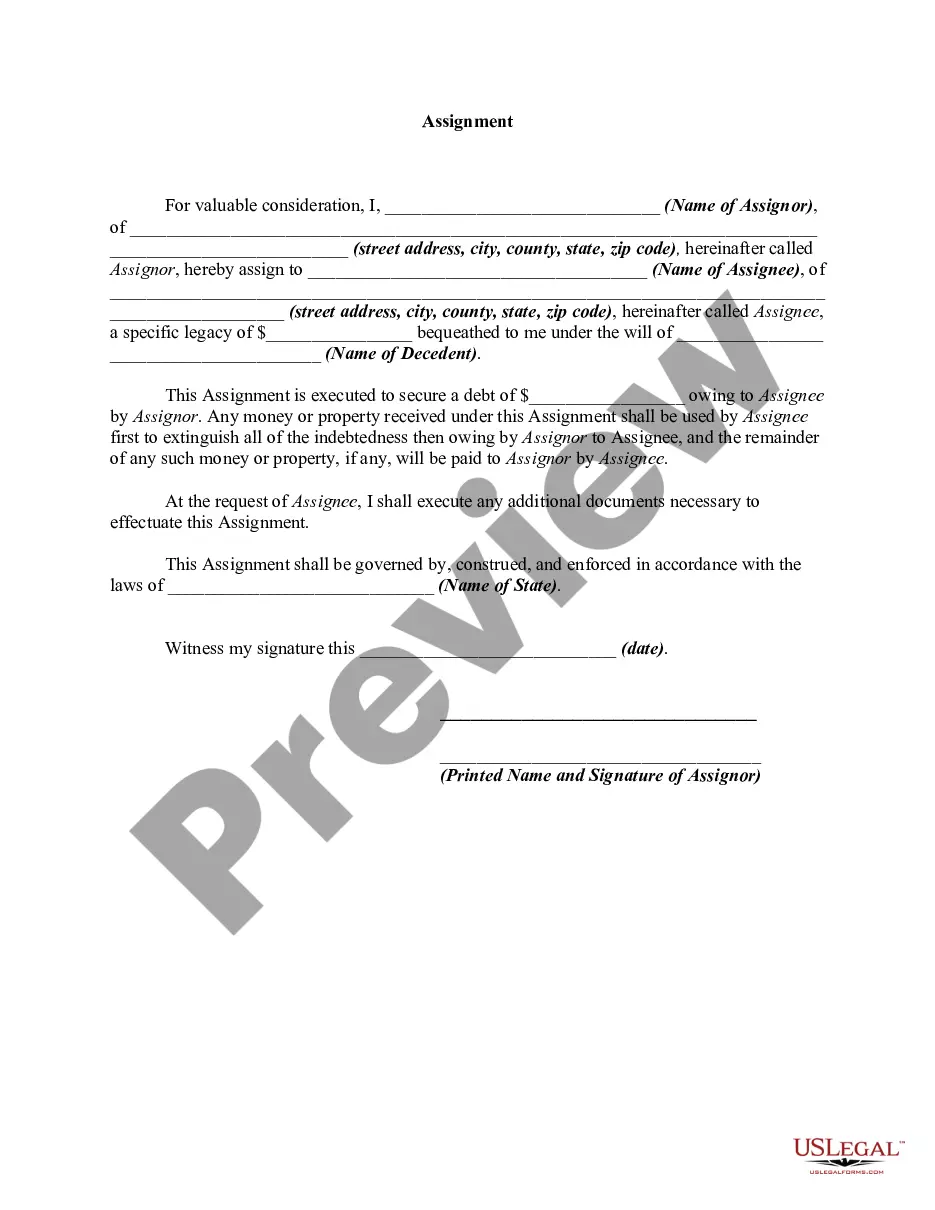
How to fill out Assignment Of All Of Expected Interest In Estate In Order To Pay Indebtedness?
Drafting legal paperwork from scratch can often be intimidating. Some cases might involve hours of research and hundreds of dollars invested. If you’re searching for a simpler and more cost-effective way of creating Assignment All Sample Formula or any other forms without the need of jumping through hoops, US Legal Forms is always at your disposal.
Our online library of more than 85,000 up-to-date legal forms addresses virtually every aspect of your financial, legal, and personal affairs. With just a few clicks, you can quickly access state- and county-compliant forms carefully put together for you by our legal professionals.
Use our platform whenever you need a trusted and reliable services through which you can quickly find and download the Assignment All Sample Formula. If you’re not new to our services and have previously created an account with us, simply log in to your account, select the form and download it away or re-download it anytime later in the My Forms tab.
Don’t have an account? No problem. It takes minutes to register it and navigate the catalog. But before jumping directly to downloading Assignment All Sample Formula, follow these recommendations:
- Review the document preview and descriptions to ensure that you have found the document you are searching for.
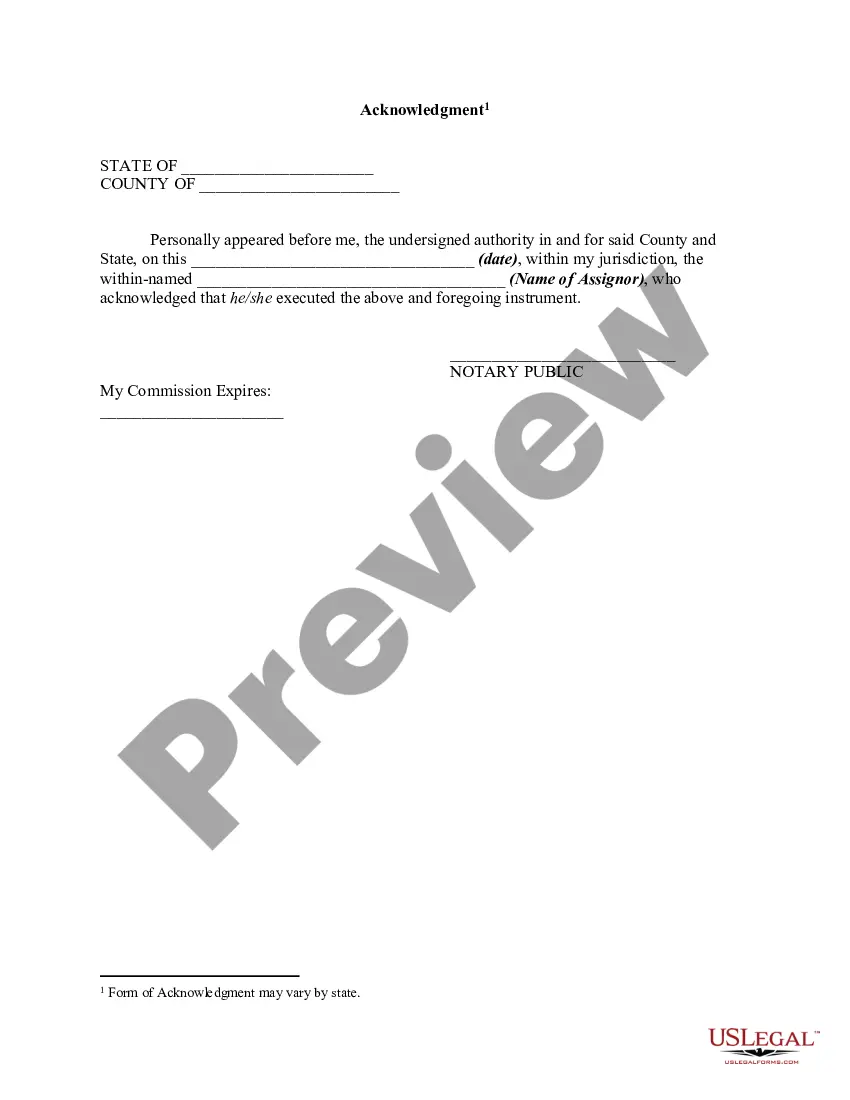
- Check if template you select complies with the requirements of your state and county.
- Choose the right subscription option to purchase the Assignment All Sample Formula.
- Download the form. Then fill out, sign, and print it out.
US Legal Forms has a spotless reputation and over 25 years of expertise. Join us today and turn document completion into something simple and streamlined!
Form popularity
FAQ
The Formula of Random Sampling (N-n/N-(n-1)). Here P is a probability, n is the sample size, and N represents the population. Now if one cancels 1-(N-n/n), it will provide P = n/N. Moreover, the chance of a sample getting selected more than once is needed: P = 1-(1-(1/N)) n.
The higher the statistical power of a test, the lower the risk of making a Type II error. Power is usually set at 80%. This means that if there are true effects to be found in 100 different studies with 80% power, only 80 out of 100 statistical tests will actually detect them.
The sample size was determined by Fisher's formula of; N = (Z 2 x p(1-p))/d 2 .
If the goal is 80% power to distinguish between hypothesized proportions p1 and p2 with a study of size n, equally divided between the two groups, a conservative sample size is n = [2.8/(p1?p2)]2 or, more precisely, n = 2[p1(1?p1) + p2(1?p2)] · [2.8/(p1?p2)]2.
Cochran's (1977) formula uses two key factors: (1) the risk the researcher is willing to accept in the study, commonly called the margin of error, or the error the researcher is willing to accept, and (2) the alpha level, the level of acceptable risk the researcher is willing to accept that the true margin Page 3 ...