Work-related Injuries Examples
Description
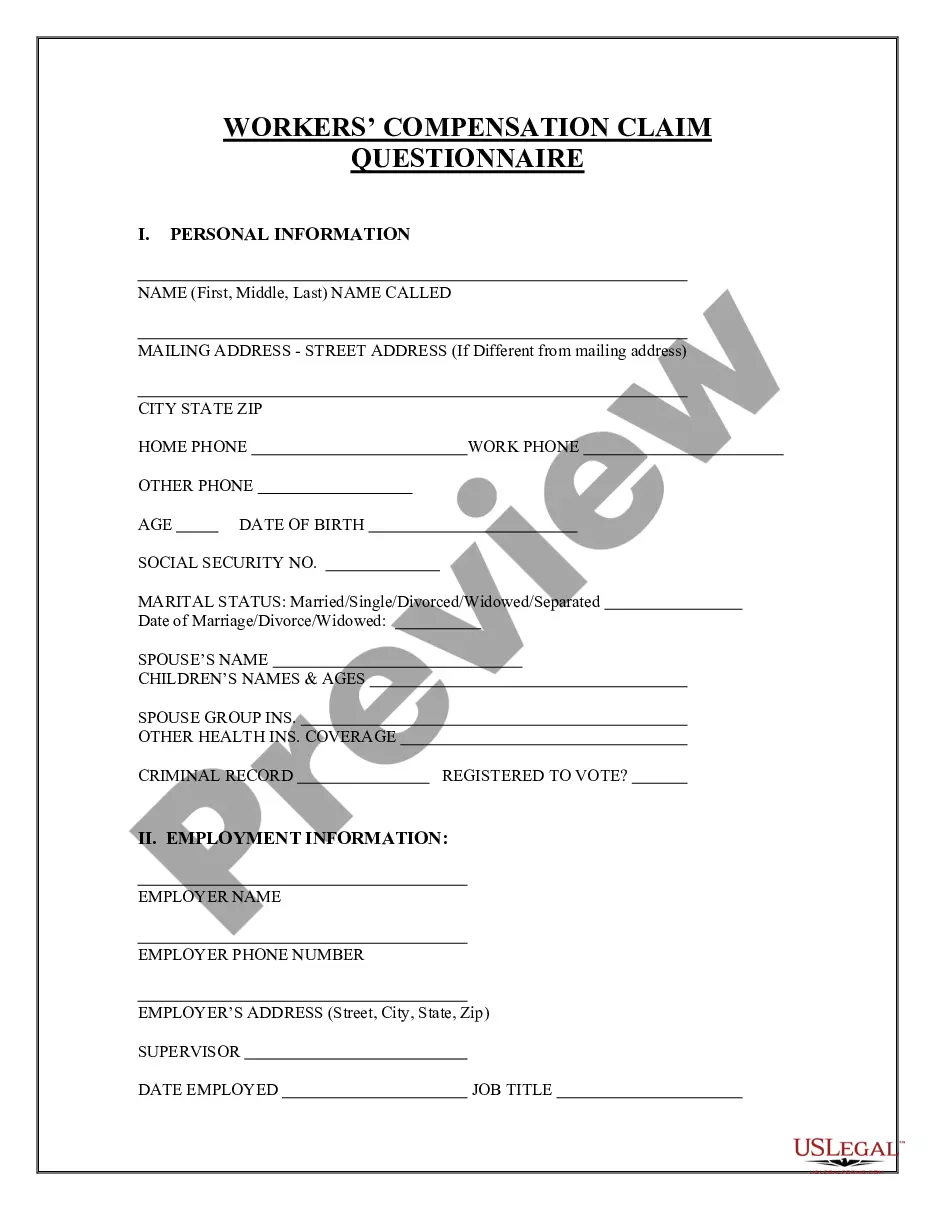
Get your form ready online
Our built-in tools help you complete, sign, share, and store your documents in one place.
Make edits, fill in missing information, and update formatting in US Legal Forms—just like you would in MS Word.
Download a copy, print it, send it by email, or mail it via USPS—whatever works best for your next step.
Sign and collect signatures with our SignNow integration. Send to multiple recipients, set reminders, and more. Go Premium to unlock E-Sign.
If this form requires notarization, complete it online through a secure video call—no need to meet a notary in person or wait for an appointment.
We protect your documents and personal data by following strict security and privacy standards.

Make edits, fill in missing information, and update formatting in US Legal Forms—just like you would in MS Word.

Download a copy, print it, send it by email, or mail it via USPS—whatever works best for your next step.

Sign and collect signatures with our SignNow integration. Send to multiple recipients, set reminders, and more. Go Premium to unlock E-Sign.

If this form requires notarization, complete it online through a secure video call—no need to meet a notary in person or wait for an appointment.

We protect your documents and personal data by following strict security and privacy standards.
Looking for another form?




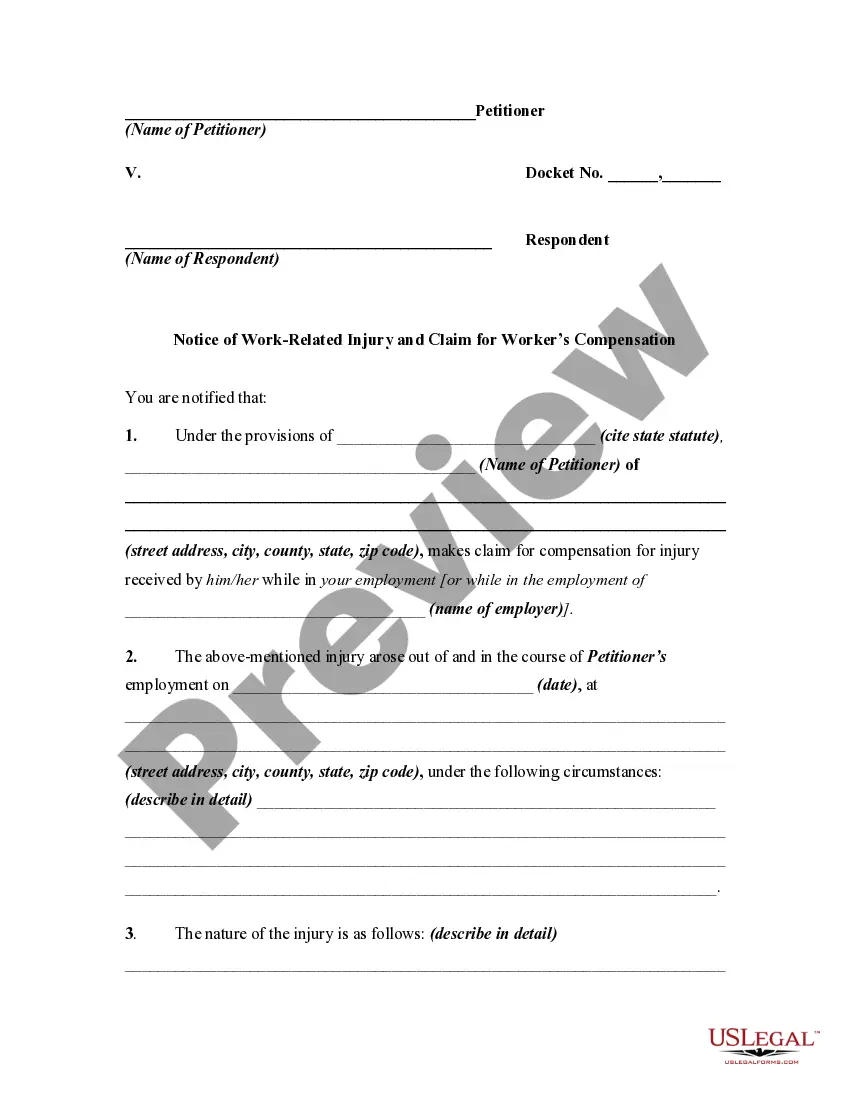
How to fill out Notice Of Work-Related Injury And Claim For Worker's Compensation?
The examples of Work-related Injuries displayed on this page is a reusable legal template crafted by expert attorneys in accordance with national and local statutes.
For over 25 years, US Legal Forms has assisted individuals, businesses, and legal practitioners with more than 85,000 certified, state-specific documents for any professional and personal situation.
Select the format you desire for your Work-related Injuries Examples (PDF, DOCX, RTF) and download the document to your device.
- Search for the form you require and examine it.
- Browse the sample you searched and preview it or read the form description to confirm it meets your requirements. If it does not, utilize the search feature to locate the appropriate one. Click Buy Now when you have found the template you need.
- Register and Log In.
- Select the pricing plan that best fits you and create an account. Use PayPal or a credit card to make an immediate payment. If you already possess an account, Log In and review your subscription to proceed.
- Acquire the editable template.
Form popularity
FAQ
The #1 work-related injury in the United States is the overexertion injury. This often occurs when employees lift, push, or pull heavy objects without appropriate techniques or tools. Work-related injuries examples often include back injuries and other musculoskeletal disorders due to overexertion. Implementing ergonomic practices can help mitigate these injuries and improve employee safety.
The most common work-related injury is a slip or fall. Such incidents can happen in various environments, from offices to construction sites. Work-related injuries examples often highlight the need for maintaining safe workspaces and using protective gear. Employers should conduct regular safety audits to minimize these risks.
An injury at work qualifies as any physical or mental harm that occurs while performing job-related tasks. This includes accidents that happen on-site, as well as injuries occurring during business trips or activities related to work duties. Work-related injuries examples include slip and fall incidents, machinery accidents, and even conditions like carpal tunnel syndrome due to repetitive strain. Understanding these definitions can aid employees in seeking proper compensation.
The hardest injury to prove is often an injury related to mental health, such as workplace stress or emotional distress. These injuries may not have clear physical evidence, making it challenging to link them directly to job duties. Work-related injuries examples in this category could include anxiety disorders or depression stemming from workplace conditions. Documentation and consistent consultations with healthcare professionals are crucial in these cases.
The most common injury in the workplace is a sprain or strain. These injuries often occur due to lifting heavy objects or repetitive motion. Work-related injuries examples frequently include muscle strains, especially in jobs that require physical labor. It's important for employees to receive proper training on lifting techniques to reduce this risk.
In a negligence claim, you must prove duty, breach, causation, and damages. This means showing that the other party had a responsibility to act reasonably, failed in that duty, directly caused your injury, and that you suffered damages as a result. Understanding these elements can clarify the process. Familiarizing yourself with work-related injuries examples can help frame your argument effectively.
A personal injury claim often requires detailed medical records to establish the nature and extent of your injuries. You should also gather evidence such as photographs, witness statements, and reports from other involved parties. It's essential to document everything thoroughly to support your claim. Learning about common work-related injuries examples will help you understand the vital evidence needed for such claims.
For an injury claim, you typically need medical documentation, including doctor’s notes and treatment records. Additionally, keep any receipts related to medical expenses, as well as evidence like photographs and witness statements. Organizing this evidence effectively strengthens your claim. Familiarizing yourself with work-related injuries examples can help ensure you cover all necessary aspects in your documentation.
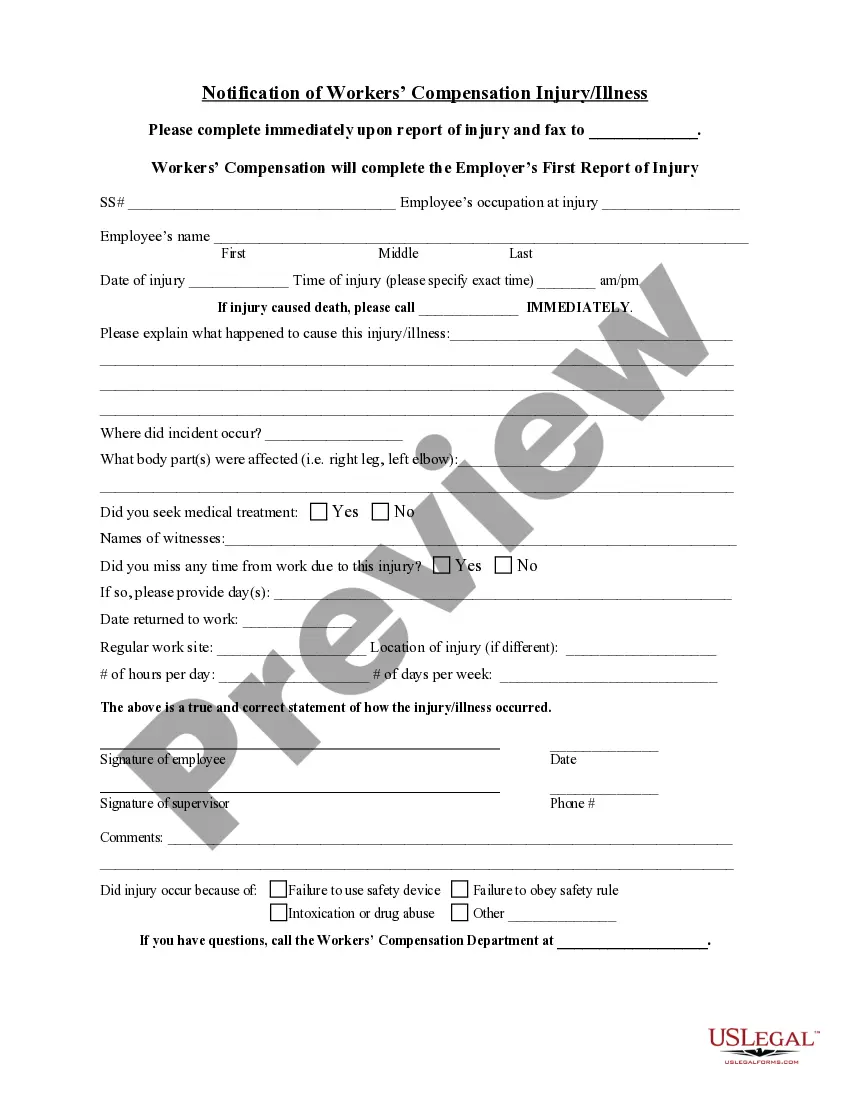
To write an injury report, begin with the date, time, and location of the incident. Describe what happened in a clear and factual manner, focusing on the circumstances leading to the injury. Include specifics such as any equipment involved and the names of witnesses. For work-related injuries examples, consider using templates available on platforms like US Legal Forms to streamline the process.
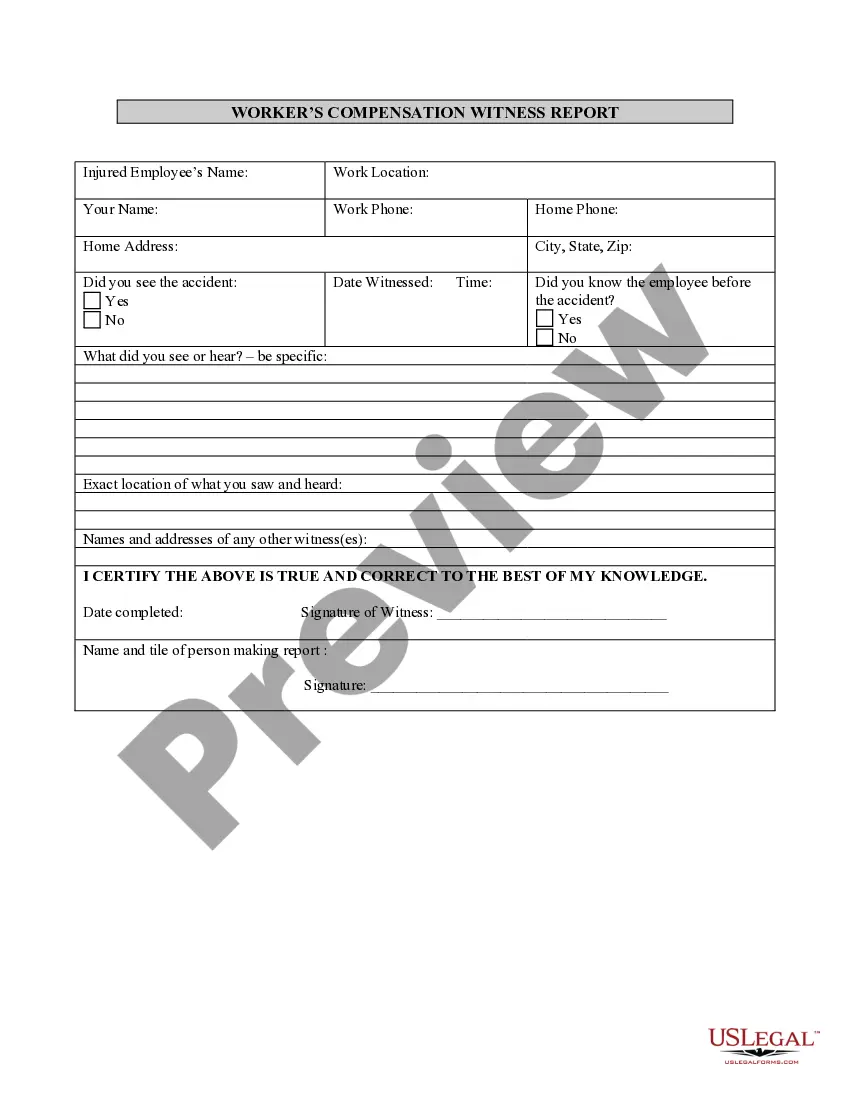
An example of evidence of injury includes medical records that detail your diagnosis, treatment, and prognosis. Additionally, photographs of the injury and the accident scene can serve as crucial visual evidence. Witness statements from colleagues who observed the incident can also support your claim. Collecting comprehensive evidence is essential when discussing work-related injuries examples and building your case.