Affidavit Of Mother Son Relationship With Daughter
Description
Get your form ready online
Our built-in tools help you complete, sign, share, and store your documents in one place.
Make edits, fill in missing information, and update formatting in US Legal Forms—just like you would in MS Word.
Download a copy, print it, send it by email, or mail it via USPS—whatever works best for your next step.
Sign and collect signatures with our SignNow integration. Send to multiple recipients, set reminders, and more. Go Premium to unlock E-Sign.
If this form requires notarization, complete it online through a secure video call—no need to meet a notary in person or wait for an appointment.
We protect your documents and personal data by following strict security and privacy standards.

Make edits, fill in missing information, and update formatting in US Legal Forms—just like you would in MS Word.

Download a copy, print it, send it by email, or mail it via USPS—whatever works best for your next step.

Sign and collect signatures with our SignNow integration. Send to multiple recipients, set reminders, and more. Go Premium to unlock E-Sign.

If this form requires notarization, complete it online through a secure video call—no need to meet a notary in person or wait for an appointment.

We protect your documents and personal data by following strict security and privacy standards.
Looking for another form?
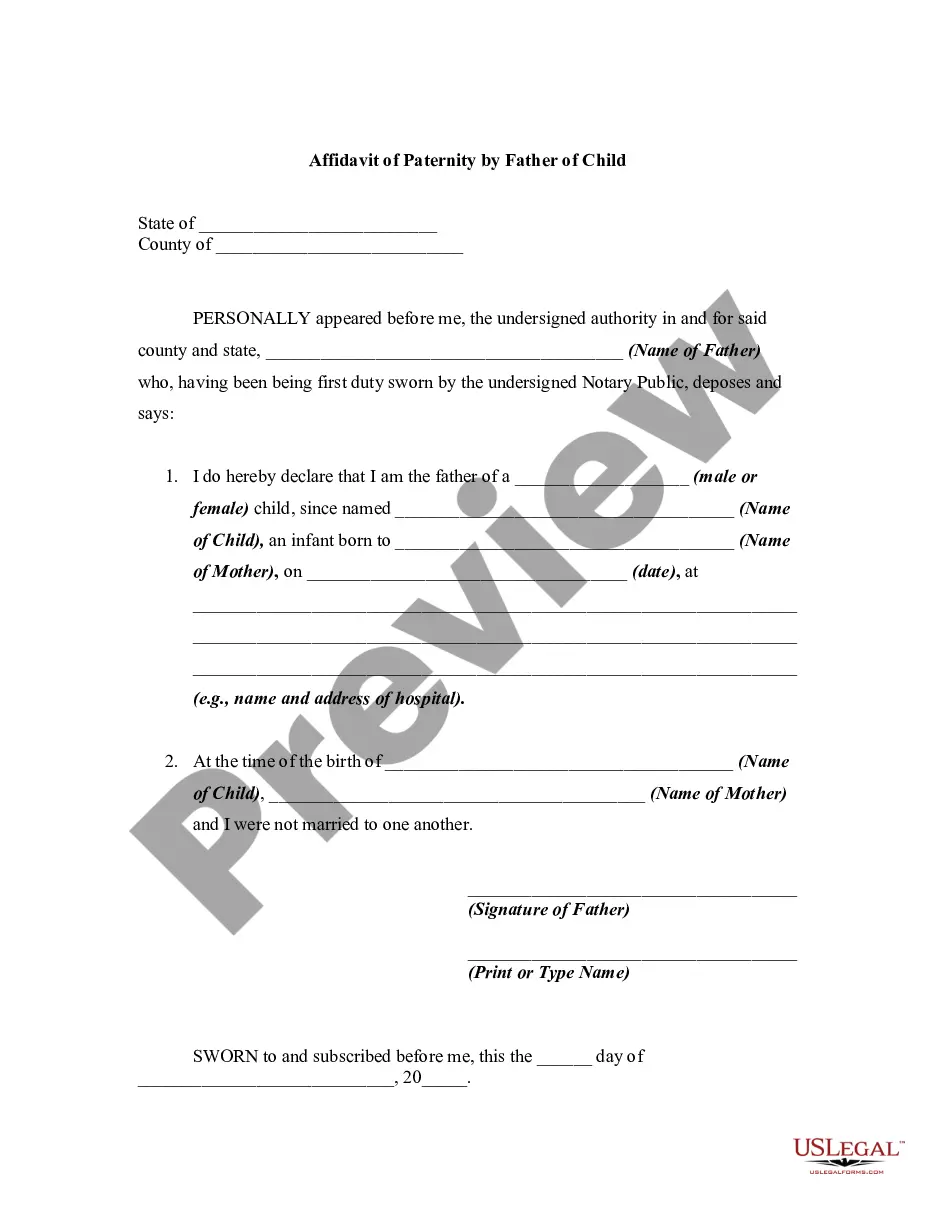
How to fill out Affidavit Of Paternity By Father Of Child?
The Sworn Statement Of Maternal Paternal Bond With Daughter you see on this page is a reusable legal template created by experienced attorneys in accordance with national and local laws and regulations.
For over 25 years, US Legal Forms has supplied individuals, organizations, and legal practitioners with more than 85,000 validated, state-specific forms for any business and personal circumstance. It’s the quickest, most direct, and most reliable way to secure the documents you require, as the service ensures bank-level data security and anti-malware safeguards.
Join US Legal Forms to have verified legal templates for all of life’s scenarios at your fingertips.
- Browse for the document you require and review it.
- Sign up and Log In.
- Obtain the editable template.
- Fill out and sign the document.
- Download your paperwork once more.
Form popularity
FAQ
Writing an affidavit for proof of relationship involves several key steps. First, clearly state your name and relationship to the child, then provide a detailed account of your relationship, including important dates and events. To simplify this process, consider using platforms like US Legal Forms, which offer templates and guidance for creating an Affidavit of mother son relationship with daughter, ensuring your document meets legal standards.
A parent affidavit is a sworn statement made by a parent that outlines specific information about their relationship with their child. This document can serve to affirm the nature of the relationship, such as in cases requiring an Affidavit of mother son relationship with daughter. It may be used in legal situations, such as custody disputes or proving guardianship, ensuring clarity in the parent-child relationship.
Proof of mother child relationship refers to any legal document that establishes the bond between a mother and her child. This can include documents like a birth certificate that lists the mother's name, or an Affidavit of mother son relationship with daughter. Such proof is often necessary for legal matters, including custody cases, immigration processes, or when applying for benefits.
School records which contain information such as the date of admission to the school, the child's date of birth or age at the time of admission, the child's place of birth, and names of the child's parents, may be submitted in support of your I-130 application, as secondary evidence of a relationship.
Alternative documents might include two or more affidavits of birth (sworn letters written by relatives or other persons with personal knowledge of the facts of a child's birth), as well as medical records, school records, and religious records (such as certificate of baptism issued by a church) showing the names of ...
A copy of the child's birth certificate showing the child's name. A statement showing the dates and places your child has lived with you, and proof that your child has lived with you and has been in your legal custody for at least two years.
Letters from third parties such as friends and family, religious leaders, neighbors, etc., are called Affidavits. These letters are written testimony that your marriage is real. To be valid, the affidavit must contain the full name and address of the person who made it, indicating its date and place of birth.
Relationship History: Clearly describe the relationship between the affiant and the individual(s) in question. Include relevant details such as dates, places, and circumstances of meetings or interactions that establish the relationship.