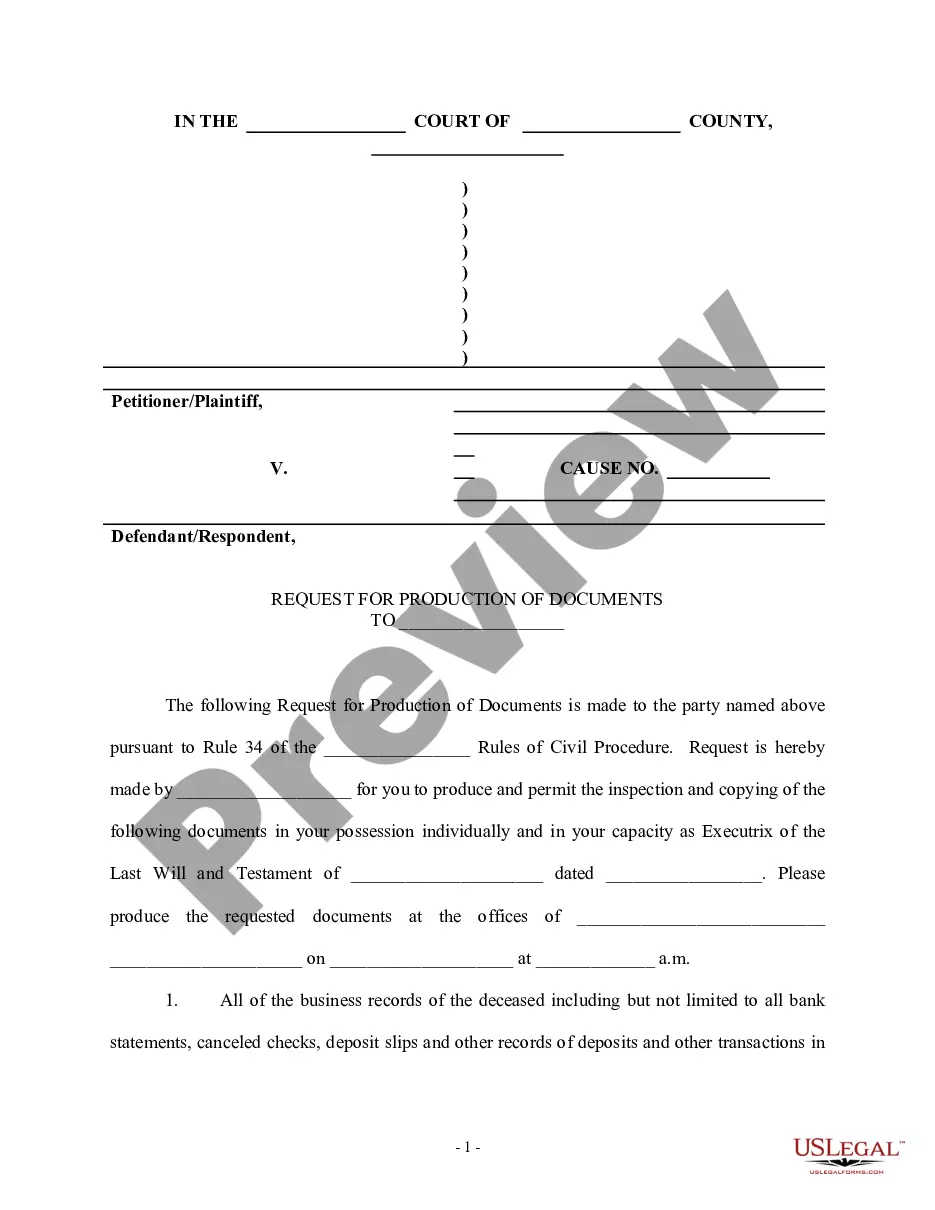
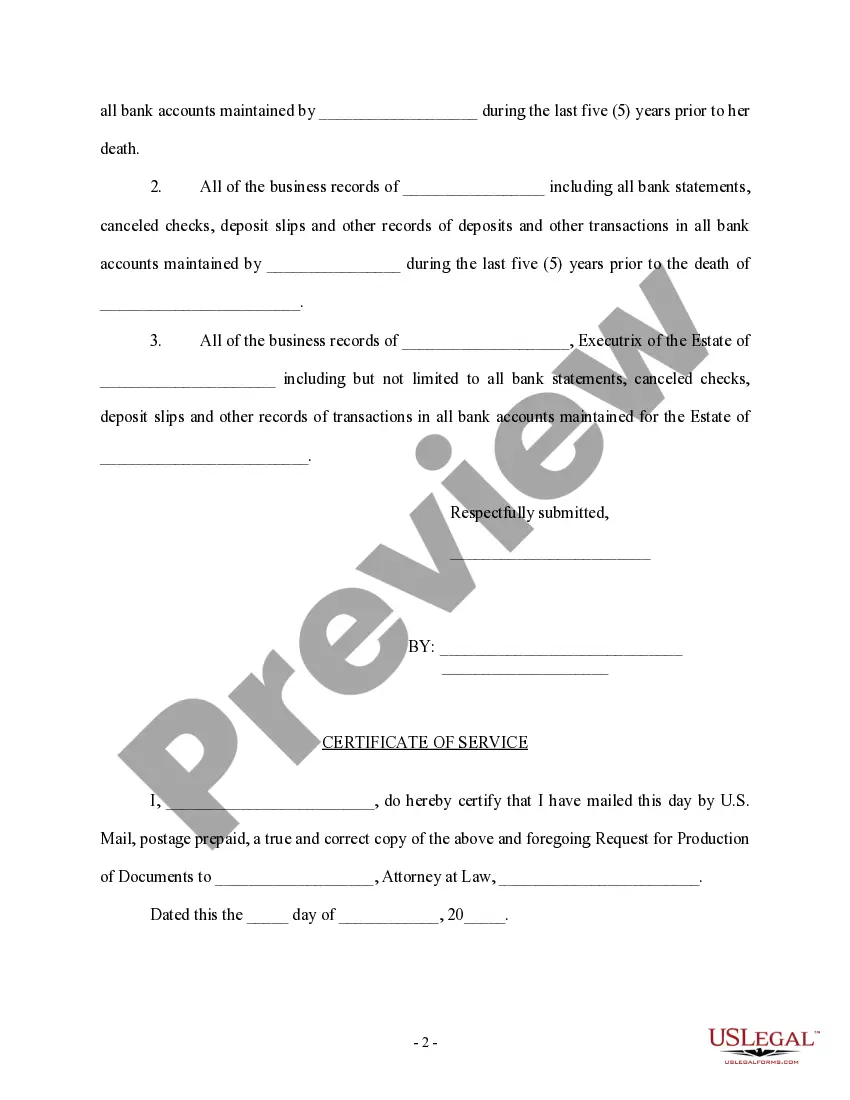
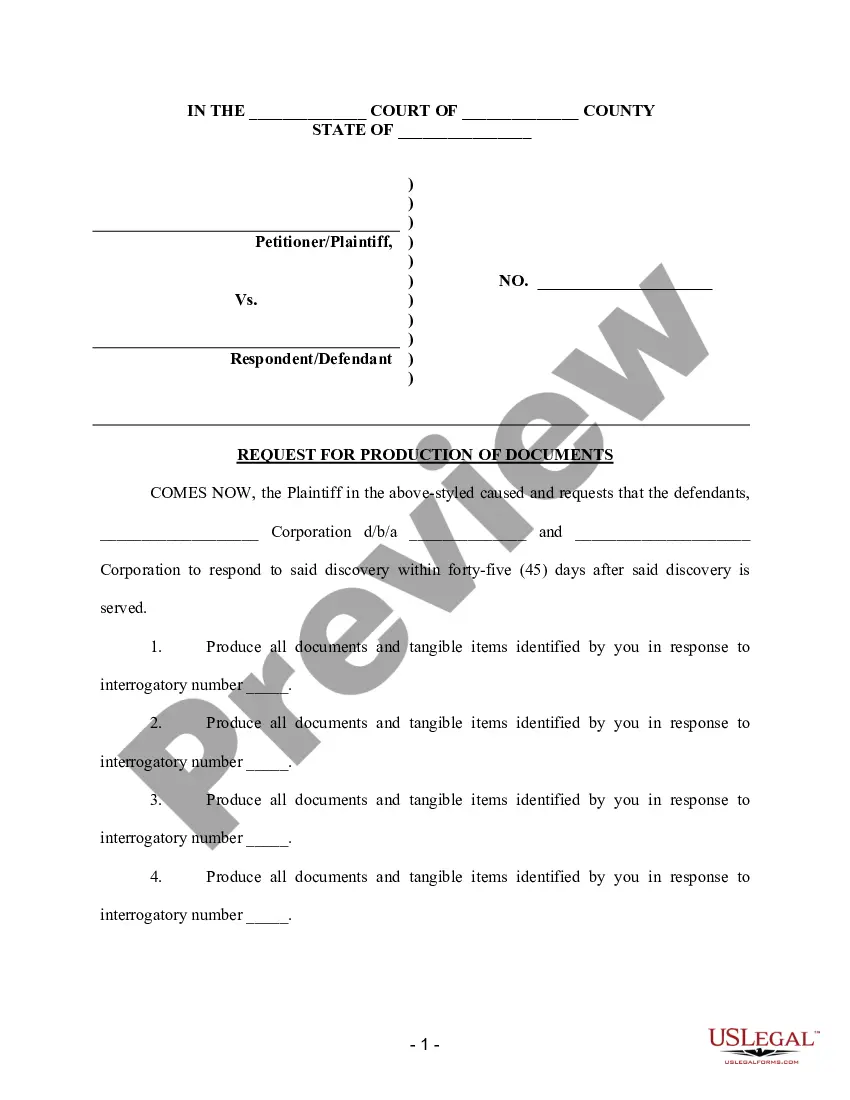
Request For Production Of Documents California Responses
Description
Get your form ready online
Our built-in tools help you complete, sign, share, and store your documents in one place.
Make edits, fill in missing information, and update formatting in US Legal Forms—just like you would in MS Word.
Download a copy, print it, send it by email, or mail it via USPS—whatever works best for your next step.
Sign and collect signatures with our SignNow integration. Send to multiple recipients, set reminders, and more. Go Premium to unlock E-Sign.
If this form requires notarization, complete it online through a secure video call—no need to meet a notary in person or wait for an appointment.
We protect your documents and personal data by following strict security and privacy standards.

Make edits, fill in missing information, and update formatting in US Legal Forms—just like you would in MS Word.

Download a copy, print it, send it by email, or mail it via USPS—whatever works best for your next step.

Sign and collect signatures with our SignNow integration. Send to multiple recipients, set reminders, and more. Go Premium to unlock E-Sign.

If this form requires notarization, complete it online through a secure video call—no need to meet a notary in person or wait for an appointment.

We protect your documents and personal data by following strict security and privacy standards.
Looking for another form?







How to fill out Request For Production Of Documents?
Whether for commercial reasons or for personal issues, everyone must confront legal circumstances at some point in their life. Completing legal documentation necessitates meticulous attention, beginning with selecting the correct form example.
For example, if you select an incorrect version of a Request For Production Of Documents California Responses, it will be denied once you submit it. Thus, it is vital to have a reliable source of legal documents like US Legal Forms.
With an extensive US Legal Forms catalog available, you don’t need to waste time searching for the correct template across the internet. Take advantage of the library’s user-friendly navigation to find the appropriate template for any occasion.
- Locate the template you require by utilizing the search field or catalog navigation.
- Review the form’s details to confirm it aligns with your case, state, and locality.
- Click on the form’s preview to examine it.
- If it is not the correct document, return to the search feature to locate the Request For Production Of Documents California Responses sample you want.
- Download the file if it satisfies your requirements.
- If you have a US Legal Forms account, simply click Log in to access previously saved templates in My documents.
- In case you don’t have an account yet, you can obtain the form by clicking Buy now.
- Select the suitable pricing option.
- Complete the account registration form.
- Choose your payment method: you can utilize a credit card or PayPal account.
- Select the document format you desire and download the Request For Production Of Documents California Responses.
- Once it is downloaded, you can fill out the form using editing software or print it and complete it by hand.
Form popularity
FAQ
An example response to a request for production of documents includes acknowledging the request and stating whether you will provide the requested documents. You might say, 'I will provide the requested documents within the stipulated timeframe,' or 'I object to the request based on relevance.' Crafting a well-structured response is essential to maintain clarity and transparency in your case. Consider using US Legal Forms for templates that guide you in composing effective California responses.
In California, you typically have 30 days to respond to a request for production of documents. This timeframe begins once you receive the request, allowing you to gather the necessary materials. It is crucial to adhere to this deadline to avoid potential legal complications or sanctions. Using US Legal Forms can help you track these timelines and ensure your responses are compliant with California laws.
A Rule 34 request for production of documents is a formal legal request used in California to obtain specific documents from the opposing party in a lawsuit. This request is part of the discovery process, allowing both sides to gather evidence and information. When you submit a request for production of documents, you articulate which documents are pertinent to your case. Utilizing a platform like US Legal Forms can simplify this process by providing templates tailored for California responses.
To file a Request for Production of documents, you must draft a formal request that specifies the documents you seek. You then serve this request to the other party, following the appropriate court rules in California. It is crucial to ensure that your request is clear and detailed to avoid confusion. Platforms like US Legal Forms can assist you in creating a legally sound Request for production of documents, making the filing process smoother and more efficient.
Typically, you have 30 days to respond to a Request for Production of documents in California. This timeframe starts from the date you receive the request, so it's important to mark your calendar. If you need additional time, you may request an extension, but this should be clearly communicated to the requesting party. Staying on top of your timeline ensures timely and effective responses to your Request for production of documents California responses.
In California, it is not mandatory to verify responses to a Request for Production of documents. However, it is prudent to ensure the accuracy and completeness of the responses provided. By verifying RFP responses, you can avoid potential disputes and misunderstandings later in the process. Utilizing platforms like US Legal Forms can help you streamline this verification process and ensure compliance with legal standards.
Once you've received (been served) the request, you have 30 or 35 days to respond, depending on how you received the request. In eviction cases (also known as unlawful detainer cases) you have 5 or 10 days to respond.
In responding to Requests for Production of documents you have three response choices (1) agree to produce (C.C.P. §2031.220); (2) state that after a diligent search and a reasonable inquiry you have no documents (C.C.P. §2031.230) or (3) object (C.C.P. §2031.240).
Within 30 days after service of a demand, the party to whom the demand is directed shall serve the original of the response on the party making the demand, and a copy of the response on all other parties who have appeared in the action, unless on motion the court has shortened or extended the time for response.
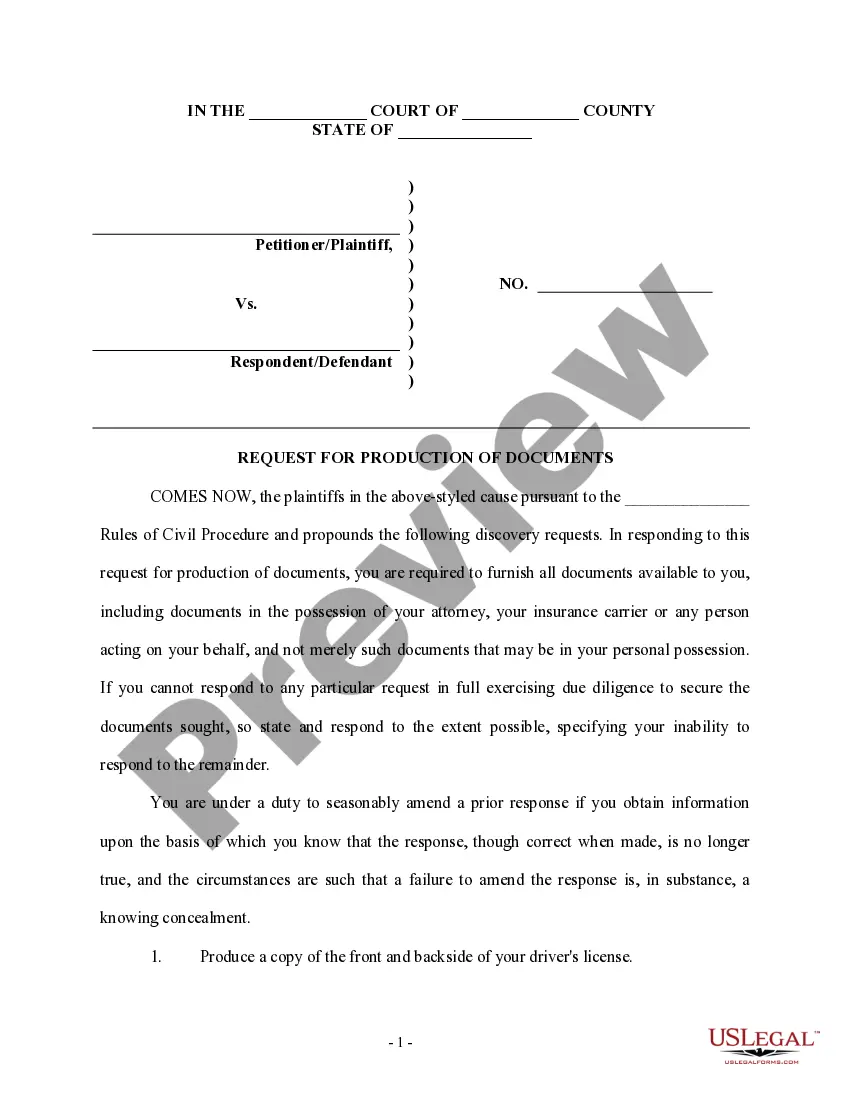
Requests for Production or Demands for Inspection require you to produce documents for copying or in some cases actual items for inspection. Responding to the request has 2 parts: State if you can comply with the request (all of it or some of it) or give the reason why you can't comply.