Writing Action
Description




Get your form ready online
Our built-in tools help you complete, sign, share, and store your documents in one place.
Make edits, fill in missing information, and update formatting in US Legal Forms—just like you would in MS Word.
Download a copy, print it, send it by email, or mail it via USPS—whatever works best for your next step.
Sign and collect signatures with our SignNow integration. Send to multiple recipients, set reminders, and more. Go Premium to unlock E-Sign.
If this form requires notarization, complete it online through a secure video call—no need to meet a notary in person or wait for an appointment.
We protect your documents and personal data by following strict security and privacy standards.

Make edits, fill in missing information, and update formatting in US Legal Forms—just like you would in MS Word.

Download a copy, print it, send it by email, or mail it via USPS—whatever works best for your next step.

Sign and collect signatures with our SignNow integration. Send to multiple recipients, set reminders, and more. Go Premium to unlock E-Sign.

If this form requires notarization, complete it online through a secure video call—no need to meet a notary in person or wait for an appointment.

We protect your documents and personal data by following strict security and privacy standards.
Looking for another form?
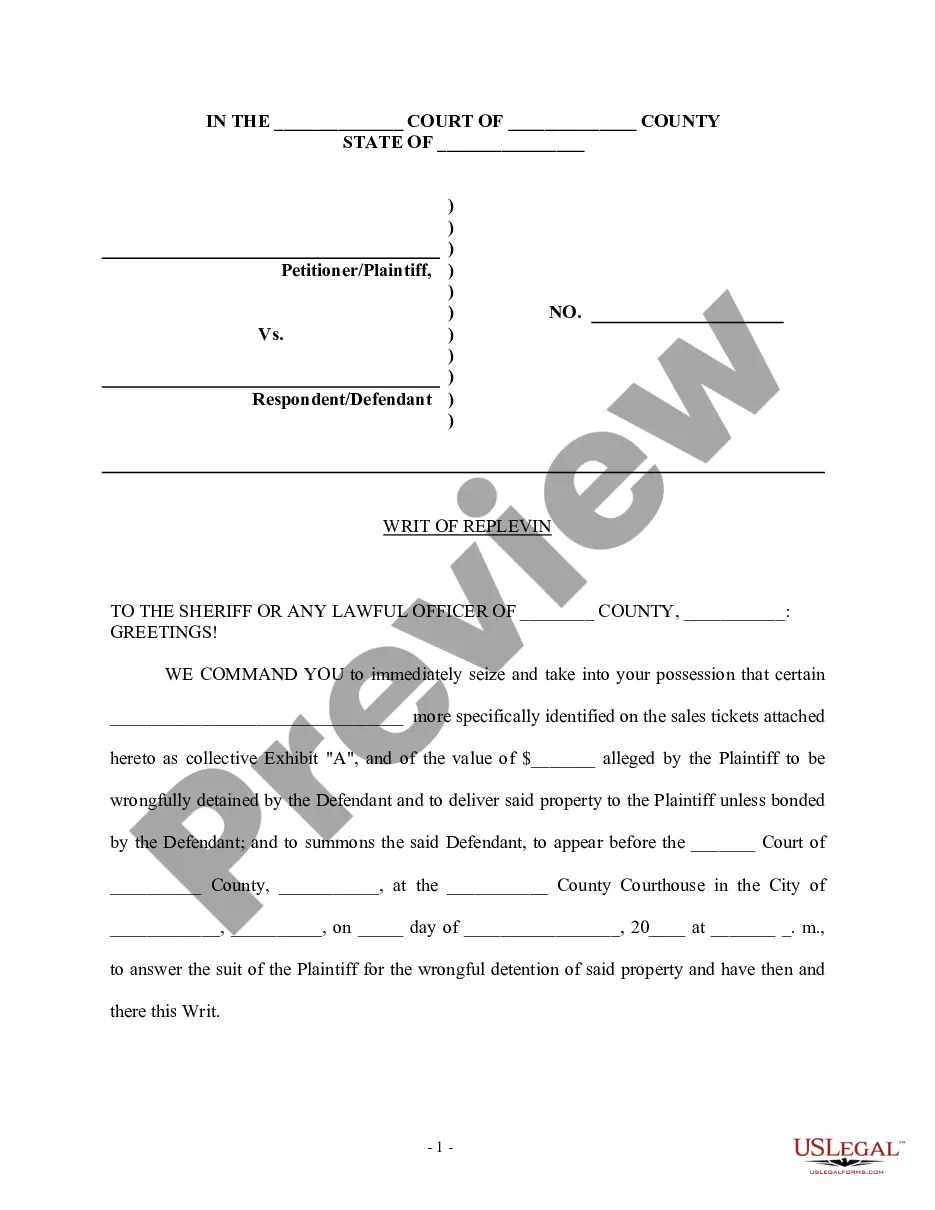
How to fill out Writ Of Replevin Or Repossession?
- Log in to your existing US Legal Forms account and ensure your subscription is active. If it has expired, renew it based on your chosen payment plan.
- For new users, start by browsing the Preview mode and descriptions of available forms to select the one that aligns with your legal needs.
- If you don’t find the right form, utilize the Search feature to look for another relevant template that fits your requirements.
- Once you've identified the suitable document, click on the Buy Now button and opt for your preferred subscription plan. You will need to create an account to access the library.
- Complete your purchase by entering your credit card or using PayPal to settle the subscription fee.
- Download the template to your device. You can later access it anytime through the My Forms section of your profile.
By following these straightforward steps, you can conveniently acquire the legal forms you need without hassle. The comprehensive nature of US Legal Forms ensures you have access to over 85,000 customizable documents to meet your specific needs.
Take action today and empower yourself with the perfect legal documents!
Form popularity
FAQ
Writing an action sequence requires attention to pacing and clarity. Engage your readers by using sensory details that let them feel the intensity of the moment. By meticulously planning the sequence, you’ll create a coherent flow that makes your writing action impactful and memorable. Utilize platforms like USLegalForms to access resources that help refine your writing skills.
To write an action sequence, begin by defining the purpose it serves in your story. Create a sense of urgency by employing short sentences, dynamic verbs, and varying sentence length. As you progress, ensure that each action connects back to the overall theme and character development, making your writing action both thrilling and meaningful.
Writing an action script requires a clear structure that enhances visual storytelling. Begin with a logline that outlines the plot, followed by concise scenes that detail physical actions. Integrate dialogue sparingly, focusing instead on how characters interact through their actions; this emphasizes writing action effectively.
Writing action involves crafting vivid, dynamic scenes that pull the reader into the moment. Use strong verbs and precise descriptions to show what characters are doing, ensuring each action drives the narrative. This technique keeps readers engaged and invested in the unfolding drama.
To create a sequence of action, start by outlining the key events that drive your story forward. Focus on the characters’ motivations and stakes involved. As you write action, remember to keep the pace swift while clearly delineating movements and reactions to maintain flow and clarity.
An action sequence typically features a series of events that involves movement and conflict. For instance, consider a chase scene where a character pursues another through a busy city. This moment captures intense emotions and critical plot developments, showcasing how writing action can heighten excitement and engage readers.
Action verbs are powerful verbs that convey physical or mental activities. They provide concrete imagery and drive the narrative forward by adding energy to your writing. Examples include 'jump,' 'run,' 'think,' and 'create.' Using varied action verbs enhances your writing action, making it more engaging for your audience.
In a story, action refers to the events that propel the plot forward. It involves the characters taking steps to achieve their goals, facing challenges, and experiencing consequences. Understanding writing action enriches your narrative by creating tension and excitement. This dynamic element captivates readers, keeping them invested in the characters.
Writing action requires clarity and purpose. Start by determining the main action in your scene, and then use clear, vivid language to convey what happens. Focus on showing movement and emotion to draw your readers in. Engaging writing action adds depth to your narrative and keeps the story lively.
To improve your writing action scenes, practice visualizing the movement and flow of the scene. Study examples from successful authors to see how they create tension and pacing. Additionally, consider using platforms like US Legal Forms to find resources that guide you in structuring your action scenes effectively.