What Is Law And Justice
Description

Get your form ready online
Our built-in tools help you complete, sign, share, and store your documents in one place.
Make edits, fill in missing information, and update formatting in US Legal Forms—just like you would in MS Word.
Download a copy, print it, send it by email, or mail it via USPS—whatever works best for your next step.
Sign and collect signatures with our SignNow integration. Send to multiple recipients, set reminders, and more. Go Premium to unlock E-Sign.
If this form requires notarization, complete it online through a secure video call—no need to meet a notary in person or wait for an appointment.
We protect your documents and personal data by following strict security and privacy standards.

Make edits, fill in missing information, and update formatting in US Legal Forms—just like you would in MS Word.

Download a copy, print it, send it by email, or mail it via USPS—whatever works best for your next step.

Sign and collect signatures with our SignNow integration. Send to multiple recipients, set reminders, and more. Go Premium to unlock E-Sign.

If this form requires notarization, complete it online through a secure video call—no need to meet a notary in person or wait for an appointment.

We protect your documents and personal data by following strict security and privacy standards.
Looking for another form?
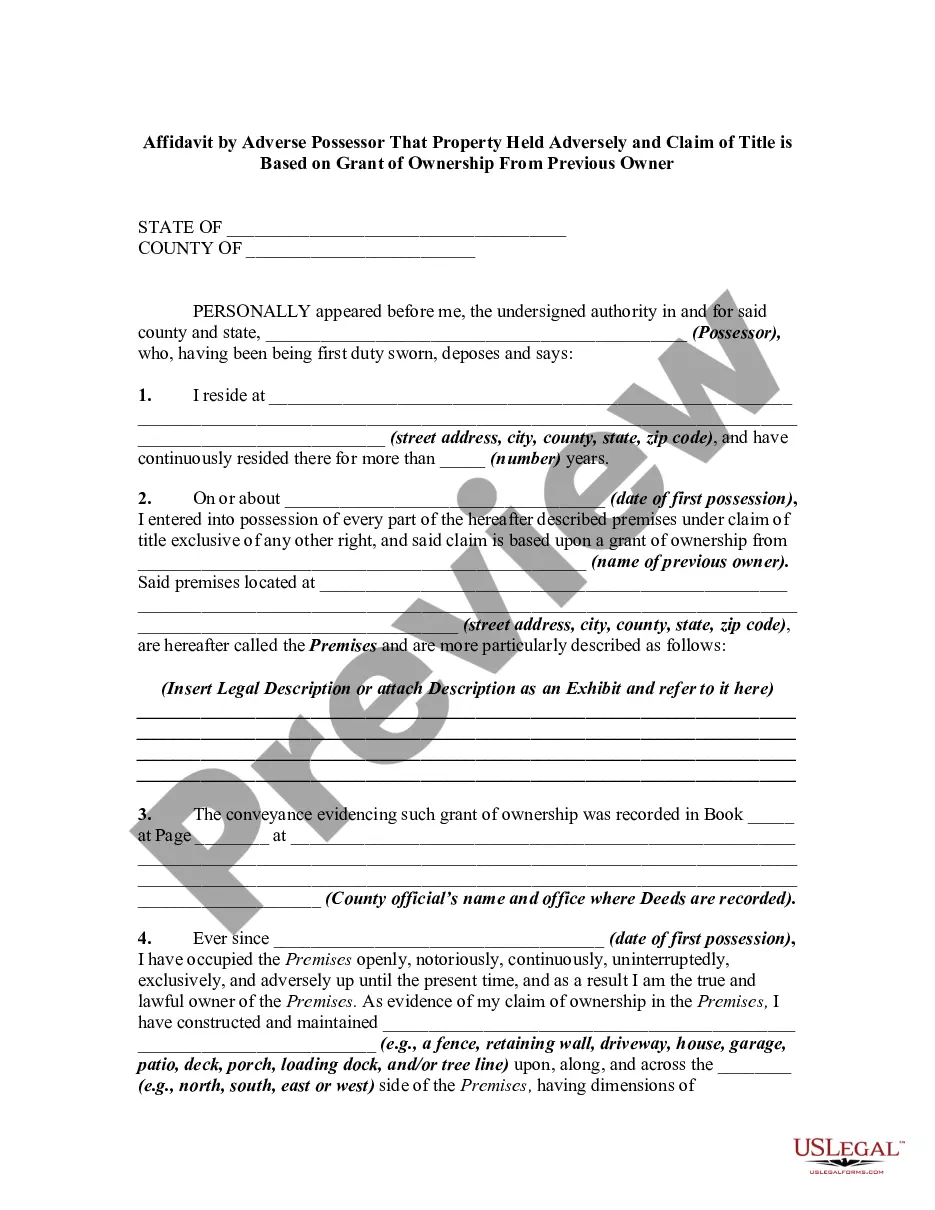
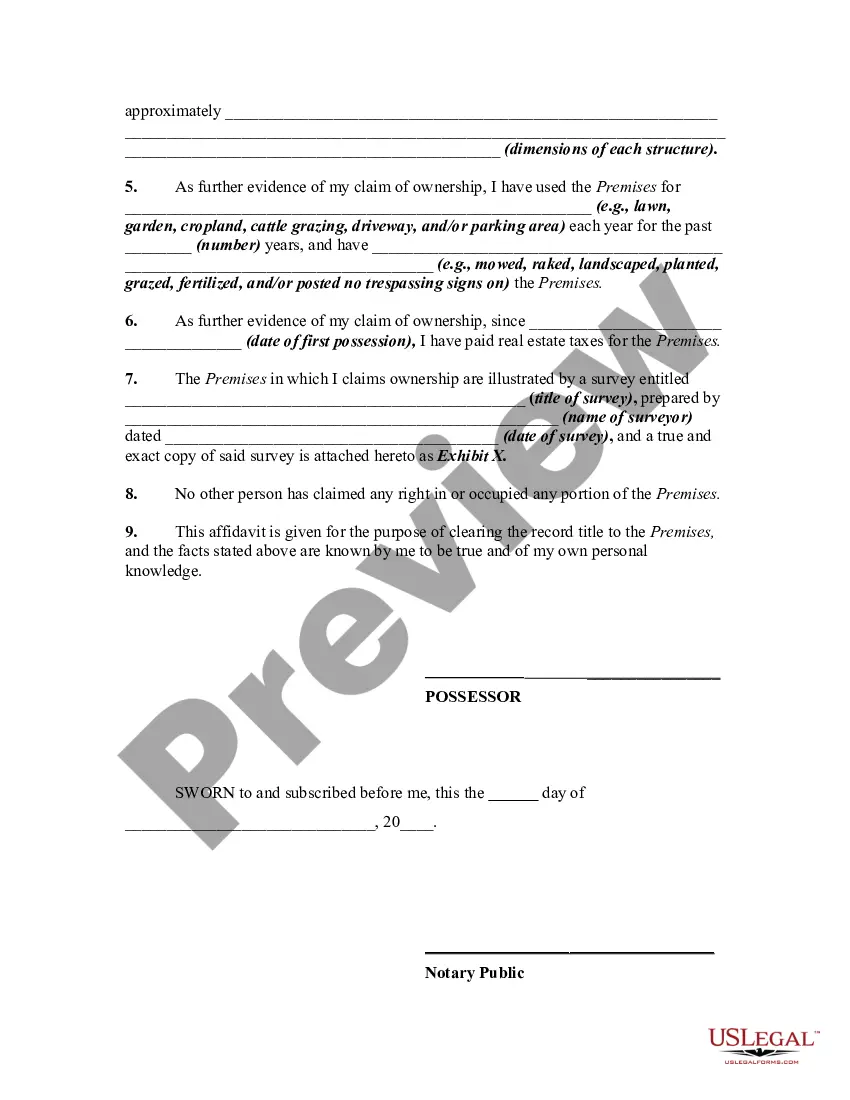
How to fill out Affidavit By Adverse Possessor That Property Held Adversely And Claim Of Title Is Based On Grant Of Ownership From Previous Owner - Squatters Rights?
- If you are returning, log in to access your account and download the needed form template by clicking the Download button. Verify that your subscription is still active; if not, renew it per your payment plan.
- For new users, start by reviewing the Preview mode and the form description. Ensure it is the right document that meets your specific needs and local jurisdictional requirements.
- Perform a search using the Search tab if the initial template you selected does not meet your expectations. Find a suitable option and proceed.
- Purchase the document by selecting the Buy Now button. Choose a subscription plan that aligns with your needs and create an account to gain access to the extensive library.
- Complete your purchase by entering your credit card information or opting for PayPal. This step will finalize your subscription.
- Download your selected form template onto your device. You can access your documents any time through the My Forms section in your profile.
US Legal Forms empowers users with an extensive and comprehensive library offering over 85,000 legal forms, enabling effective management of various legal processes.
Now is the time to leverage these resources for your legal needs. Start using US Legal Forms to simplify your document preparation today!
Form popularity
FAQ
While law and justice are interconnected, they are not the same thing. Law provides the framework for governance and order, whereas justice is the moral philosophy behind fairness and equality. It is essential to discuss these concepts in conjunction because a fair legal system should strive for justice in its applications. You can explore these ideas further on platforms like US Legal Forms, which offer resources to gain a deeper understanding of law and justice.
Law refers to the system of rules created and enforced through social institutions to regulate behavior, while justice represents the concept of fairness and moral rightness. Together, law and justice aim to create an equitable society where rights are protected and wrongs are addressed. Understanding the relationship between law and justice is crucial for anyone studying this field. The balance between these two elements is essential for a functioning legal system.
In law and justice, you engage in various activities that promote legal understanding and uphold justice. This can include working as a lawyer, paralegal, or law enforcement officer. Professionals in this field advocate for clients, investigate crimes, and ensure compliance with laws. Your work ultimately contributes to maintaining social order and protecting citizens' rights.
In criminal justice classes, you will learn about the criminal justice system's structure, including law enforcement, the court system, and corrections. Expect to engage in discussions about crime prevention, the rights of defendants, and the ethical dilemmas faced by professionals in the field. Additionally, these classes often include practical applications through case studies and internships. This knowledge equips you with the skills necessary to navigate complex legal environments.
A law and justice class introduces students to the foundational concepts of the legal system and the principles of justice. In this class, you will explore topics such as criminal law, civil rights, and the roles of law enforcement. This understanding is crucial for anyone interested in pursuing a career in the field of law or criminal justice. Overall, these classes prepare students for further studies or careers in law and justice.
While there isn't a definitive 'best' major for law, fields such as political science, philosophy, and history provide valuable insights. These majors help develop critical thinking, argumentation, and analytical skills necessary for law school. Ultimately, choose a major that resonates with your interests and goals within the spectrum of law and justice. You can also explore resources on platforms like USLegalForms to better prepare for your legal education journey.
Law and justice are represented by concepts such as fairness, equality, and the rule of law. Symbols like the scales of justice embody the balance required in legal proceedings. Additionally, legal frameworks and the court system demonstrate how society seeks to uphold justice. Understanding what represents law and justice helps you appreciate their role in maintaining order and protecting rights.
Justice studies can serve as an excellent major for aspiring law students. This field examines the concepts of justice and the legal system's impact on society. By studying justice, you gain insight into social issues and legal theory, which can enhance your critical thinking. If you want to understand the broader implications of law and justice, this major aligns well with your goals.
Criminal justice can indeed be a beneficial major for those aiming to become lawyers. It equips you with knowledge about the legal process, law enforcement, and the court system. By focusing on criminal justice, you develop skills that are valuable in law school and legal practice. Therefore, if you are passionate about defending rights and ensuring justice, this major is a great choice.
Choosing Law and Justice as a major can open many doors for you. This field helps you understand legal systems, human rights, and the ethical implications of law. A strong foundation in law and justice prepares students for various careers, from legal practice to public policy. Therefore, if you're interested in making a significant impact, this major is certainly worth considering.