Adverse
Description

Get your form ready online
Our built-in tools help you complete, sign, share, and store your documents in one place.
Make edits, fill in missing information, and update formatting in US Legal Forms—just like you would in MS Word.
Download a copy, print it, send it by email, or mail it via USPS—whatever works best for your next step.
Sign and collect signatures with our SignNow integration. Send to multiple recipients, set reminders, and more. Go Premium to unlock E-Sign.
If this form requires notarization, complete it online through a secure video call—no need to meet a notary in person or wait for an appointment.
We protect your documents and personal data by following strict security and privacy standards.

Make edits, fill in missing information, and update formatting in US Legal Forms—just like you would in MS Word.

Download a copy, print it, send it by email, or mail it via USPS—whatever works best for your next step.

Sign and collect signatures with our SignNow integration. Send to multiple recipients, set reminders, and more. Go Premium to unlock E-Sign.

If this form requires notarization, complete it online through a secure video call—no need to meet a notary in person or wait for an appointment.

We protect your documents and personal data by following strict security and privacy standards.
Looking for another form?

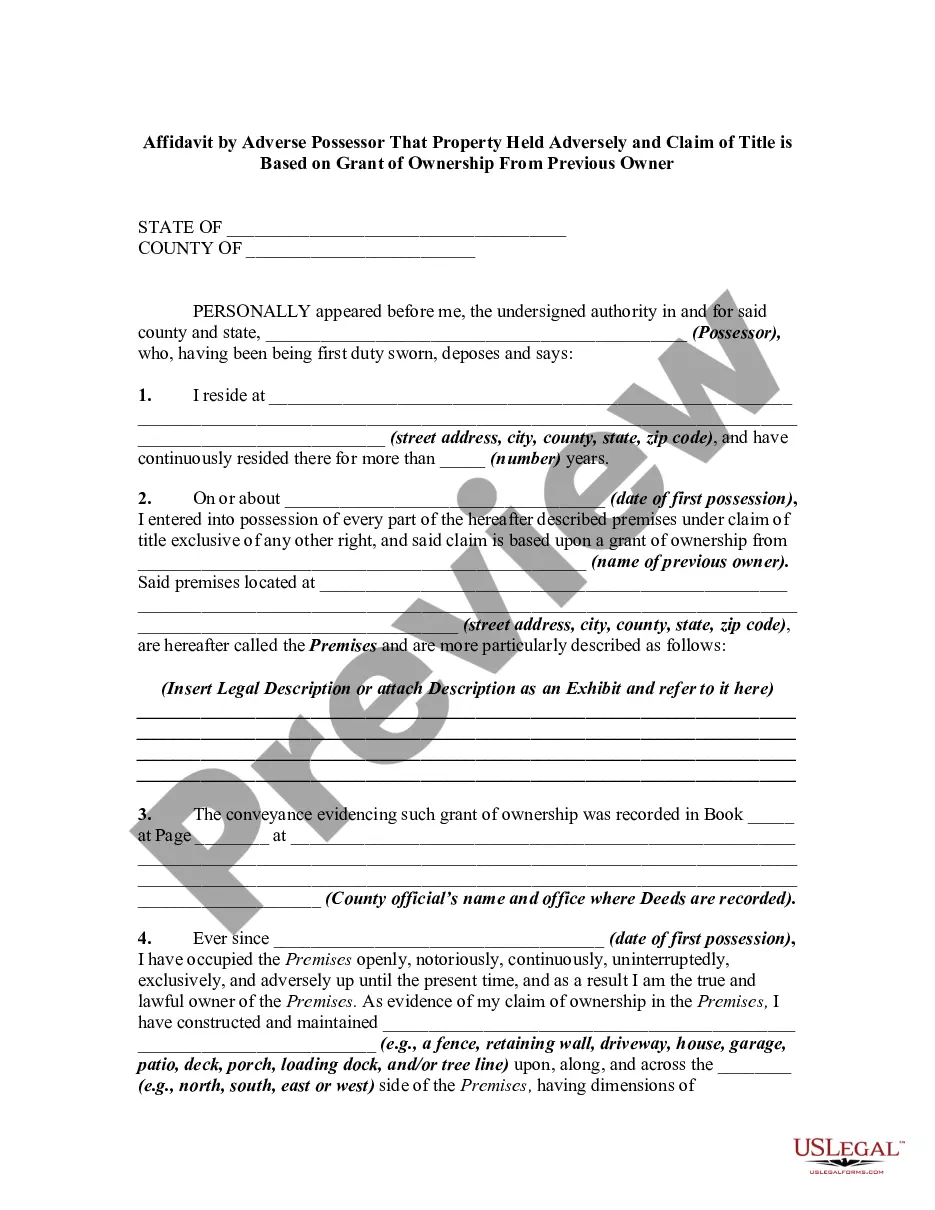
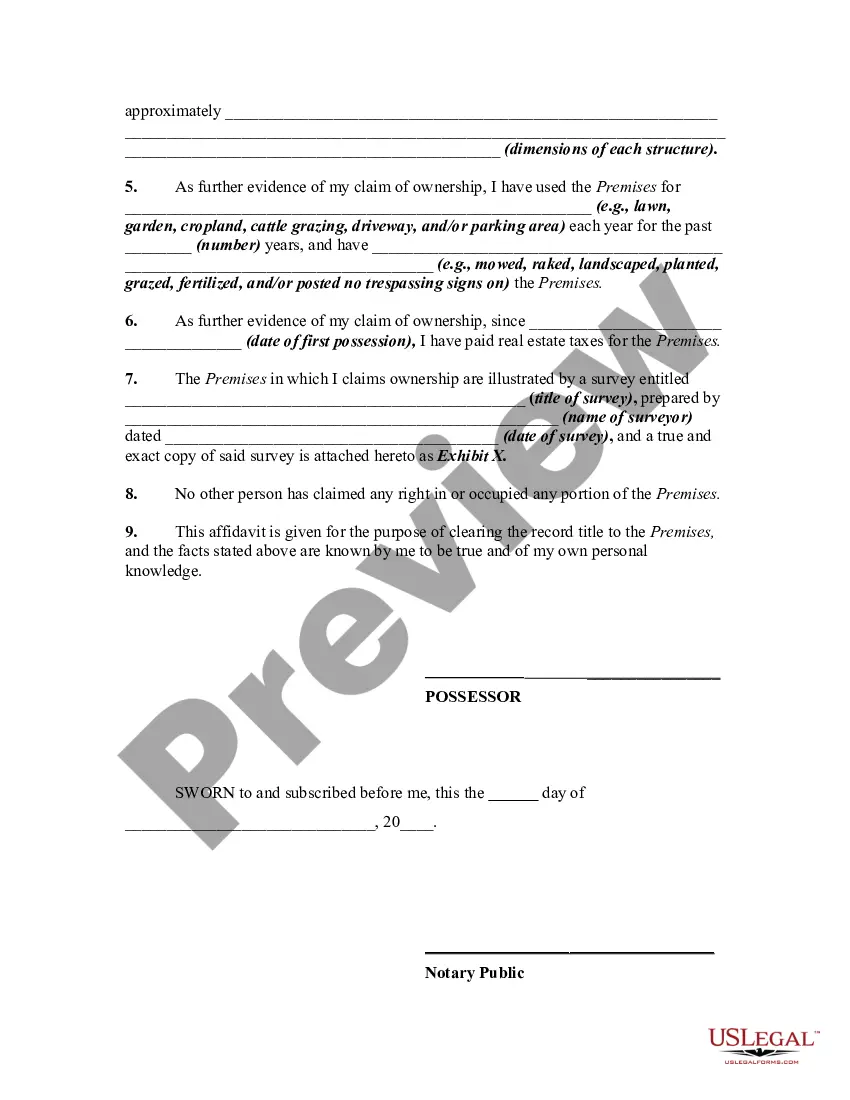
How to fill out Affidavit By Adverse Possessor That Property Held Adversely And Claim Of Title Is Based On Grant Of Ownership From Previous Owner - Squatters Rights?
- Log in to your account if you're a returning user. Ensure your subscription is active before downloading the necessary form template.
- For first-time users, begin by previewing the form descriptions. Confirm you have selected a template that aligns with your local jurisdiction's requirements.
- If you exhibit any discrepancies, search for alternative templates using the search tab to find a more suitable option.
- Once you find the correct document, click on the 'Buy Now' button to select your preferred subscription plan.
- Complete the purchase by entering your payment details through a credit card or via your PayPal account.
- After your transaction is confirmed, download your form. It will be accessible under 'My Forms' in your profile for future reference.
In conclusion, using US Legal Forms mitigates adverse effects stemming from improper legal documentation. Their library ensures you have the right resources at your fingertips.
Start now and navigate your legal needs confidently with US Legal Forms!
Form popularity
FAQ
Yes, adverse effects must be reported, as they play a critical role in ensuring the safety of drugs and medical products. Reporting allows for the identification of potential risks and timely intervention. It is essential for healthcare providers and patients alike to prioritize these reports to enhance overall public health.
The four criteria for adverse event reporting typically include the event's seriousness, the relationship to the drug, the outcome of the event, and whether the event was anticipated or unexpected. Each criterion helps to establish the importance of the event in understanding drug safety. By following these criteria, healthcare professionals can ensure thorough evaluations and safeguard patient health.
Reporting an adverse drug reaction involves notifying your healthcare provider immediately. You can also report to the FDA through the MedWatch system, providing all pertinent details about the drug and your experience. Effective reporting can lead to critical insights that improve drug safety for everyone.
To write an adverse drug reaction, start with the specific drug name and the reaction experienced, detailing symptoms and any relevant health conditions. Include the dosage taken and the time frame in which the reaction occurred. Providing comprehensive information will assist healthcare providers in evaluating the incident and determining necessary actions.
An example of an adverse incident could be a patient experiencing severe side effects after taking a prescribed medication. This might include an unexpected allergic reaction or an interaction with another drug that leads to hospitalization. Documenting the incident is crucial as it aids in understanding the effects of medications and ensures necessary precautions are taken.
To report an adverse drug effect, begin by notifying your healthcare provider, who can assist you in documenting the event. You can also report it directly to the Food and Drug Administration (FDA) through their MedWatch program. Providing accurate details about the drug, dosage, and your health status enhances the effectiveness of the reporting process.
To write an adverse event, you should start by clearly detailing what occurred, including the date, time, and location. Then, describe the individuals involved, and provide specific information about the event itself. Remember to include any medical or legal implications related to the adverse situation. This clear documentation helps in assessing the impact and necessary responses.
In New York, the rules for adverse possession require that a claimant demonstrate continuous possession for at least 10 years. The possession must be open, notorious, and without the permission of the actual owner. Also, the claimant must show that their use of the property was exclusive. Familiarizing yourself with these regulations can help you navigate any potential adverse possession issues.
To record an adverse possession claim, the occupant must gather evidence that demonstrates their continuous, adverse use of the property. This includes showing how long they have occupied the land, any improvements made, and the method of occupation. Once this information is organized, filing a claim with the proper local land office can formalize the process.
life example of adverse possession might involve a neighbor who has used a strip of vacant land for gardening over several decades without the owner's knowledge. If the owner never challenges the use and the gardener maintains the land openly, the gardener could file a claim of adverse possession. This scenario shows how longterm use can lead to unexpected legal ownership of land.