Release Agreement Example
Description

Get your form ready online
Our built-in tools help you complete, sign, share, and store your documents in one place.
Make edits, fill in missing information, and update formatting in US Legal Forms—just like you would in MS Word.
Download a copy, print it, send it by email, or mail it via USPS—whatever works best for your next step.
Sign and collect signatures with our SignNow integration. Send to multiple recipients, set reminders, and more. Go Premium to unlock E-Sign.
If this form requires notarization, complete it online through a secure video call—no need to meet a notary in person or wait for an appointment.
We protect your documents and personal data by following strict security and privacy standards.

Make edits, fill in missing information, and update formatting in US Legal Forms—just like you would in MS Word.

Download a copy, print it, send it by email, or mail it via USPS—whatever works best for your next step.

Sign and collect signatures with our SignNow integration. Send to multiple recipients, set reminders, and more. Go Premium to unlock E-Sign.

If this form requires notarization, complete it online through a secure video call—no need to meet a notary in person or wait for an appointment.

We protect your documents and personal data by following strict security and privacy standards.
Looking for another form?






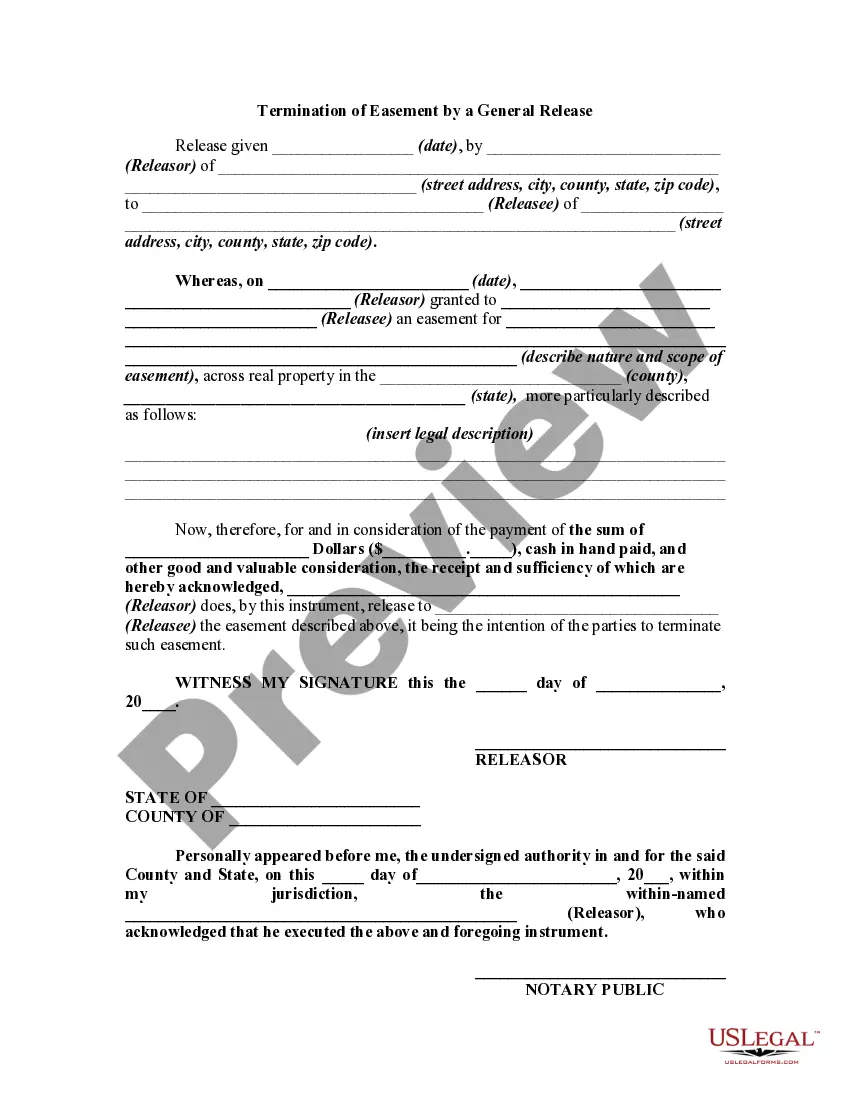
How to fill out Terminating Or Termination Of Easement By A General Release?
Acquiring legal templates that align with federal and local regulations is essential, and the internet provides numerous options available for selection.
However, what is the benefit of spending time searching for the suitable Release Agreement Example template online when the US Legal Forms online library has already collated such templates in one location.
US Legal Forms represents the largest online legal catalog, boasting over 85,000 editable templates crafted by attorneys for every business and personal scenario. They are easy to navigate with all documents categorized by state and intended use. Our experts keep abreast of legislative updates, ensuring that your form remains current and compliant whenever you obtain a Release Agreement Example from our platform.
Once you identify the correct form, click Buy Now and choose a subscription plan. Create an account or Log In, and complete the payment using PayPal or credit card. Choose the preferred format for your Release Agreement Example and download it. All documents accessed via US Legal Forms are reusable. To re-download and complete previously purchased forms, visit the My documents tab in your account. Leverage the most extensive and user-friendly legal documentation service!
- Acquiring a Release Agreement Example is straightforward and swift for both existing and new users.
- If you already possess an account with an active subscription, Log In to download the document template you require in your desired format.
- For new visitors to our website, adhere to the steps below.
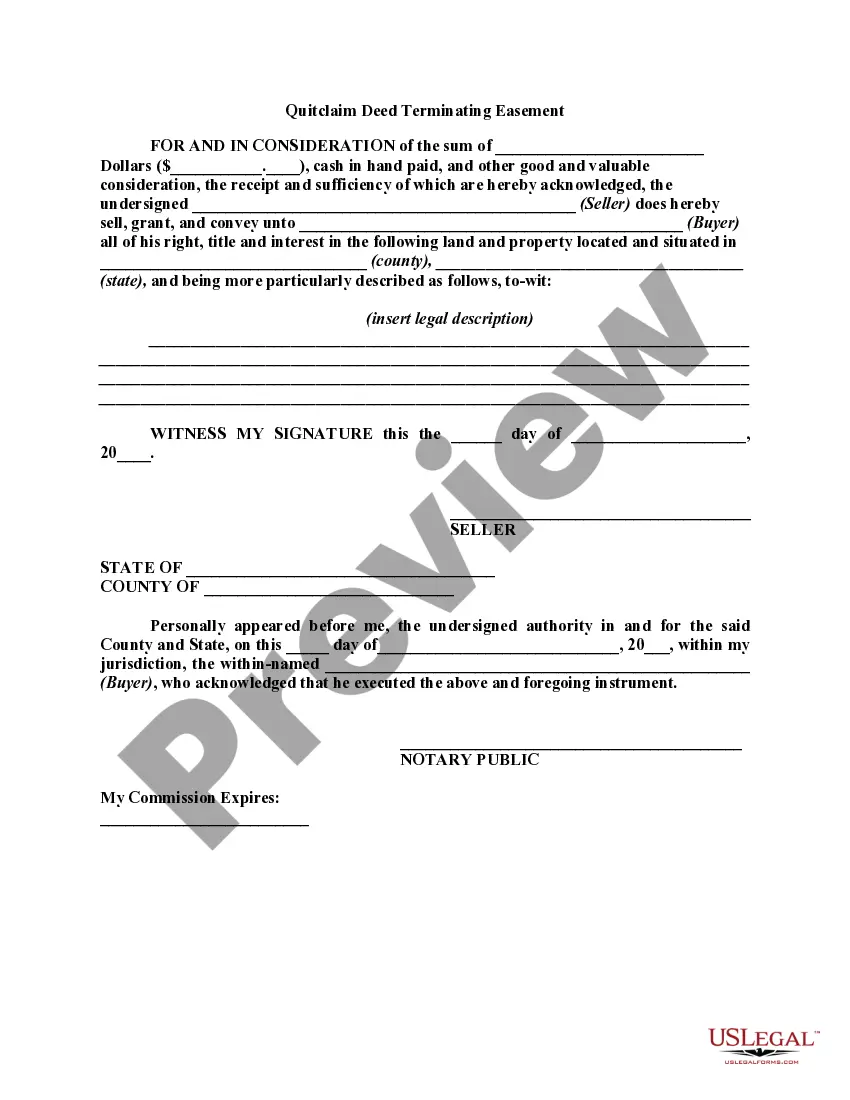
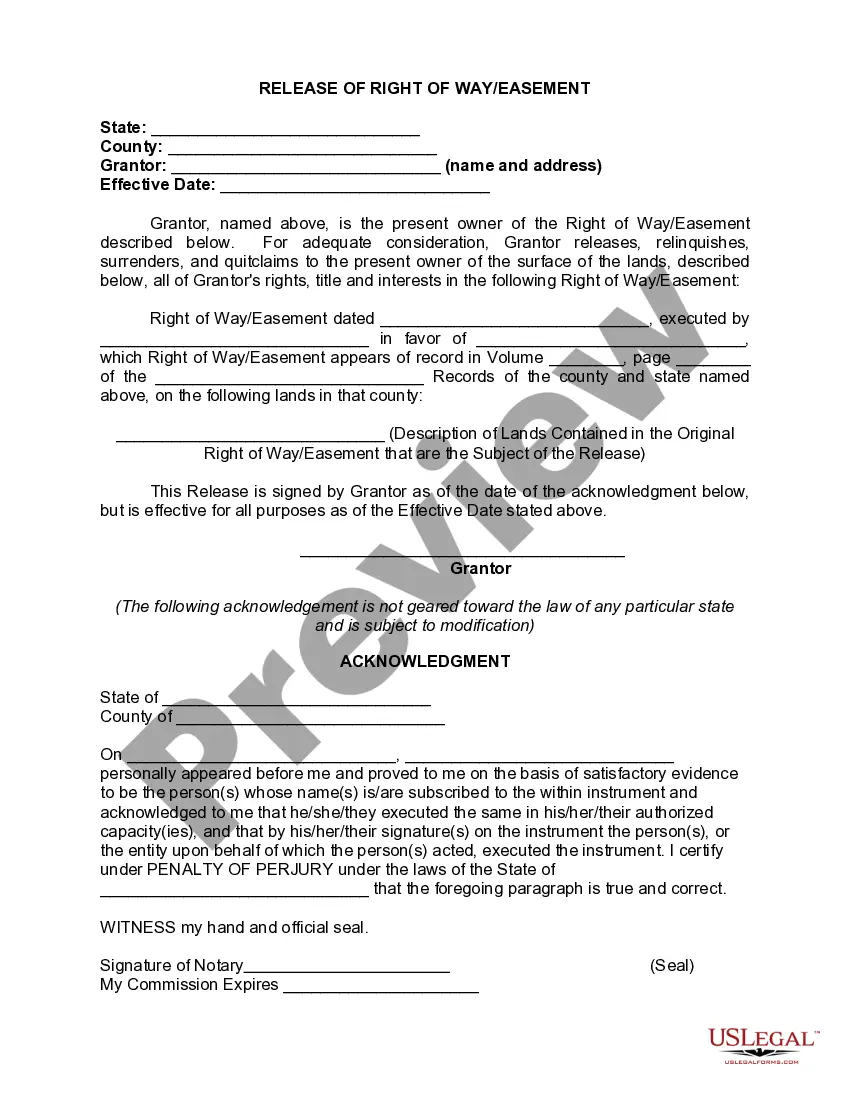
- Review the template utilizing the Preview function or by reading the text description to confirm it satisfies your requirements.
- If necessary, search for another template using the search feature at the top of the page.
Form popularity
FAQ
Drafting a release requires clarity and precision. Start by capturing the involved parties, the claims to be released, and any relevant dates. Make sure to include a section that outlines any terms or conditions related to the release. To see how this is done, refer to a release agreement example available on US Legal Forms, which can provide a solid foundation for your draft.
Release clauses typically include terms that detail the scope of the release and any limitations. Common examples include waivers of liability for specific actions or events, and disclaimers regarding future claims. These clauses ensure that all parties understand their rights and responsibilities. For more context, look for a release agreement example on the US Legal Forms platform to see how these clauses are effectively utilized.
Writing a release agreement involves outlining the terms clearly and concisely. Begin by identifying the parties and the claims being released. Next, include a statement that confirms the release of any future claims related to the matter. For a well-structured release agreement example, US Legal Forms offers templates that can simplify your writing process.
To fill out a release of claims form, start by entering the names of the parties involved. Clearly state the purpose of the release and include specific details regarding the claims being released. It is essential to date and sign the form to make it legally binding. For a comprehensive release agreement example, consider using resources from US Legal Forms to guide you.
A release form is a document that gives the photographer or videographer permission to use your likeness in their work. This could be for a photo shoot, film, commercial, or other project. The release form will include your name, contact information, and a description of what you are agreeing to.
Those seven elements are: Identification (Defining all the parties involved) Offer (The agreement) Acceptance (Agreement mirrored by other parties) Mutual consent (Signatory consent of all parties) Consideration (The value exchanged for the offer) Capacity (Legal/mental competence of all parties)
I agree to the terms of this Agreement, and I am voluntarily signing this release of all claims. I acknowledge that I have read and understand this Agreement, and I understand that I cannot pursue any of the claims and rights that I have waived in this Agreement at any time in the future.
How Do You Write a Release Form? The first step in writing is identifying all parties involved, including the releaser and the release. Specify the activity or event in detail, such as a photo shoot, a video production, or a performance. Clearly specify what is being released, whether liability, claims, or damages.
Party A and Party B do hereby irrevocably and unconditionally release, cancel, and forever discharge the other Party and its directors, officers, employees, subsidiaries, affiliates, agents, and representatives from any and all claims, complaints, causes of action, demands, damages, obligations, liabilities, losses, ...