Parent Child Support With Dna Test
Description
Get your form ready online
Our built-in tools help you complete, sign, share, and store your documents in one place.
Make edits, fill in missing information, and update formatting in US Legal Forms—just like you would in MS Word.
Download a copy, print it, send it by email, or mail it via USPS—whatever works best for your next step.
Sign and collect signatures with our SignNow integration. Send to multiple recipients, set reminders, and more. Go Premium to unlock E-Sign.
If this form requires notarization, complete it online through a secure video call—no need to meet a notary in person or wait for an appointment.
We protect your documents and personal data by following strict security and privacy standards.

Make edits, fill in missing information, and update formatting in US Legal Forms—just like you would in MS Word.

Download a copy, print it, send it by email, or mail it via USPS—whatever works best for your next step.

Sign and collect signatures with our SignNow integration. Send to multiple recipients, set reminders, and more. Go Premium to unlock E-Sign.

If this form requires notarization, complete it online through a secure video call—no need to meet a notary in person or wait for an appointment.

We protect your documents and personal data by following strict security and privacy standards.
Looking for another form?
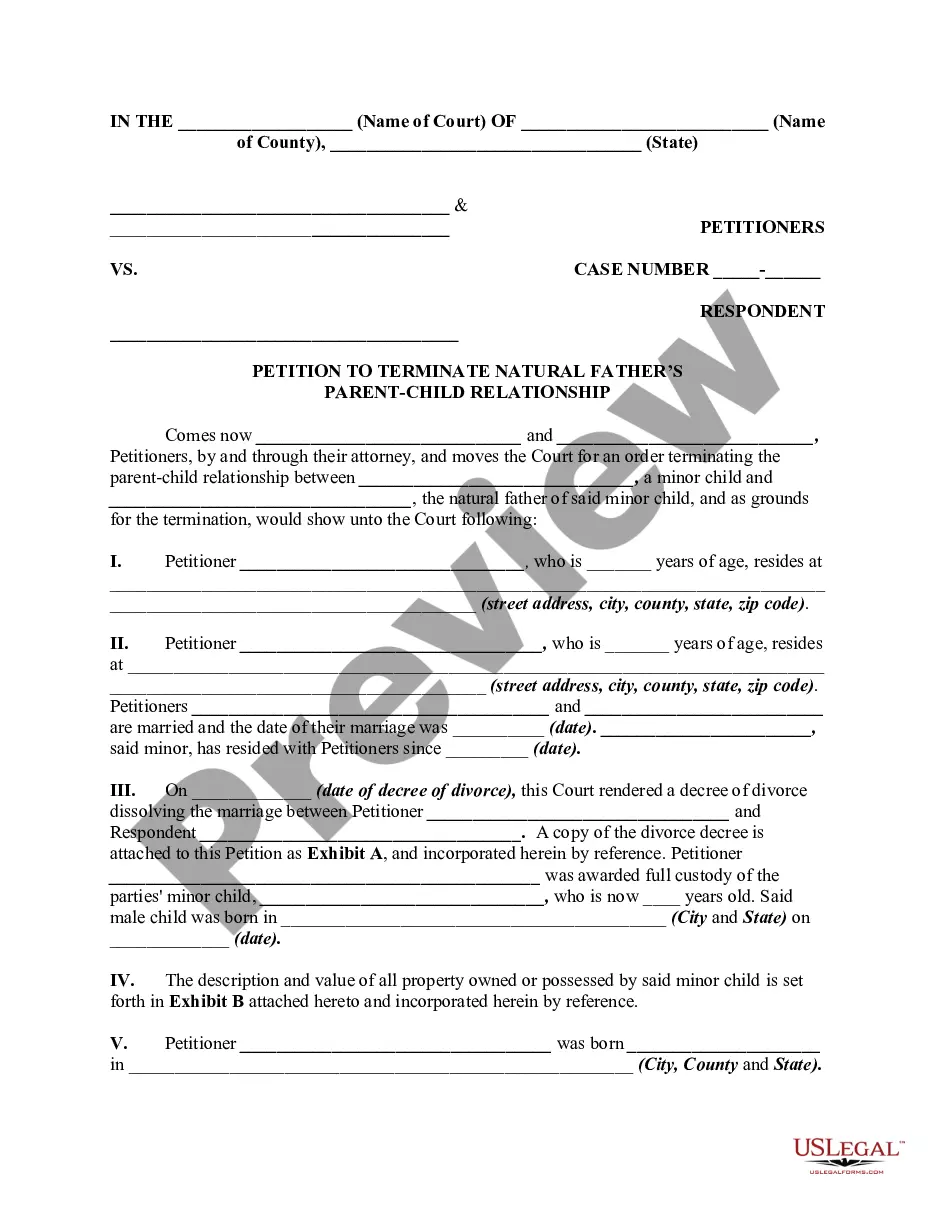
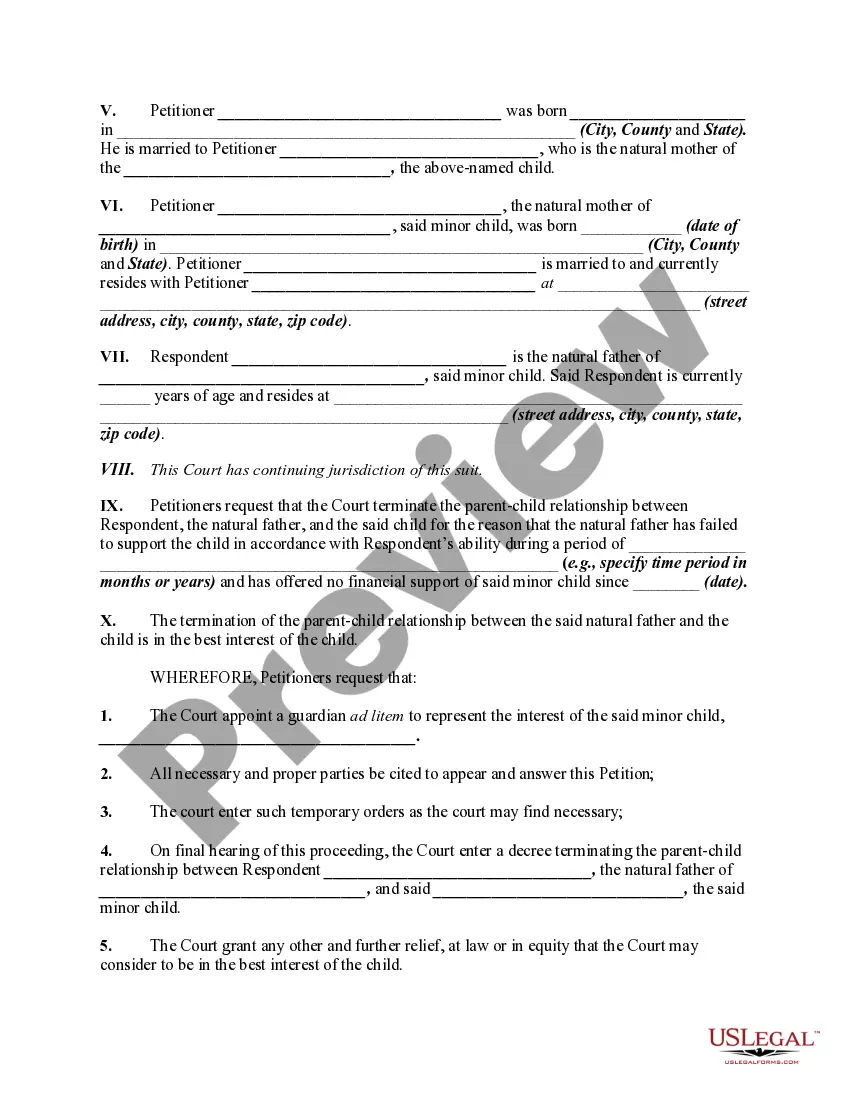
How to fill out Petition By Stepfather And Natural Mother To Terminate Natural Fathers Parent / Child Relationship For Failure To Support Child - Release Of Parental Rights?
Creating legal documents from the ground up can occasionally feel a bit daunting.
Certain situations may require extensive research and substantial financial commitments.
If you’re seeking an easier and more economical method for producing Parent Child Support With Dna Test or any other documents without hassle, US Legal Forms is always available.
Our online repository of over 85,000 current legal forms covers nearly every aspect of your financial, legal, and personal circumstances. With just a few clicks, you can swiftly obtain state- and county-specific templates meticulously crafted for you by our legal professionals.
Examine the form preview and descriptions to confirm that you have located the form you are looking for. Verify that the form you choose complies with the regulations and laws of your state and county. Select the appropriate subscription option to purchase the Parent Child Support With Dna Test. Download the file, then complete, sign, and print it out. US Legal Forms has an impeccable reputation and over 25 years of experience. Join us now and simplify your document completion process!
- Utilize our platform whenever you require trustworthy and dependable services to swiftly find and download the Parent Child Support With Dna Test.
- If you are familiar with our website and have previously established an account, simply Log In to your account, locate your form, and download it instantly or re-download it anytime from the My documents section.
- Not registered yet? No issue. It only takes a few minutes to sign up and browse the catalog.
- Before diving straight into the download of Parent Child Support With Dna Test, keep in mind these recommendations.
Form popularity
FAQ
A swab of the oral mucosa is sufficient to obtain the sample. A paternity test requires at least two samples: one from the child and one from the possible father. Ideally, a sample from the mother should also be tested. The results make it possible to rule out paternity or classify it as highly probable.
It is a required step before asking the court to order child support, custody or parenting time. It helps your child become eligible for the father's inheritance, medical benefits, Social Security and possibly veteran's benefits.
Although a mother can refuse a peace of mind paternity test, the mother's permission is not needed to carry out such a test, provided her DNA is not being submitted for testing and the potential father has parental responsibility for any child being tested.
Yes, a man can be put on child support without a DNA test in Texas. For unmarried parents, the biological father does not have legal rights to his child until paternity is established.
The tissue samples from the cotton swab are sent to a lab that specializes in genetic marker testing. The lab compares the tissue samples from the mother, the child, and the man to see what special characteristics ? known as ?genetic markers? ? the child shares with the mother and the man who may be the father.