Questions To Ask During Custody Trial
Description

Get your form ready online
Our built-in tools help you complete, sign, share, and store your documents in one place.
Make edits, fill in missing information, and update formatting in US Legal Forms—just like you would in MS Word.
Download a copy, print it, send it by email, or mail it via USPS—whatever works best for your next step.
Sign and collect signatures with our SignNow integration. Send to multiple recipients, set reminders, and more. Go Premium to unlock E-Sign.
If this form requires notarization, complete it online through a secure video call—no need to meet a notary in person or wait for an appointment.
We protect your documents and personal data by following strict security and privacy standards.

Make edits, fill in missing information, and update formatting in US Legal Forms—just like you would in MS Word.

Download a copy, print it, send it by email, or mail it via USPS—whatever works best for your next step.

Sign and collect signatures with our SignNow integration. Send to multiple recipients, set reminders, and more. Go Premium to unlock E-Sign.

If this form requires notarization, complete it online through a secure video call—no need to meet a notary in person or wait for an appointment.

We protect your documents and personal data by following strict security and privacy standards.
Looking for another form?








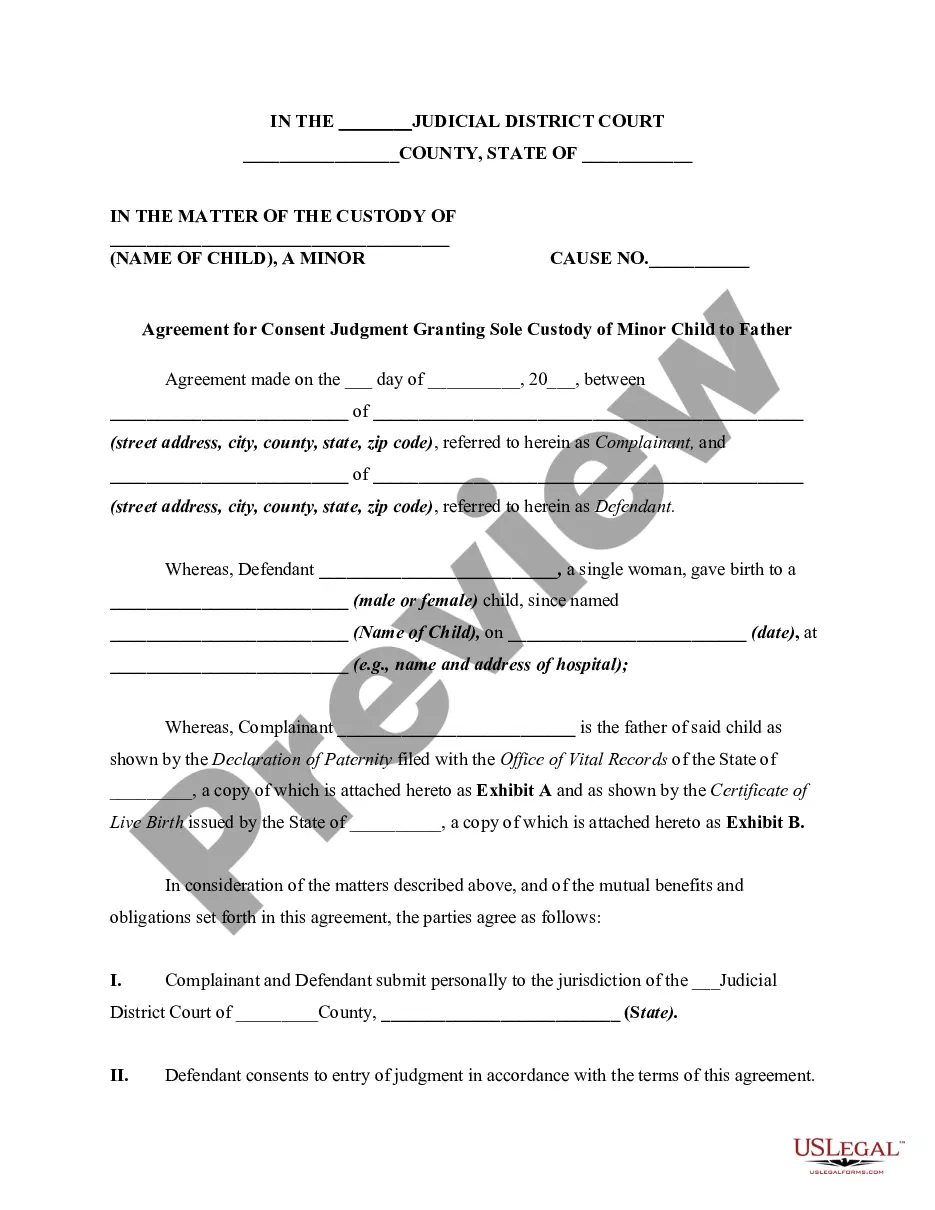
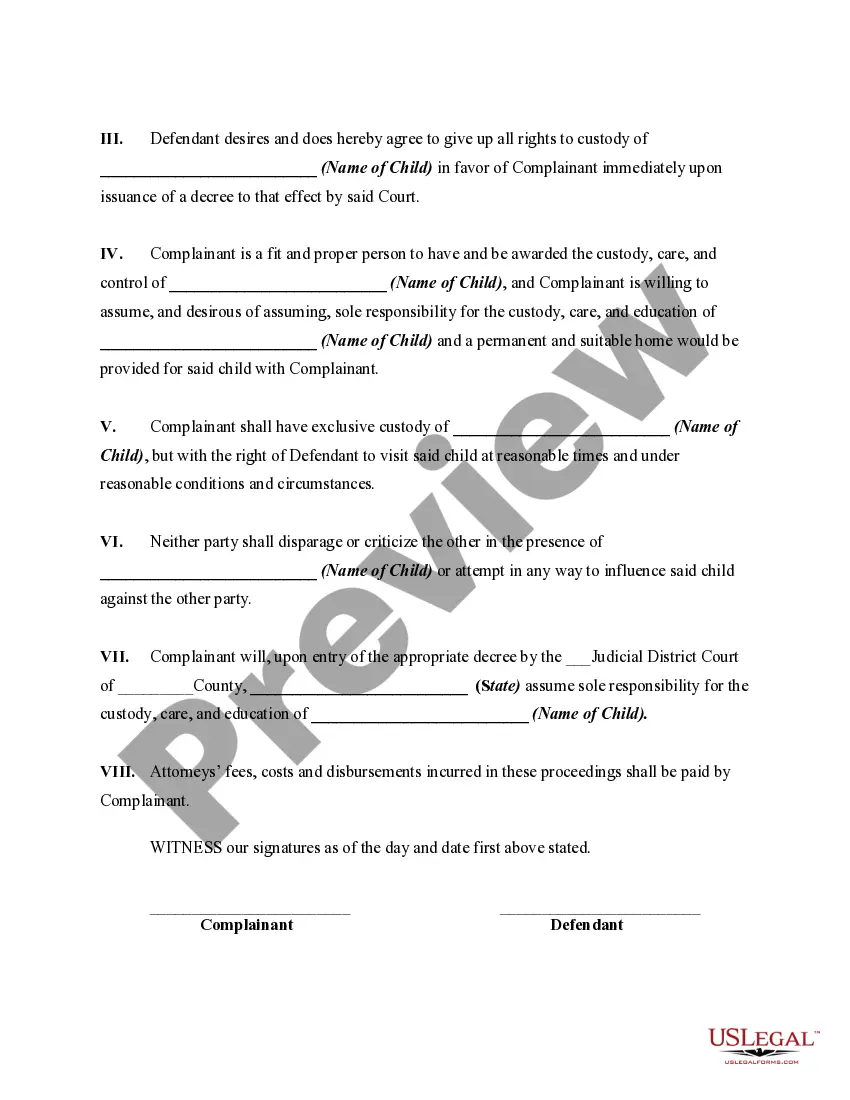
How to fill out Agreement For Consent Judgment Granting Sole Custody Of Minor Child To Father?
Finding a reliable source for the most up-to-date and suitable legal templates is half the battle of managing bureaucracy.
Identifying the correct legal documents requires accuracy and meticulousness, which is why it is essential to obtain samples of Questions To Ask During Custody Trial solely from reputable sources, such as US Legal Forms. An incorrect template will squander your time and delay your situation.
Once you have the form on your device, you can edit it with the editor or print it and fill it out by hand. Eliminate the stress associated with your legal documentation. Explore the vast US Legal Forms library to find legal samples, verify their relevance to your situation, and download them instantly.
- Utilize the catalog navigation or search bar to find your template.
- View the form’s details to verify if it meets the specifications of your state and locality.
- Access the form preview, if available, to ensure the form is the one you need.
- Return to the search and locate the appropriate document if the Questions To Ask During Custody Trial does not meet your criteria.
- If you are confident in the form’s applicability, download it.
- If you are a registered user, click Log in to verify and access your selected forms in My documents.
- If you do not have an account yet, click Buy now to acquire the form.
- Choose the pricing plan that best fits your needs.
- Proceed with the registration to finalize your purchase.
- Complete your purchase by selecting a payment method (credit card or PayPal).
- Choose the file format for downloading Questions To Ask During Custody Trial.
Form popularity
FAQ
During a custody trial, the court typically asks questions that assess the child's best interests. Expect inquiries about your parenting style, living situation, and your relationship with your child. It's also common for the court to explore your willingness to cooperate with the other parent. To prepare, think about the questions to ask during custody trial that will highlight your strengths as a parent.
One of the biggest mistakes in a custody battle is failing to prepare adequately. Many parents overlook the significance of understanding the questions to ask during custody trial. Being unprepared can lead to missed opportunities to present your case effectively. Consider using resources like US Legal Forms to help you navigate the complexities of custody trials.
When you are in child support court, it's important to avoid making negative statements about the other parent. Instead, focus on factual information that supports your case. Additionally, do not express your personal feelings or frustrations, as these can detract from your credibility. Remember, the court wants to see your commitment to your child's best interests.
Winning full custody in court requires you to present a strong case that prioritizes your child's best interests. Gather evidence of your parenting abilities, maintain a positive relationship with your child, and demonstrate your willingness to co-parent effectively. Understanding the legal framework and preparing pertinent questions to ask during custody trial can enhance your argument. US Legal Forms offers valuable resources that can guide you through this process.
To demonstrate to the court that you are a good parent, you should highlight your involvement in your child's life. Share examples of your daily routines, educational support, and emotional nurturing. Documenting your parental responsibilities can strengthen your case. Consider utilizing resources like US Legal Forms to prepare questions to ask during custody trial, which can help clarify your role as a devoted parent.
When you are in court for child custody, focus on expressing your love and commitment to your child. Discuss your parenting style, your ability to provide a stable environment, and your plans for the child's future. Remember to remain calm and respectful, as the judge will notice your demeanor. Prepare by reviewing questions to ask during custody trial to ensure you effectively communicate your points.
There are several cases that family court hears, including but not limited to adoption, child custody, divorce, domestic violence, guardianship, and juvenile infractions. Expert witnesses like doctors, mental health professionals, and teachers often play an essential part in these cases.
You can't call a witness who knows a defendant and who testifies to every good deed that defendant has done in their life. Basically, character witness testimony is limited to a reputation of a defendant in the community for truthfulness.
Share examples that demonstrate how the parent cares for their child and supports their best interests. Highlight the parent's strengths, and show how they play an active role in their child's upbringing and overall well-being. Be specific, and focus on the parent?child relationship.
Parties often come to their divorce and/or family law attorney with the proposal that they call character witnesses. Typically, the most common character witnessed that are presented by a party are friends and family members.