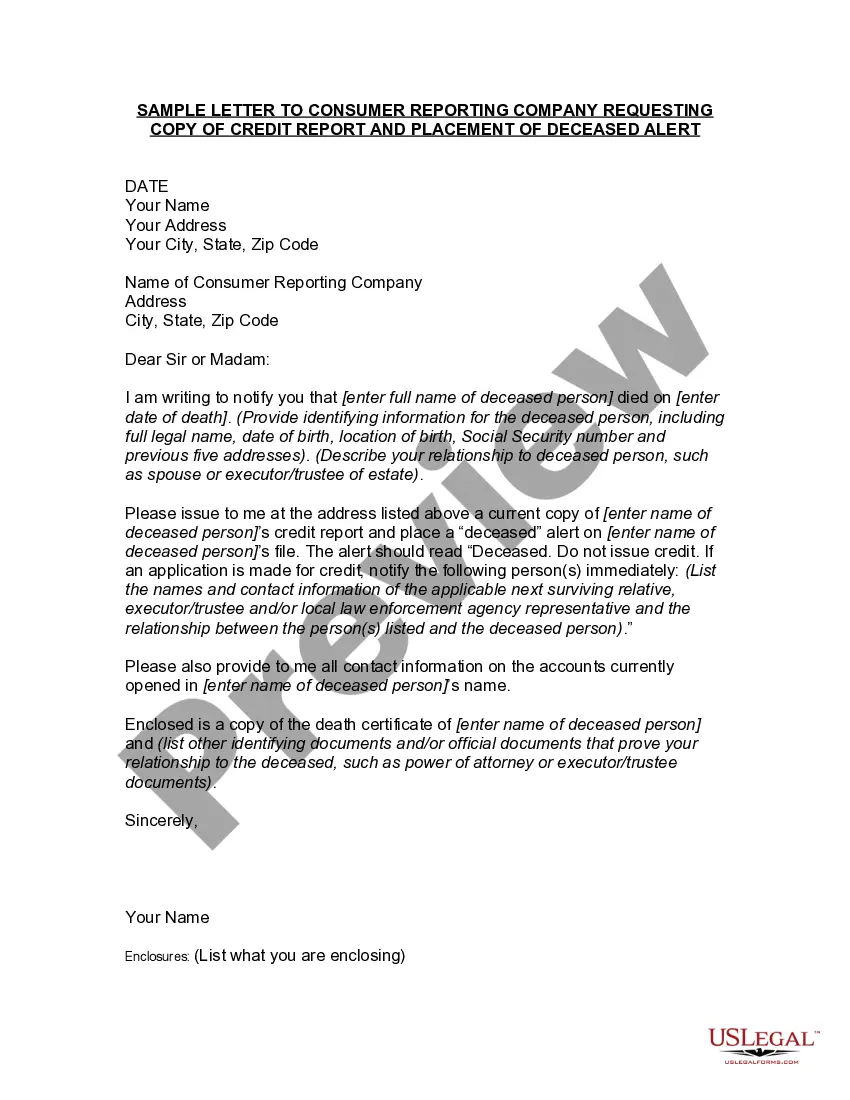
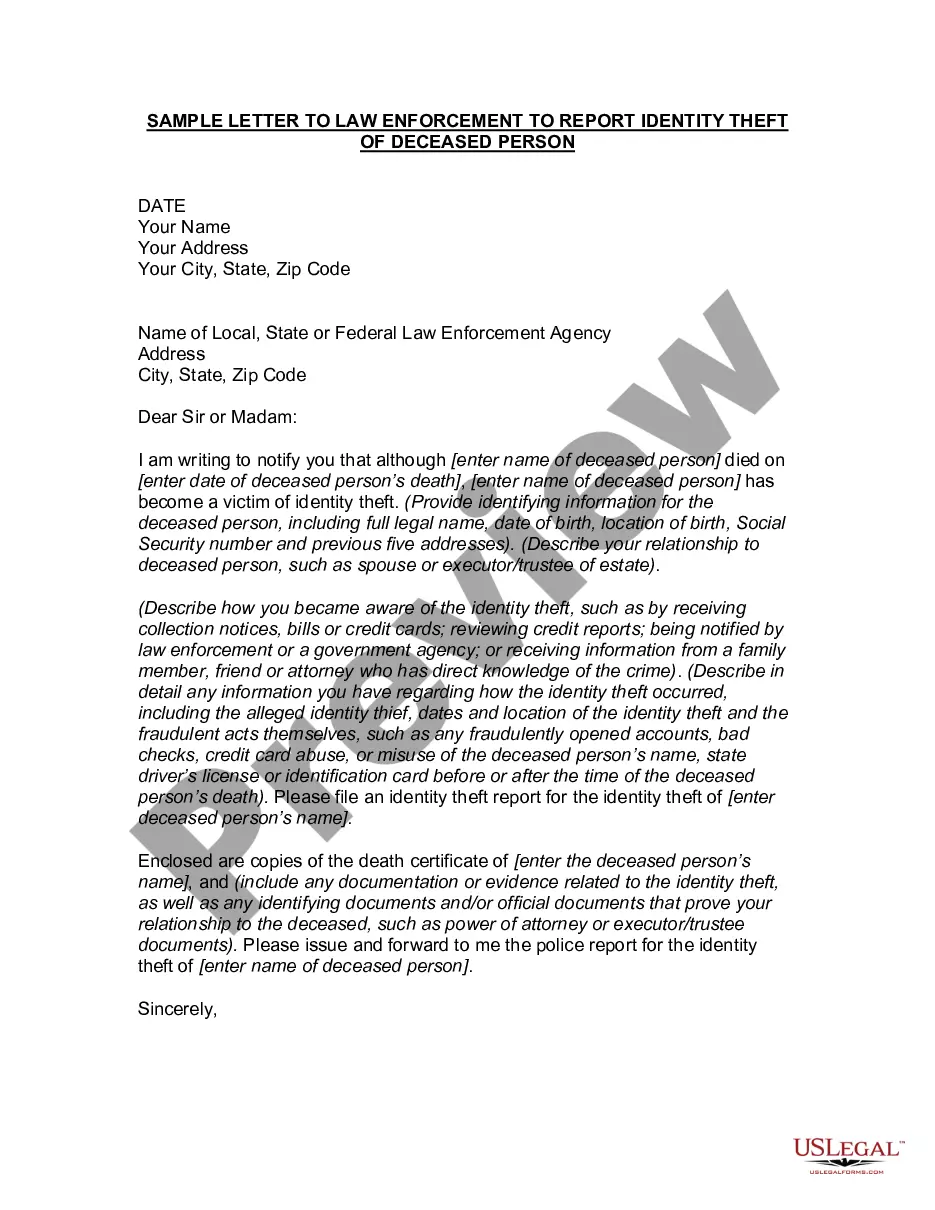
Credit Reporting Bureaus Deceased With No Estate
Description
Get your form ready online
Our built-in tools help you complete, sign, share, and store your documents in one place.
Make edits, fill in missing information, and update formatting in US Legal Forms—just like you would in MS Word.
Download a copy, print it, send it by email, or mail it via USPS—whatever works best for your next step.
Sign and collect signatures with our SignNow integration. Send to multiple recipients, set reminders, and more. Go Premium to unlock E-Sign.
If this form requires notarization, complete it online through a secure video call—no need to meet a notary in person or wait for an appointment.
We protect your documents and personal data by following strict security and privacy standards.

Make edits, fill in missing information, and update formatting in US Legal Forms—just like you would in MS Word.

Download a copy, print it, send it by email, or mail it via USPS—whatever works best for your next step.

Sign and collect signatures with our SignNow integration. Send to multiple recipients, set reminders, and more. Go Premium to unlock E-Sign.

If this form requires notarization, complete it online through a secure video call—no need to meet a notary in person or wait for an appointment.

We protect your documents and personal data by following strict security and privacy standards.
Looking for another form?
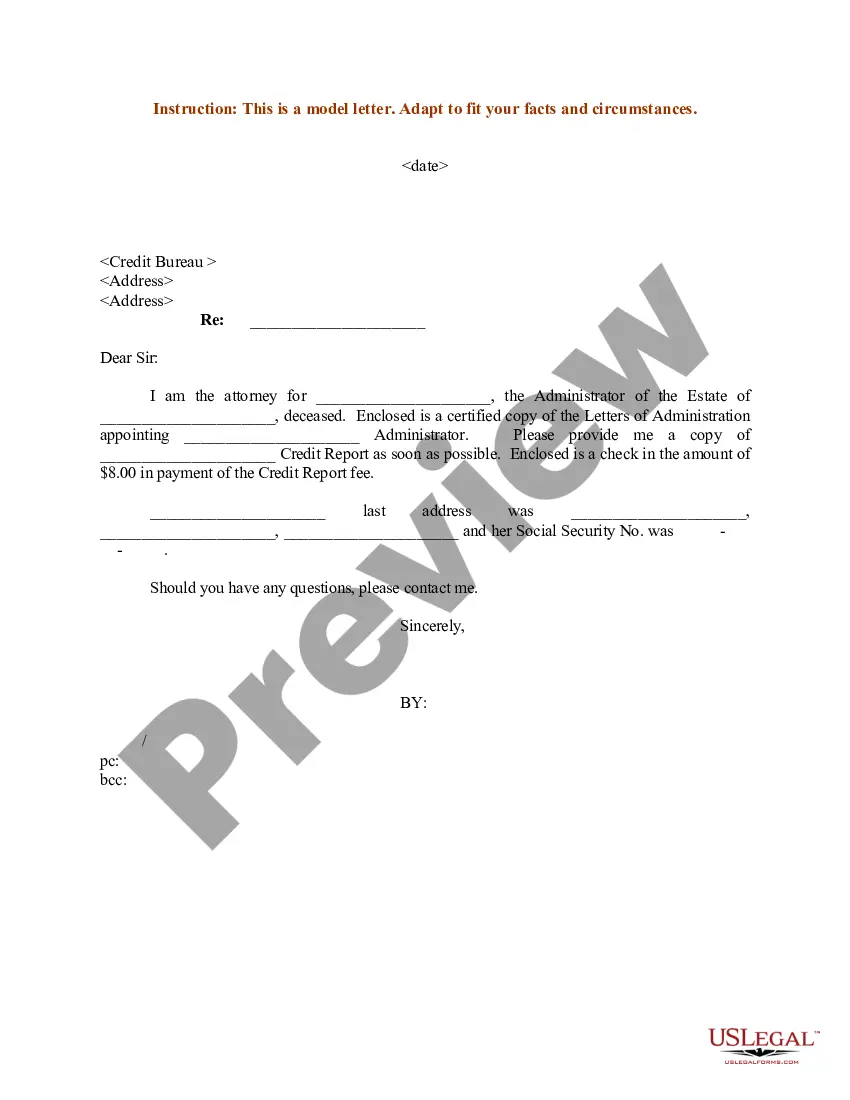
How to fill out Letter To Credit Reporting Bureaus Or Agencies Requesting Copy Of Deceased Person's Credit Report And Placement Of Deceased Alert?
Utilizing legal document examples that adhere to federal and local regulations is essential, and the internet provides numerous choices to consider.
However, what is the benefit of squandering time looking for the properly drafted Credit Reporting Bureaus Deceased With No Estate template online when the US Legal Forms online library already has such documents gathered in one location.
US Legal Forms is the largest online legal repository containing over 85,000 editable templates created by lawyers for various professional and personal situations. They are easy to navigate with all documents categorized by state and intended use. Our experts keep up with legislative updates, ensuring that your form is always current and compliant when acquiring a Credit Reporting Bureaus Deceased With No Estate from our site.
Click Buy Now when you have found the appropriate form and select a subscription plan. Create an account or Log In and complete the payment via PayPal or a credit card. Choose the suitable format for your Credit Reporting Bureaus Deceased With No Estate and download it. All templates accessible via US Legal Forms are reusable. To re-download and fill out previously acquired forms, visit the My documents tab in your account. Enjoy the most comprehensive and user-friendly legal document service!
- Acquiring a Credit Reporting Bureaus Deceased With No Estate is quick and easy for both existing and new users.
- If you already possess an account with an active subscription, Log In and obtain the document sample you need in the appropriate format.
- If you are a newcomer to our website, follow these steps.
- View the template using the Preview option or through the text outline to confirm it meets your requirements.
- Utilize the search tool at the top of the page to find another sample if necessary.
Form popularity
FAQ
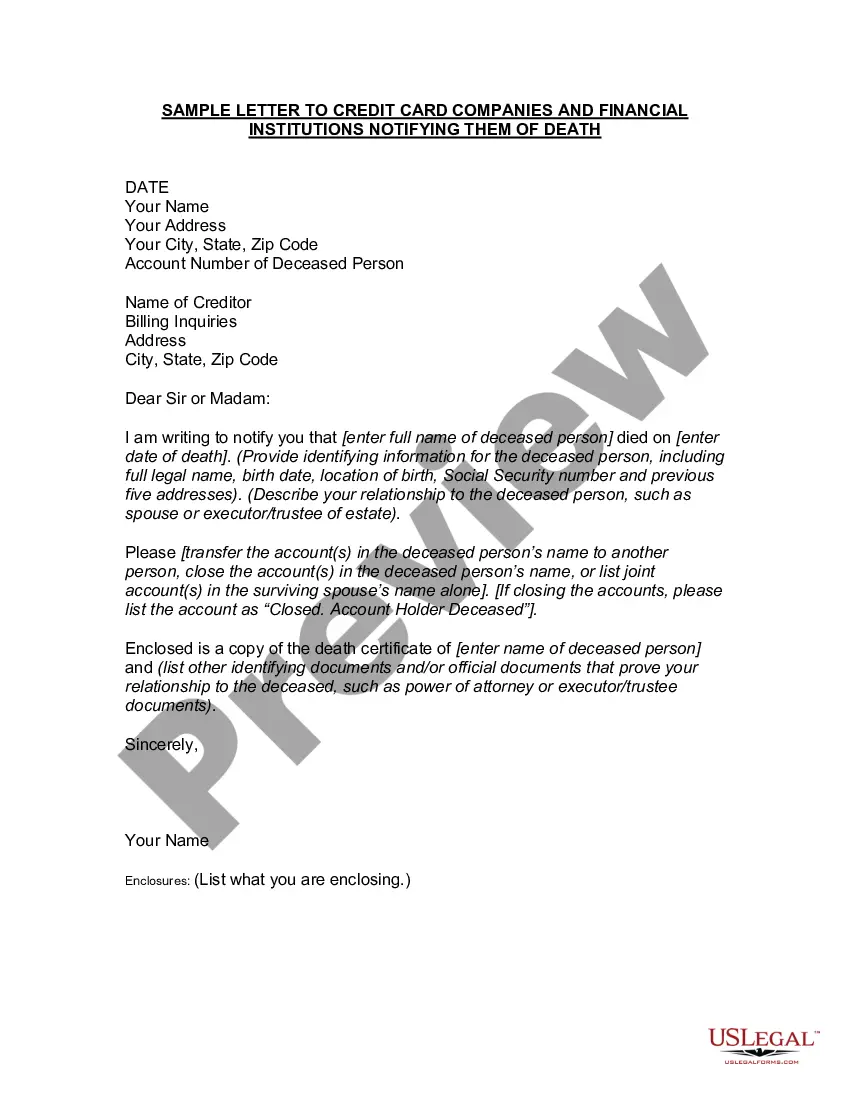
To get the credit report of a deceased person, gather necessary documents like the death certificate and proof of your identity. You can then submit a request directly to the credit reporting bureaus deceased with no estate. Ensure your request includes all required information for a timely response.
If any juror who has been given due notice to appear in court shall fail to do so without sufficient excuse, he shall be fined not less than $50 nor more than $200. Code 1950, § 8-208.18; 1973, c. 439; 1977, c.
As stated simply in the official Virginia Model Jury Instructions, a Commonwealth jury is instructed to award a car accident victim full and fair financial compensation for the ?physical pain? and ?mental anguish? sustained in the accident.
Beyond a reasonable doubt is the legal burden of proof required to affirm a conviction in a criminal case. In a criminal case, the prosecution bears the burden of proving that the defendant is guilty beyond all reasonable doubt.
If you have been convicted of a felony as an adult and have not had your civil rights restored, or have been declared mentally incompetent and your competence has not been reinstated, you are not eligible to serve on a jury.
Proof beyond a reasonable doubt is proof that leaves you firmly convinced the defendant is guilty. It is not required that the government prove guilt beyond all possible doubt. A reasonable doubt is a doubt based upon reason and common sense and is not based purely on speculation.
The burden of proof requires a party to produce evidence to establish the truth of facts needed to satisfy all the required legal elements of the dispute. The burden of proof is usually on the person who brings a claim in a dispute.
A party must persuade you, by the evidence presented in court, that what he or she is required to prove is more likely to be true than not true. This is referred to as "the burden of proof."
When a party has the burden of proving any claim [or affirmative defense] by a preponderance of the evidence, it means you must be persuaded by the evidence that the claim [or affirmative defense] is more probably true than not true.