Privacy And Confidentiality For Patients
Description
Get your form ready online
Our built-in tools help you complete, sign, share, and store your documents in one place.
Make edits, fill in missing information, and update formatting in US Legal Forms—just like you would in MS Word.
Download a copy, print it, send it by email, or mail it via USPS—whatever works best for your next step.
Sign and collect signatures with our SignNow integration. Send to multiple recipients, set reminders, and more. Go Premium to unlock E-Sign.
If this form requires notarization, complete it online through a secure video call—no need to meet a notary in person or wait for an appointment.
We protect your documents and personal data by following strict security and privacy standards.

Make edits, fill in missing information, and update formatting in US Legal Forms—just like you would in MS Word.

Download a copy, print it, send it by email, or mail it via USPS—whatever works best for your next step.

Sign and collect signatures with our SignNow integration. Send to multiple recipients, set reminders, and more. Go Premium to unlock E-Sign.

If this form requires notarization, complete it online through a secure video call—no need to meet a notary in person or wait for an appointment.

We protect your documents and personal data by following strict security and privacy standards.
Looking for another form?








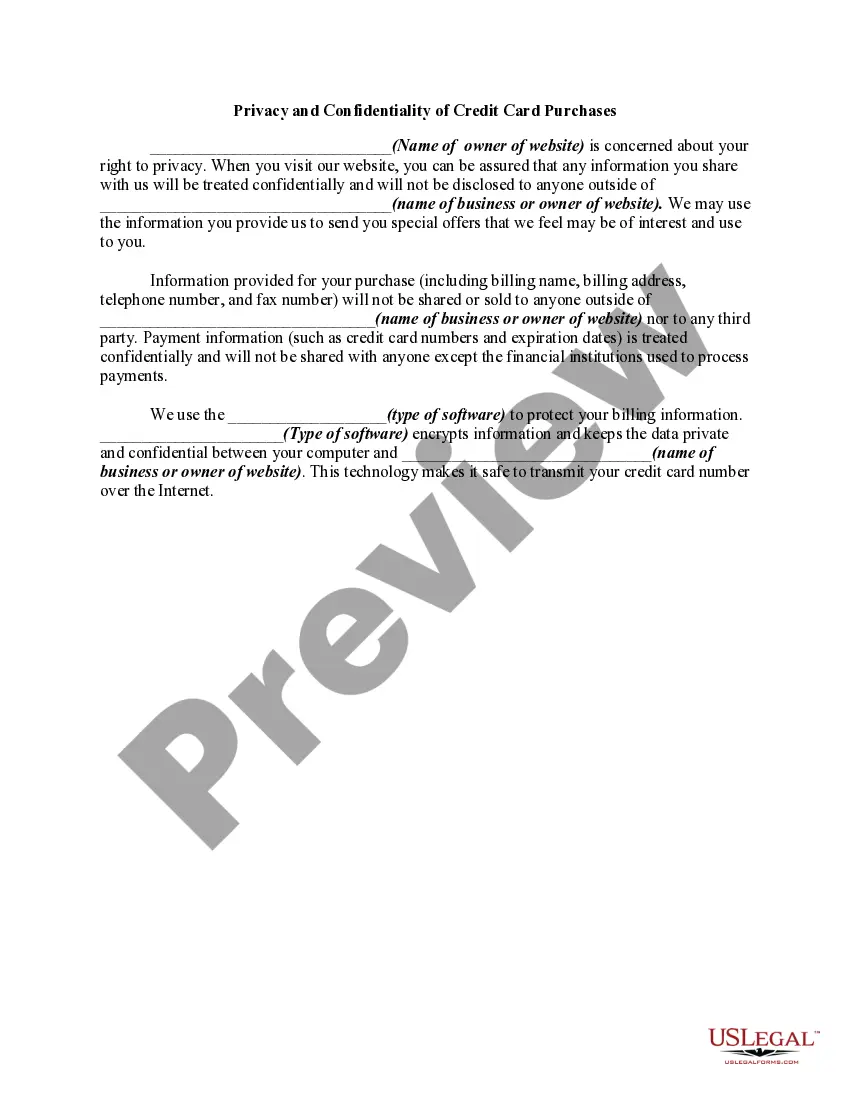
How to fill out Privacy And Confidentiality Of Credit Card Purchases?
Precisely formulated formal documentation is one of the fundamental assurances for steering clear of issues and legal disputes, but obtaining it without assistance from a lawyer may require some time.
Whether you need to swiftly find a current Privacy and Confidentiality for Patients or various other templates for employment, family, or business contexts, US Legal Forms is always available to assist.
The process is even simpler for existing users of the US Legal Forms library. If your subscription is active, you only need to Log In to your account and click the Download button next to the chosen document. Furthermore, you can access the Privacy and Confidentiality for Patients at any time later, as all documents ever acquired on the platform remain accessible within the My documents section of your profile. Save time and money on preparing official documentation. Give US Legal Forms a try today!
- Ensure that the form is appropriate for your situation and area by reviewing the description and preview.
- Search for another example (if needed) using the Search bar in the header of the page.
- Click Buy Now once you find the relevant template.
- Choose your pricing plan, sign into your account or create a new one.
- Select your preferred payment method to purchase the subscription plan (via credit card or PayPal).
- Select either PDF or DOCX file format for your Privacy and Confidentiality for Patients.
- Click Download, then print the template to complete it or upload it to an online editor.
Form popularity
FAQ
Confidentiality in the medical setting refers to the principle of keeping secure and secret from others, information given by or about an individual in the course of a professional relationship,1 and it is the right of every patient, even after death.
4 ways of protecting patient privacyBuild a security culture in your organization.Perform a security risk assessment.Create a PHI security improvement plan.Encrypt all patient data.
Patient privacy encompasses a number of aspects, including personal space (physical privacy), personal data (informational privacy), personal choices including cultural and religious affiliations (decisional privacy), and personal relationships with family members and other intimates (associational privacy).
4 ways of protecting patient privacyBuild a security culture in your organization.Perform a security risk assessment.Create a PHI security improvement plan.Encrypt all patient data.
Check out a few tried-and-true best practices for maintaining patient privacy and ensuring their information is safeguarded to the highest degree.Let Your Patients Know They're the Priority.Use HIPAA-Compliant Software.Conduct an Audit of Your Own.