Transfer Property Act In India
Description
Get your form ready online
Our built-in tools help you complete, sign, share, and store your documents in one place.
Make edits, fill in missing information, and update formatting in US Legal Forms—just like you would in MS Word.
Download a copy, print it, send it by email, or mail it via USPS—whatever works best for your next step.
Sign and collect signatures with our SignNow integration. Send to multiple recipients, set reminders, and more. Go Premium to unlock E-Sign.
If this form requires notarization, complete it online through a secure video call—no need to meet a notary in person or wait for an appointment.
We protect your documents and personal data by following strict security and privacy standards.

Make edits, fill in missing information, and update formatting in US Legal Forms—just like you would in MS Word.

Download a copy, print it, send it by email, or mail it via USPS—whatever works best for your next step.

Sign and collect signatures with our SignNow integration. Send to multiple recipients, set reminders, and more. Go Premium to unlock E-Sign.

If this form requires notarization, complete it online through a secure video call—no need to meet a notary in person or wait for an appointment.

We protect your documents and personal data by following strict security and privacy standards.
Looking for another form?








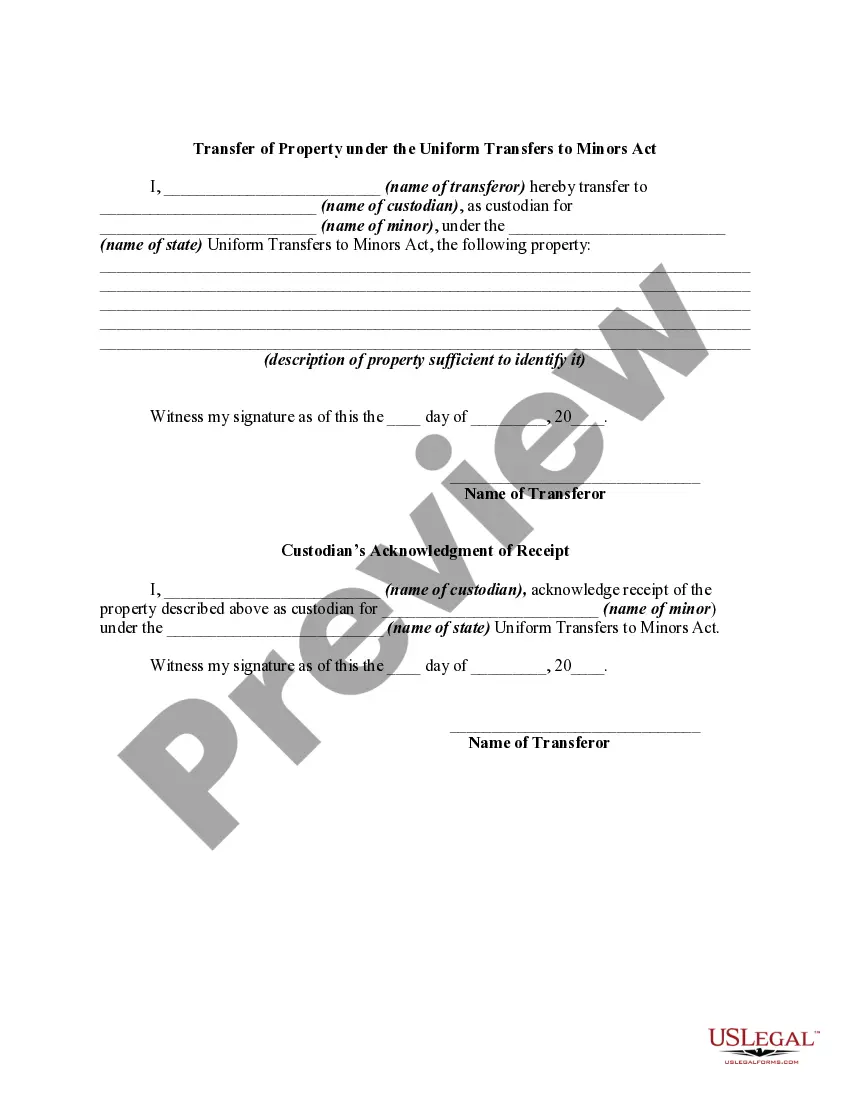
How to fill out Transfer Of Property Under The Uniform Transfers To Minors Act?
Creating legal documents from the ground up can frequently feel a bit daunting. Some situations may require extensive research and significant financial resources.
If you are seeking a simpler and more economical method of preparing the Transfer Property Act in India or any other forms without unnecessary complications, US Legal Forms is always available to assist you.
Our online repository of more than 85,000 current legal documents covers nearly every aspect of your financial, legal, and personal affairs. With just a few clicks, you can promptly access templates that comply with state and county regulations, expertly crafted by our legal professionals.
Utilize our platform whenever you require trustworthy and dependable services through which you can effortlessly locate and download the Transfer Property Act in India. If you are already familiar with our services and have previously registered an account with us, simply Log In to your account, choose the template and download it directly or re-download it at any time in the My documents section.
Verify that the form you choose aligns with the laws and regulations of your state and county. Select the most appropriate subscription option to obtain the Transfer Property Act in India. Download the document, then complete, sign, and print it. US Legal Forms has an impeccable reputation and over 25 years of expertise. Join us today and transform form completion into a straightforward and efficient process!
- Not registered yet? No problem.
- It only takes a few minutes to sign up and explore the library.
- But before you dive into downloading the Transfer Property Act in India, consider these pointers.
- Review the document preview and descriptions to ensure you have located the form you are looking for.
Form popularity
FAQ
The Transfer of Property Act in India covers various aspects of property transfer, including the rights and obligations of the parties involved in transactions. It outlines the different types of property, such as movable and immovable, and specifies the methods of transfer. Additionally, it addresses issues such as leases, mortgages, and the rights of mortgagees and mortgagors. If you need assistance navigating these complexities, platforms like USLegalForms can provide valuable resources.
The 12 year property rule in India refers to the legal principle that if a person possesses a property openly and without interruption for twelve years, they can claim ownership of that property through adverse possession. This rule is fundamental under the Transfer Property Act in India, as it protects individuals who may have been in possession of property without formal ownership. It is crucial to document any claims and understand the implications of this rule.
Under the Transfer Property Act in India, certain properties cannot be transferred. This includes properties that are not transferable by law, such as those that are subject to a legal restriction or are under a court order. Additionally, property that is owned jointly cannot be transferred without the consent of all co-owners. Understanding these limitations is essential for anyone looking to navigate property transactions.
The Transfer of Property Act in India, enacted in 1882, governs the transfer of property rights between individuals. This Act outlines the legal framework for various types of property transfers, including sale, mortgage, lease, and exchange. It aims to protect the interests of both buyers and sellers, providing clarity on the rights and responsibilities of parties involved. Understanding this Act is crucial for anyone engaged in property transactions in India.
Non-Resident Indians (NRIs) can transfer property in India by following specific legal procedures. They must adhere to the regulations under the Transfer Property Act in India, ensuring proper documentation is in place. NRIs should also consider using a power of attorney to facilitate the transaction if they are unable to be present in India. For added convenience, platforms like uslegalforms can assist NRIs in understanding and managing these requirements effectively.
To transfer property through a will in India, you need several key documents. First, the original will is essential, as it outlines the testator's wishes. Additionally, you should have proof of property ownership and identity documents such as an Aadhar card or passport. Finally, the transfer process may require a no-objection certificate from legal heirs, ensuring compliance with the Transfer Property Act in India.
Property transfer in India follows a systematic step-by-step process that encompasses due diligence, agreement to sell, execution of the sale deed, payment of stamp duty and registration, possession handover, and mutation of records.
Five ways to transfer property in India Sale deed. The most famous property transfer method in India is through Sale deeds. ... Gift deed property transfer. Gifts can be in the form of houses, shares, money, jewellery, etc. ... Release deed or relinquishment deed. ... An inheritance or Will deed. ... Settlement deed or partition deed.
In most states in India, 5% to 7% of the total market value of the property is charged as stamp duty while 1% is charged as registration fee.