Online Executor For Python
Description

Get your form ready online
Our built-in tools help you complete, sign, share, and store your documents in one place.
Make edits, fill in missing information, and update formatting in US Legal Forms—just like you would in MS Word.
Download a copy, print it, send it by email, or mail it via USPS—whatever works best for your next step.
Sign and collect signatures with our SignNow integration. Send to multiple recipients, set reminders, and more. Go Premium to unlock E-Sign.
If this form requires notarization, complete it online through a secure video call—no need to meet a notary in person or wait for an appointment.
We protect your documents and personal data by following strict security and privacy standards.

Make edits, fill in missing information, and update formatting in US Legal Forms—just like you would in MS Word.

Download a copy, print it, send it by email, or mail it via USPS—whatever works best for your next step.

Sign and collect signatures with our SignNow integration. Send to multiple recipients, set reminders, and more. Go Premium to unlock E-Sign.

If this form requires notarization, complete it online through a secure video call—no need to meet a notary in person or wait for an appointment.

We protect your documents and personal data by following strict security and privacy standards.
Looking for another form?
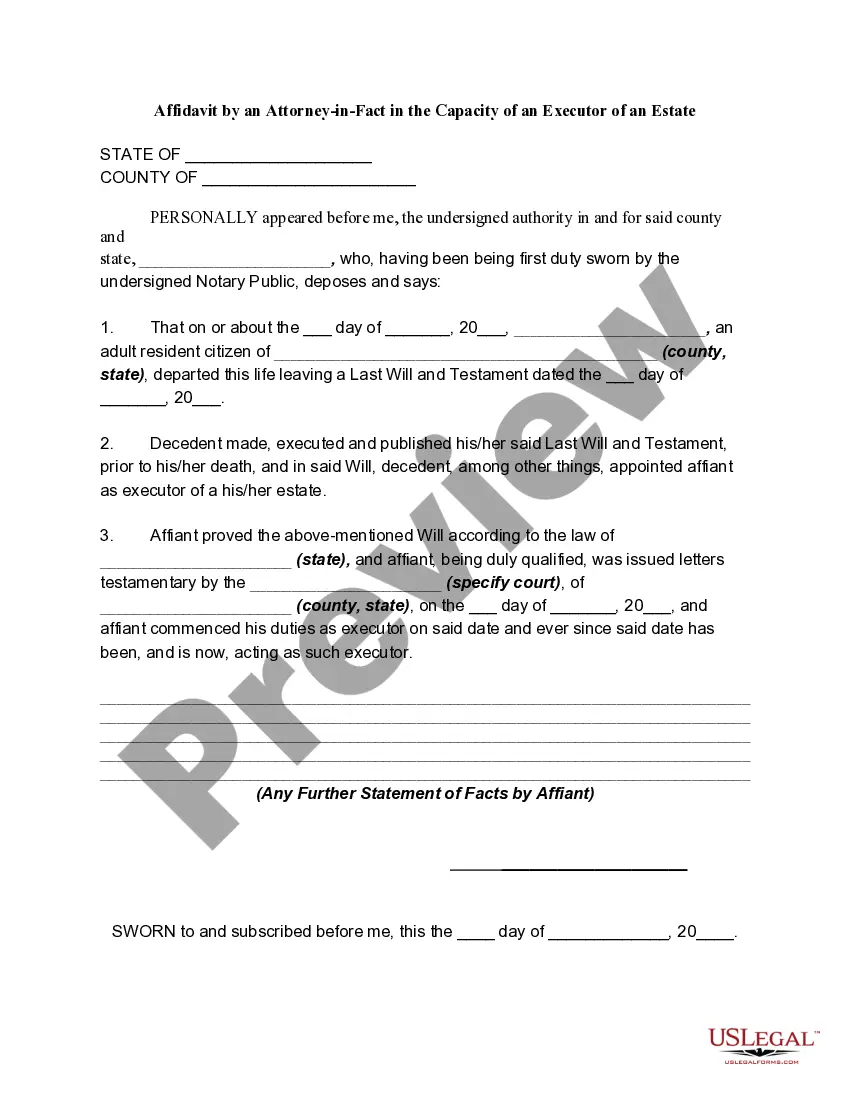
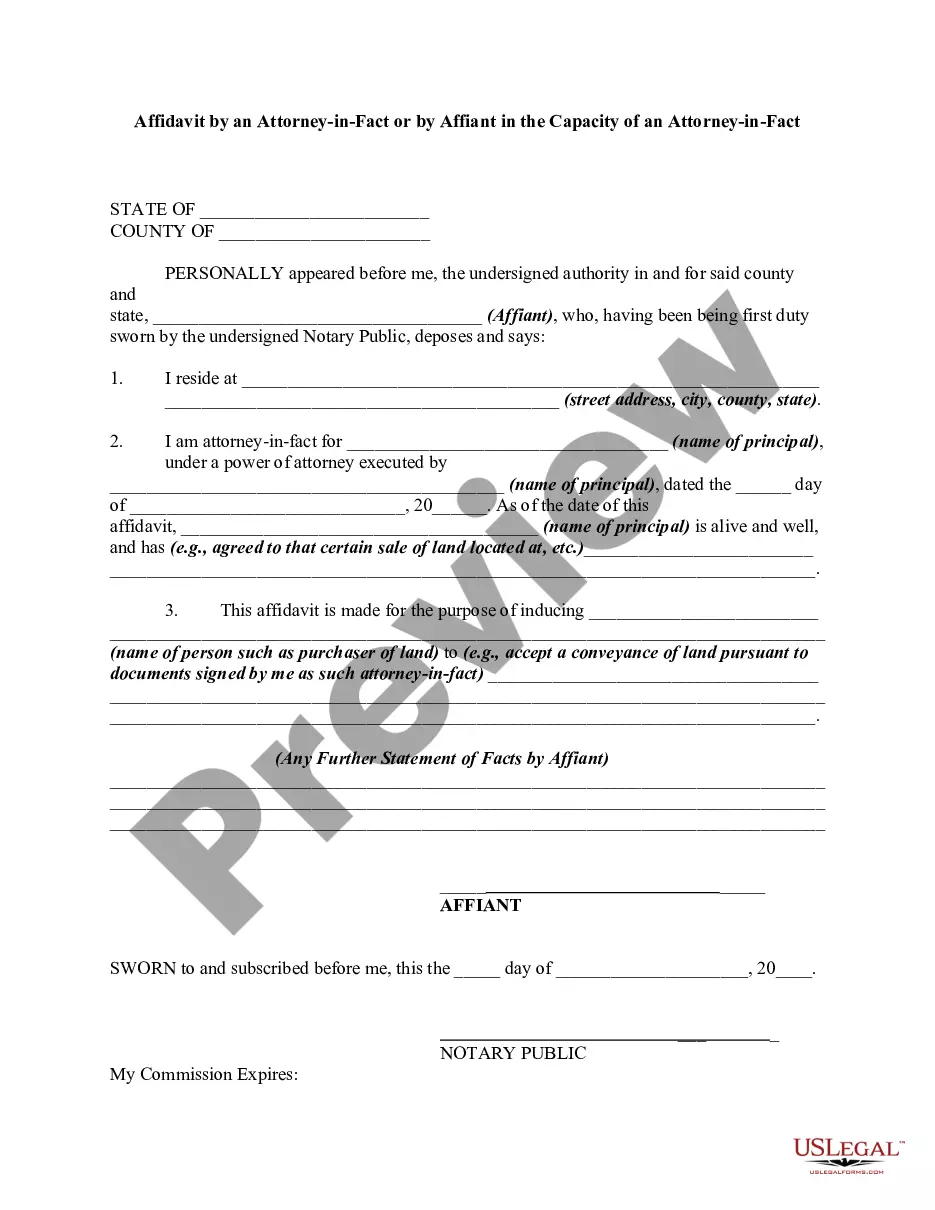
How to fill out Affidavit By An Attorney-in-Fact In The Capacity Of An Executor Of An Estate?
Gaining access to legal templates that comply with federal and state regulations is crucial, and the web provides a wealth of alternatives to choose from.
However, what is the purpose of spending time searching for the appropriately drafted Online Executor For Python example online if the expansive US Legal Forms library already consolidates such templates in one location.
US Legal Forms is the largest online legal directory, featuring over 85,000 customizable templates created by attorneys for various professional and personal situations.
Enjoy the broadest and easiest legal documentation service available!
- They are simple to navigate with all documents categorized by state and intended use.
- Our specialists stay updated with legal modifications, ensuring your documents are current and compliant when acquiring an Online Executor For Python from our site.
- Obtaining an Online Executor For Python is straightforward and efficient for both existing and new users.
- If you possess an account with an active subscription, Log In and retrieve the document sample you need in the desired format.
- If you are visiting our website for the first time, follow the steps outlined below.
Form popularity
FAQ
As of 2020, the Georgia code allows garnishments to last 1,095 days, and that law took effect on January 1, 2021. Before, wage garnishments could last about six months.
The answer is however much they need to take out of your account to cover the debt. For example, if you owe a $1,000.00 to a creditor and you have $1,000.00 in your checking account, they can take it all.
You will need the following forms: one Affidavit for Garnishment; one Summons of Garnishment; two copies of the Summons (one for the garnishee, the other for the Debtor Defendant); and two Marshall's Entry of Service sheets (one for the garnishee, one for the Debtor Defendant).
To file an exemption for wage garnishment, you must file the Claim of Exemption (WG-006). By doing this, you will explain to the Sheriff why some or all of the wages the creditor wants your employer to garnish should be exempt. Wage garnishment and bankruptcy are not for everyone to handle.
State and federal law protects some money, including wages, from garnishment even if it is in a bank. Some common exemptions are benefits from social security, supplemental security income, unemployment, workers' compensation, the Veterans' Administration, state pension, retirement funds, and disability income.
The creditor files garnishment paperwork with the court and serves your employer. Once a creditor has a judgment it's called a judgment creditor. The judgment creditor then files an Affidavit of Continuing Garnishment for Wages with a Georgia court and serves this paperwork on your employer ? called the garnishee.
The claim can be filed at any time and must be based on either: (1) that the plaintiff does not have a judgment against the defendant; (2) that the plaintiff's affidavit of garnishment is untrue or legally insufficient (left out a required element, did not identify the defendant or property properly, or listed an ...
In Georgia, a creditor can garnish the lesser of 25% of your disposable income or the amount by which your disposable earnings exceed 30% of federal minimum wage. If your disposable income is less than 30 times minimum wage, it cannot be garnished at all.