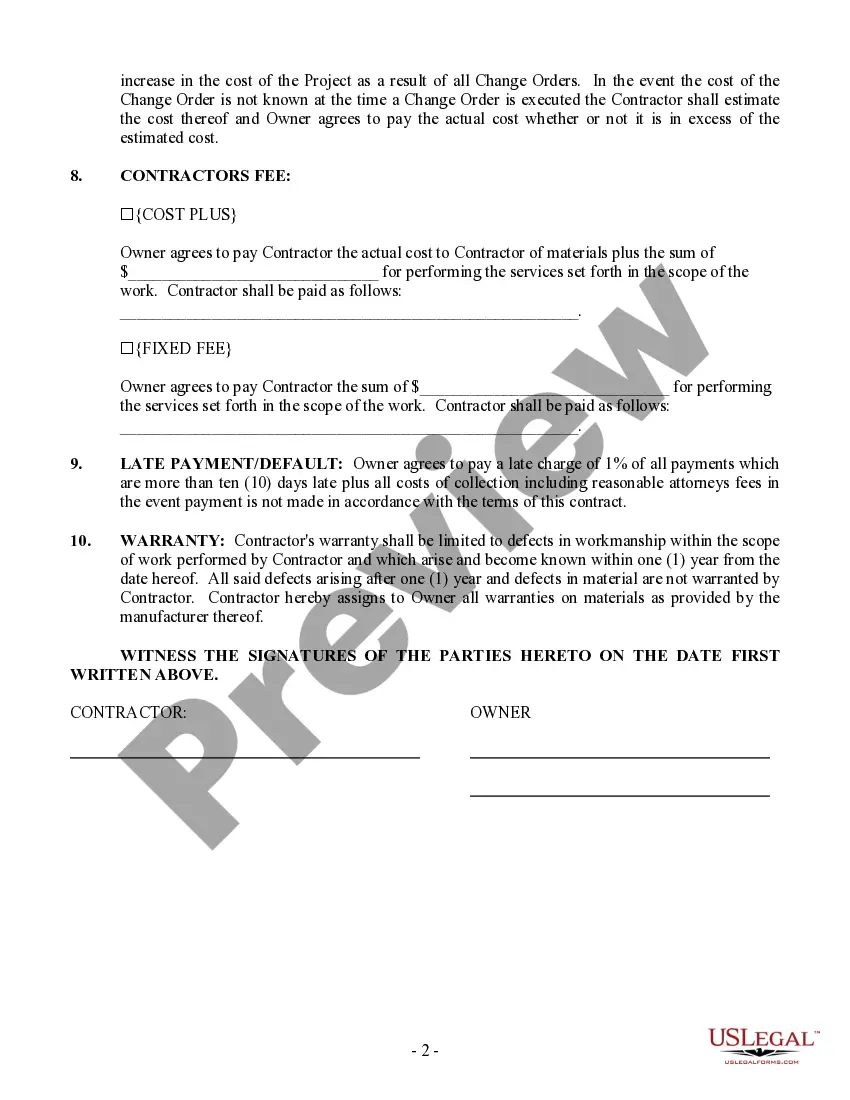
Contract Contractor Building For Residential In Ohio
Description



Form popularity
FAQ
A legally enforceable contract must include an offer, acceptance, consideration, capacity, legality, and mutual assent.
Lesson Summary. A contract is a legal agreement between two or more parties in which they agree to each other's rights and responsibilities. Offer, acceptance, awareness, consideration, and capacity are the five elements of an enforceable contract.
How to Write a Contractor Agreement Outline Services Provided. The contractor agreement should list all services the contractor will provide. Document Duration of the Work. Specify the duration of the working relationship. Outline Payment Terms. Outline Confidentiality Agreement. Consult with a Lawyer.
To be legally enforceable, an agreement must contain all of the following criteria: An offer and acceptance; Certainty of terms; Consideration; An intention to create legal relations; Capacity of the parties; and, Legality of purpose.
The state of Ohio does not require a specific handyman license to perform minor repair work on residential property.
Without a specialty contractor or general contractor license, a handyman can only perform basic projects such as painting and basic repairs. In some cities in Ohio, regulations prevent unlicensed handyman professionals from charging more than $1,000 per job and working on commercial properties.
The Ohio Construction Industry Licensing Board (OCILB) is a part of the Division of Industrial Compliance and is responsible for issuing licenses to qualified Electrical, Heating Ventilating and Air Conditioning (HVAC), Plumbing, Hydronics and Refrigeration Contractors who successfully pass the PSI licensing ...
However, general electrical work in Ohio does not require licensing. Specifically, only commercial contractors in Ohio need a license to work.
You can verify your prospective contractor's license status using the OCILB's lookup licensee information page. Note that there are no statewide licensing requirements for general contractors. Instead, these contractors obtain their licenses from the local government authorities in their respective areas of residence.
The Ohio Construction Industry Licensing Board (OCILB) issues licenses to qualified electrical, Heating Ventilating and Air Conditioning (HVAC), plumbing, hydronics and refrigeration contractors who successfully pass the PROV licensing examination.
