Construction Contracts Oregon For Public In Ohio
Description


Get your form ready online
Our built-in tools help you complete, sign, share, and store your documents in one place.
Make edits, fill in missing information, and update formatting in US Legal Forms—just like you would in MS Word.
Download a copy, print it, send it by email, or mail it via USPS—whatever works best for your next step.
Sign and collect signatures with our SignNow integration. Send to multiple recipients, set reminders, and more. Go Premium to unlock E-Sign.
If this form requires notarization, complete it online through a secure video call—no need to meet a notary in person or wait for an appointment.
We protect your documents and personal data by following strict security and privacy standards.

Make edits, fill in missing information, and update formatting in US Legal Forms—just like you would in MS Word.

Download a copy, print it, send it by email, or mail it via USPS—whatever works best for your next step.

Sign and collect signatures with our SignNow integration. Send to multiple recipients, set reminders, and more. Go Premium to unlock E-Sign.

If this form requires notarization, complete it online through a secure video call—no need to meet a notary in person or wait for an appointment.

We protect your documents and personal data by following strict security and privacy standards.
Looking for another form?






Form popularity
FAQ
Today, many industry-standard construction contracts contain a “correction period,” which is a period of time (typically one year) following final project completion during which an owner may require the contractor to return to the job site and correct defective work at the contractor's expense.
In Ohio, for a contract to be legally enforceable, certain elements—like a valid offer, acceptance, and a meeting of the minds—must be present within the document or verbal agreement. These elements help ensure the enforceability of the contract and confirm the agreement is valid and binding under the law.
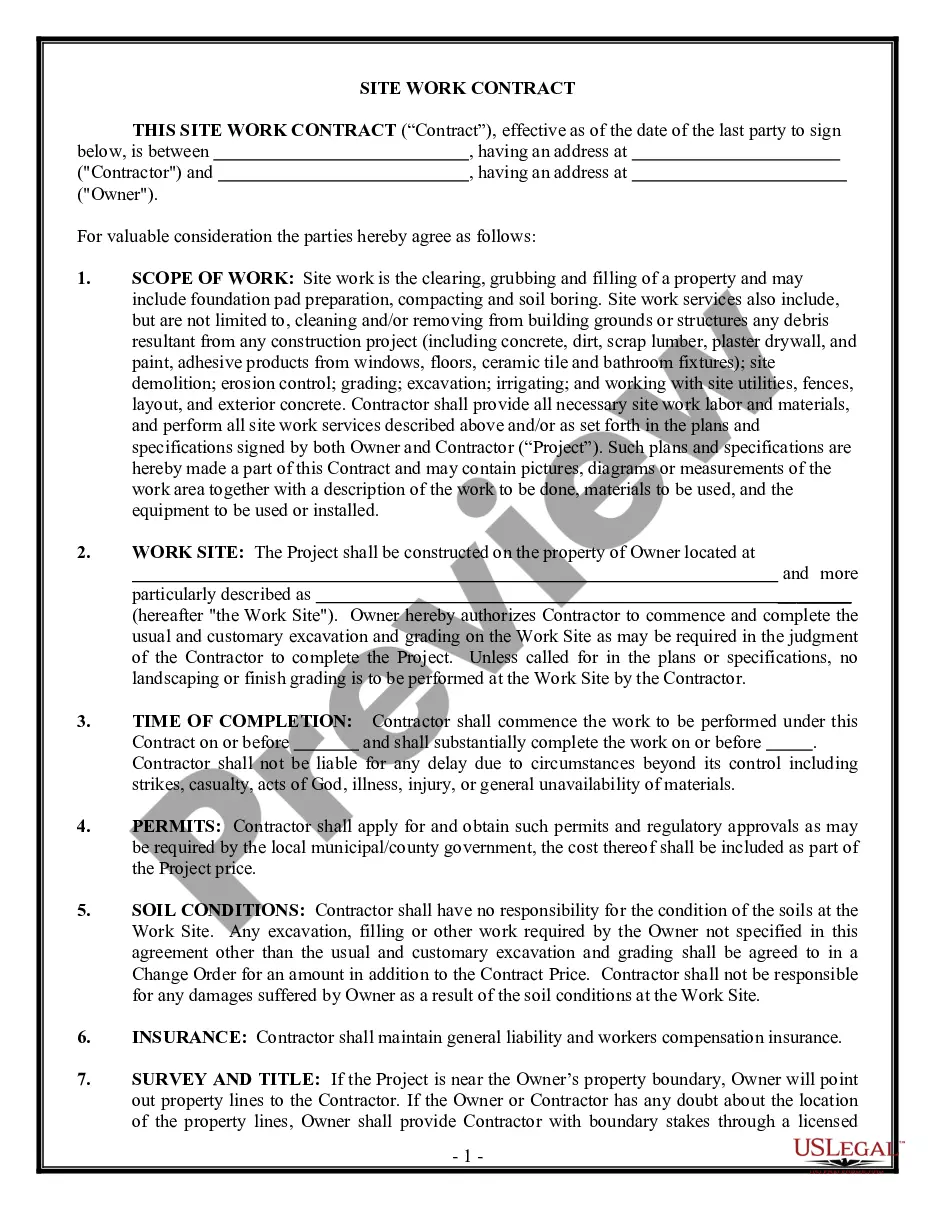
A construction contract is a mutual or legally binding agreement between two parties based on policies and conditions recorded in document form. The two parties involved are one or more property owners and one or more contractors.
Meet the state's minimum licensing requirements Candidates are 18 years of age or older. Candidates complete the licensing application. Candidates are U.S. citizens. Candidates have at least three years of general or specialized contracting experience in their industry.
To become a general contractor in Oregon, you must complete the required pre-license training. In order to obtain your Construction Contractors Board (CCB) license, you must be at least 18 years old and have completed 16 hours of training on law and business practices. You must also pass an Oregon State test.
The Ohio Contractor Licensing Law (ORC 4740), requires building and health departments who have a registration in place to require the State License before issuing commercial permits. All local building and health departments regulate residential contractors.
The Ohio Construction Industry Licensing Board (OCILB) issues licenses to qualified electrical, Heating Ventilating and Air Conditioning (HVAC), plumbing, hydronics and refrigeration contractors who successfully pass the PROV licensing examination.
If you are applying to be a Home Improvement General Contractor, you need to pass the Ohio Home Improvement Contractor 767 exam and get at least 70% on it. The test will have two different parts. The first part is on Business and Law. The second part is on the topic of the specific kind of license you wish to obtain.
Oregon Contractor Licensing Guide Complete pre-license training and take an examination. Determine your endorsement type. Register your business. Provide proof of insurance and bonds. Complete an application.
