Contract Contractor Building Without Permit Consequences In North Carolina
Description

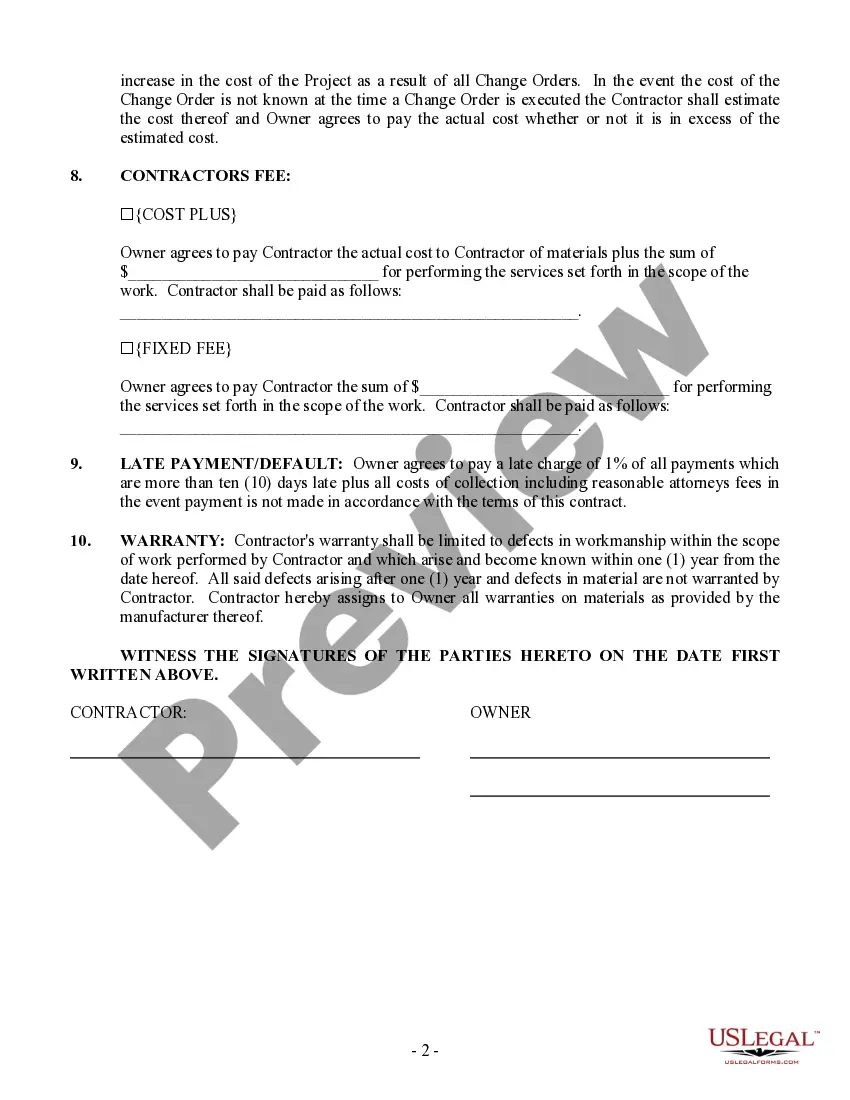
Get your form ready online
Our built-in tools help you complete, sign, share, and store your documents in one place.
Make edits, fill in missing information, and update formatting in US Legal Forms—just like you would in MS Word.
Download a copy, print it, send it by email, or mail it via USPS—whatever works best for your next step.
Sign and collect signatures with our SignNow integration. Send to multiple recipients, set reminders, and more. Go Premium to unlock E-Sign.
If this form requires notarization, complete it online through a secure video call—no need to meet a notary in person or wait for an appointment.
We protect your documents and personal data by following strict security and privacy standards.

Make edits, fill in missing information, and update formatting in US Legal Forms—just like you would in MS Word.

Download a copy, print it, send it by email, or mail it via USPS—whatever works best for your next step.

Sign and collect signatures with our SignNow integration. Send to multiple recipients, set reminders, and more. Go Premium to unlock E-Sign.

If this form requires notarization, complete it online through a secure video call—no need to meet a notary in person or wait for an appointment.

We protect your documents and personal data by following strict security and privacy standards.
Looking for another form?



Form popularity
FAQ
You can also request a complaint form by calling the Licensing Board at 919-571-4183. If the complaint request demonstrates it falls within the jurisdictional authority of the Board, a formal complaint form will be sent.
It depends on the local codes. The International Residential Code (IRC) allows you to build an accessory structure up to 200 square feet without a permit. Roughly 12 x 16 or 10x20 for example. Section R105.
Work Not Requiring A Permit Asphalt or gravel driveways. Awnings (wall mounted only) Exterior work under $15000 - Non Structural Only. Interior work under $15000 - Non Structural Only. Non-residential farm buildings. Non-structural slab (no footers for future building construction) Painting private residences.
A building permit is not required for a detached accessory structure as long as the structure does not exceed twelve feet (12') in ANY dimension. This means if the building is only 10 feet wide by 12 feet long by 11 feet tall, a building permit will not be required (A zoning permit may still be required).
In NC, you can do those a homeowner even if you aren't licensed (though the work still has to be up to code), as long as you occupy the house for at least a year afterwards. It's not always the best idea depending on the homeowner's skill level, but it is legal.
In addition, the statutes give the Board authority to enjoin unlicensed practice. What this means is that when the Board discovers that an unlicensed person or company is engaging in conduct that requires a license, it can file a lawsuit to stop that conduct.
In North Carolina, the statute of limitations for most construction disputes, such as breach of contract or implied warranty of plans, is generally three years from the date when the claimant knows or should know they have a claim.
North Carolina imposes no specific licensing requirement in order to file a valid mechanics lien.
You can also request a complaint form by calling the Licensing Board at 919-571-4183. If the complaint request demonstrates it falls within the jurisdictional authority of the Board, a formal complaint form will be sent.
