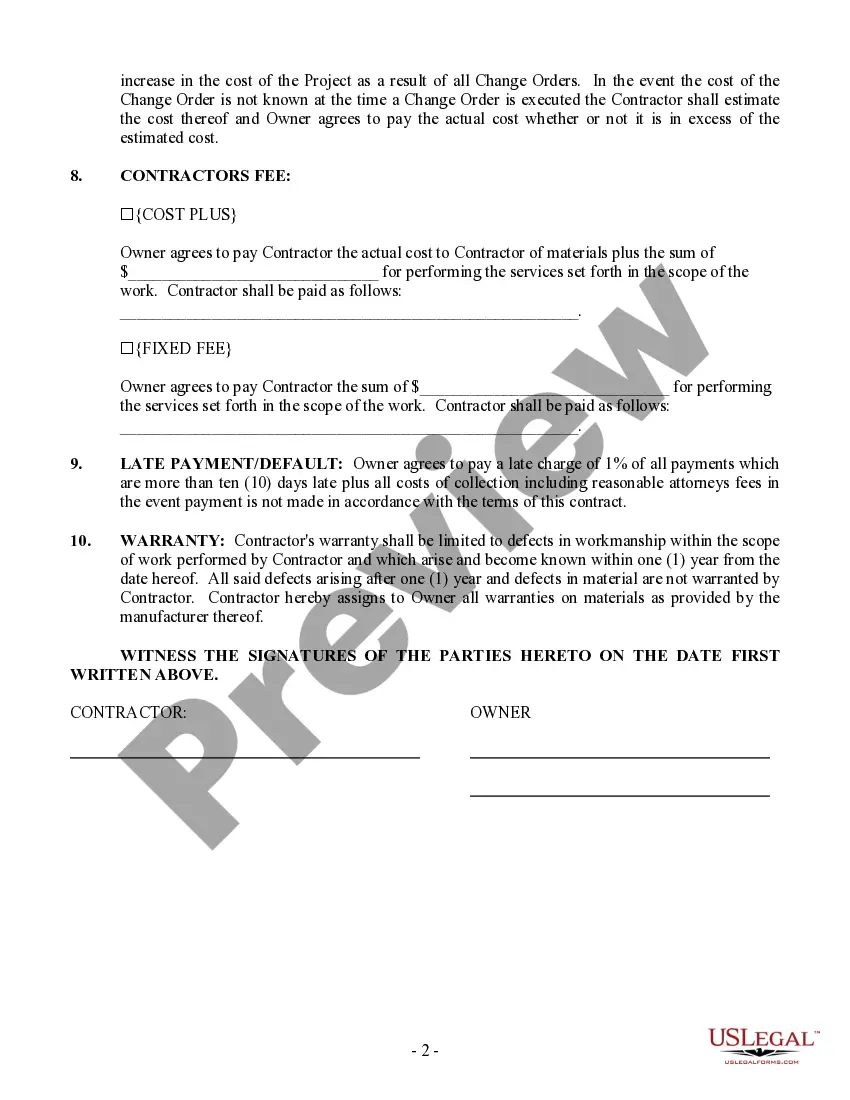
Construction Contract Cost Plus Withholding In Georgia
Description

Get your form ready online
Our built-in tools help you complete, sign, share, and store your documents in one place.
Make edits, fill in missing information, and update formatting in US Legal Forms—just like you would in MS Word.
Download a copy, print it, send it by email, or mail it via USPS—whatever works best for your next step.
Sign and collect signatures with our SignNow integration. Send to multiple recipients, set reminders, and more. Go Premium to unlock E-Sign.
If this form requires notarization, complete it online through a secure video call—no need to meet a notary in person or wait for an appointment.
We protect your documents and personal data by following strict security and privacy standards.

Make edits, fill in missing information, and update formatting in US Legal Forms—just like you would in MS Word.

Download a copy, print it, send it by email, or mail it via USPS—whatever works best for your next step.

Sign and collect signatures with our SignNow integration. Send to multiple recipients, set reminders, and more. Go Premium to unlock E-Sign.

If this form requires notarization, complete it online through a secure video call—no need to meet a notary in person or wait for an appointment.

We protect your documents and personal data by following strict security and privacy standards.
Looking for another form?



Form popularity
FAQ
A BILL to be entitled an Act to amend Article 2 of Chapter 10 of Title 13 of the Official Code of Georgia Annotated, relating to retention of contractual payments and creation of escrow accounts on contracts for installation, improvement, maintenance, or repair of water or sewer facilities, so as to change certain ...
For example, ing to retainage rules in California, state law caps retainage at 5% prior to completion and acceptance of the project. On private construction projects in Taxes, the property owner must retain 10%. You need to consult to see what the rules are in your state.
The AB5 law requires companies to use a 3-point ABC test to determine whether a worker is an independent contractor or an employee. If a worker fails to meet the ABC test criteria, they are considered an employee and must be treated as such under the law.
(A) Retainage to a maximum of 5 percent of each progress payment. At the discretion of the owner and with the approval of the contractor, the retainage of each subcontractor may be released separately as the subcontractor completes his or her work.
UCC's Applicability to the Construction Industry In general, the majority of construction contracts lean towards being service-oriented and are typically governed by common law instead of the UCC, mainly because the emphasis on services often surpasses that on goods.
The current sales tax rate at the construction location is 7.00 percent (4.00% state and 3% county). Section 48-8-30(a) imposes the 4% state sales tax on all sales of tangible personal property and on those services specifically enumerated in the law. Absent a specific tax exemption, all sales of property are taxable.
Itemized charges made for repair labor or installation labor are not subject to sales tax. O.C.G.A. §§ 48-8-2(34)(B)(iv), 48-8-3(23).
All property in Georgia is taxed at an assessment rate of 40% of its full market value. Exemptions, such as a homestead exemption, reduce the taxable value of your property.
A construction contract is a mutual or legally binding agreement between two parties based on policies and conditions recorded in document form. The two parties involved are one or more property owners and one or more contractors.
To constitute a valid contract, there must be parties able to contract, a consideration moving to the contract, the assent of the parties to the terms of the contract, and a subject matter upon which the contract can operate.
