Corporate Status Vs S Corporation Status In Queens
Description


Get your form ready online
Our built-in tools help you complete, sign, share, and store your documents in one place.
Make edits, fill in missing information, and update formatting in US Legal Forms—just like you would in MS Word.
Download a copy, print it, send it by email, or mail it via USPS—whatever works best for your next step.
Sign and collect signatures with our SignNow integration. Send to multiple recipients, set reminders, and more. Go Premium to unlock E-Sign.
If this form requires notarization, complete it online through a secure video call—no need to meet a notary in person or wait for an appointment.
We protect your documents and personal data by following strict security and privacy standards.

Make edits, fill in missing information, and update formatting in US Legal Forms—just like you would in MS Word.

Download a copy, print it, send it by email, or mail it via USPS—whatever works best for your next step.

Sign and collect signatures with our SignNow integration. Send to multiple recipients, set reminders, and more. Go Premium to unlock E-Sign.

If this form requires notarization, complete it online through a secure video call—no need to meet a notary in person or wait for an appointment.

We protect your documents and personal data by following strict security and privacy standards.
Looking for another form?








Form popularity
FAQ
How to Start an S-Corp in New York Step 1 – Choose a name. Step 2 – Choose a registered agent. Step 3 – File Articles of Organization. Step 4 – Create an operating agreement. Step 5 – Apply for an EIN. Step 6 – Meet the New York LLC publication requirement. Step 7 – Apply for S Corp status with IRS Form 2553.
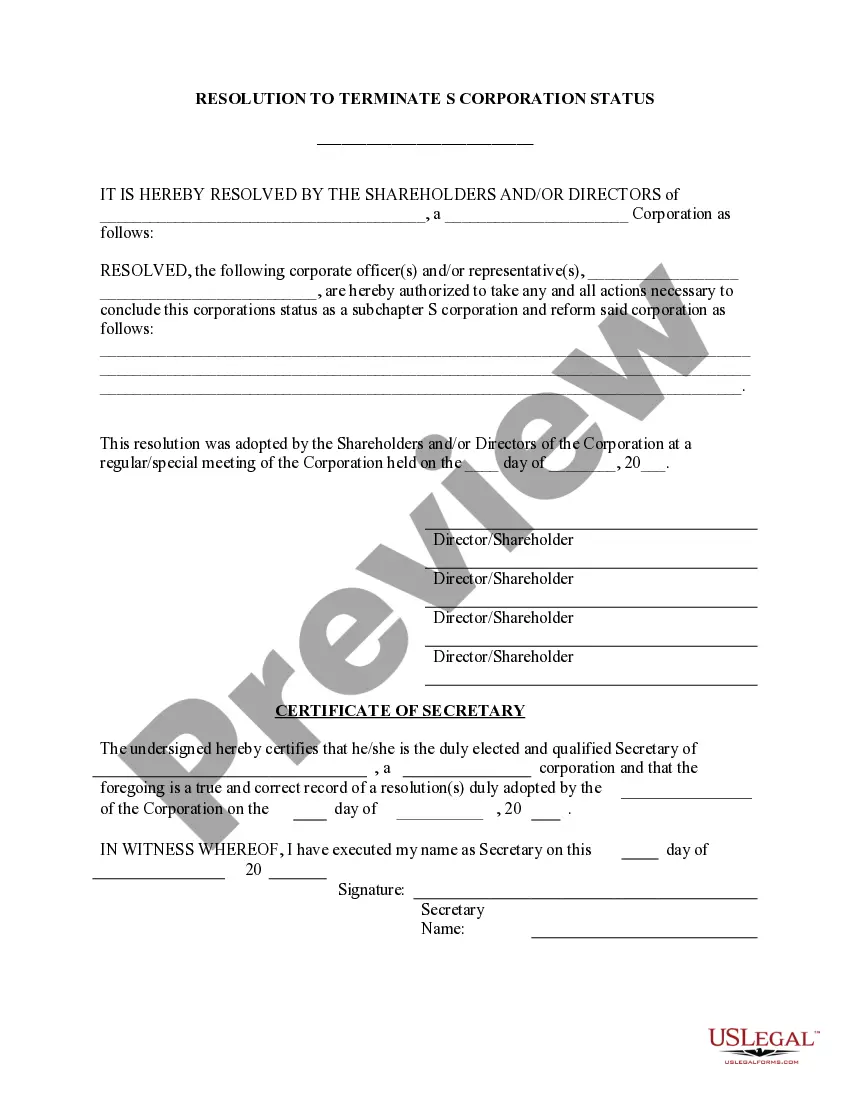
Please note New York City does not have an S corporation election and does not recognize a New York State S corporation election. In general, federal subchapter S corporations and qualified subchapter S subsidiaries are subject to the GCT.
To be taxed as an S corporation, you must convert your LLC into a traditional corporation (C corporation) with the state, and file IRS Form 2553 "Election as a Small Business Corporation" with the IRS. For your business to qualify as an S corporation, make sure it meets the IRS's specific guidelines.
The C corporation is the standard (or default) corporation under IRS rules. The S corporation is a corporation that has elected a special tax status with the IRS and therefore has some tax advantages. Both business structures get their names from the parts of the Internal Revenue Code that they are taxed under.
Every corporation, domestic or foreign, must have a Registered Agent with a registered office within the State of New York at all times.
If the shareholder(s) of an S corporation made an S election for federal purposes, New York State does not automatically treat the company as a New York S corporation unless they are mandated to file as an S corporation under Tax Law § 660(i).
We recommend converting to a C-Corp if a company wants to issue qualified small business stock and plans on selling its business in no less than five years.
The C corporation is the standard (or default) corporation under IRS rules. The S corporation is a corporation that has elected a special tax status with the IRS and therefore has some tax advantages. Both business structures get their names from the parts of the Internal Revenue Code that they are taxed under.
Names of corporations must end with either the identifier "Incorporated" or "Corp." If one of these identifiers is present, then the company is most likely a corporation.
