Caregiver Form Template For Employees In Travis
Description



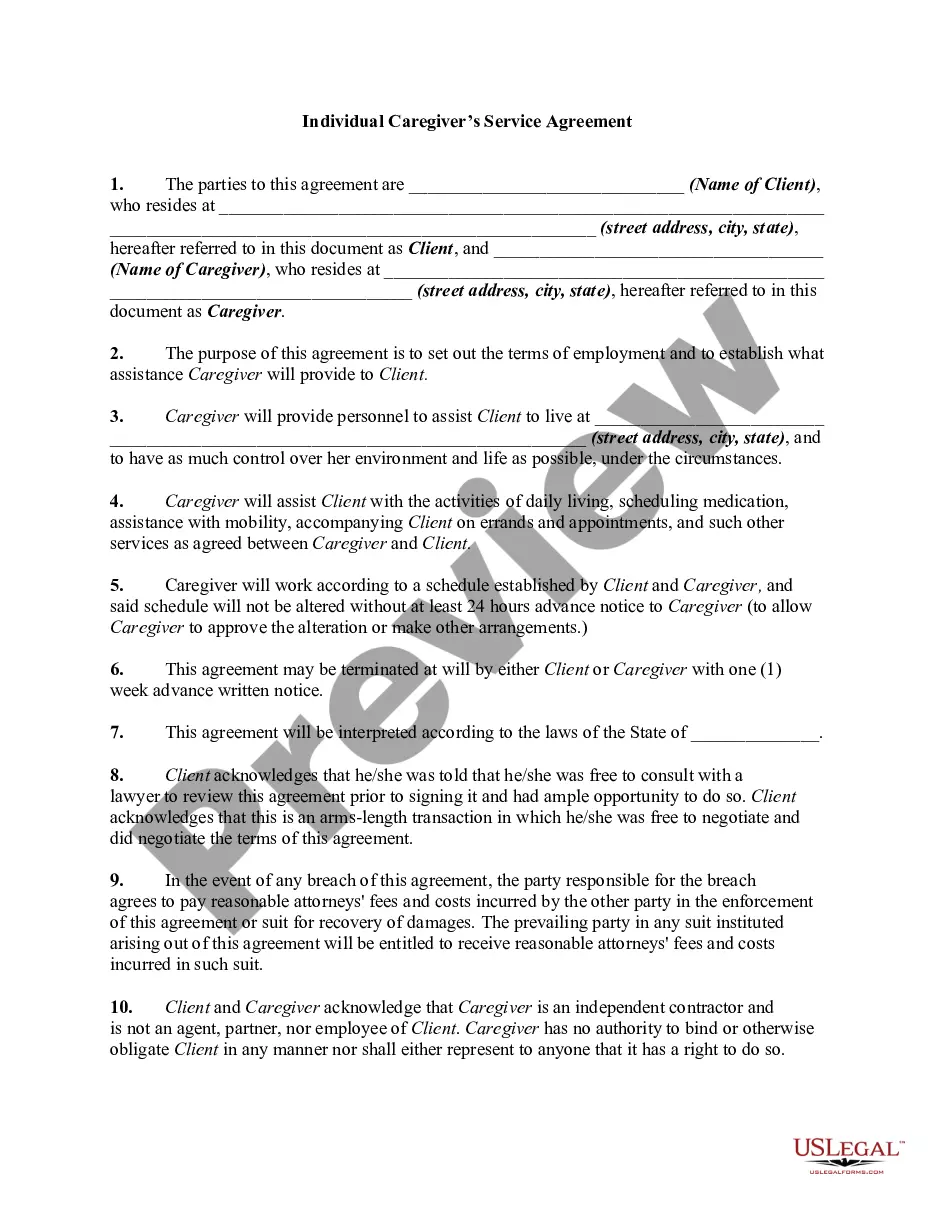


Get your form ready online
Our built-in tools help you complete, sign, share, and store your documents in one place.
Make edits, fill in missing information, and update formatting in US Legal Forms—just like you would in MS Word.
Download a copy, print it, send it by email, or mail it via USPS—whatever works best for your next step.
Sign and collect signatures with our SignNow integration. Send to multiple recipients, set reminders, and more. Go Premium to unlock E-Sign.
If this form requires notarization, complete it online through a secure video call—no need to meet a notary in person or wait for an appointment.
We protect your documents and personal data by following strict security and privacy standards.

Make edits, fill in missing information, and update formatting in US Legal Forms—just like you would in MS Word.

Download a copy, print it, send it by email, or mail it via USPS—whatever works best for your next step.

Sign and collect signatures with our SignNow integration. Send to multiple recipients, set reminders, and more. Go Premium to unlock E-Sign.

If this form requires notarization, complete it online through a secure video call—no need to meet a notary in person or wait for an appointment.

We protect your documents and personal data by following strict security and privacy standards.
Looking for another form?


Form popularity
FAQ
The measure contains five dimensions: personal and social restrictions, physical and emotional health, economic costs, value investment in caregiving, and the perception of the care recipient as provocateur. Items are scored on a 4-point scale (strongly agree, agree, disagree, strongly disagree).
Scoring is 2 points for each 'yes', 1 point for each 'sometimes', and 0 for each 'no' response. Scoring ranges from 26 to 0; a higher score indicates a higher level of caregiver strain (Travis et al., 2003; Thornton & Travis, 2003).
Scoring is 2 points for each 'yes', and 1 point for each 'sometimes' response. The higher the score, the higher the level of caregiver strain. VALIDITY AND RELIABILITY: Internal reliability coefficient is slightly higher (=. 90) than the coefficient originally reported for the CSI in 1983 (=.
To become a caregiver in Texas, you'll need to complete a training program, pass a background check, and meet certain health requirements. Some employers may also require CPR and First Aid certification.
The score is determined by adding up the “Yes” answers. A score of 7 or greater indicates a high level of stress. If score is 7 or greater – discuss, develop and prioritise support strategies with Carer.
A Caregiver Assessment is a systematic process of gathering information that describes a caregiving situation and identifies the particular problems, needs, resources and strengths of the family caregiver.
It is a self-administered instrument composed of 22 items scored on a Likert-type scale with 5 response options: never (0 points), rarely (1 point), sometimes (2 points), quite often (3 points), and almost always (4 points). Higher scores indicate greater caregiver burden.
Gerontologic health scientific literature identifies a number of scales to measure caregiver burden. The Zarit Scale of Caregiver Burden or the Zarit Burden Interview is the most widely used instrument. Originally designed and tested in 1980 containing 29 items, it was reduced to 22 questions.
While everyone's needs are unique, a checklist can help ensure the caregiving family member does everything necessary to ensure the safety and well-being of their loved one.
A Caregiver's Authorization Affidavit is an official form based on California's recognition that adults who have minors living with them are “caregivers” who often want and need to take some responsibility for the minor's education and other care.
