Confidential Disclosure Agreement With In Orange
Description

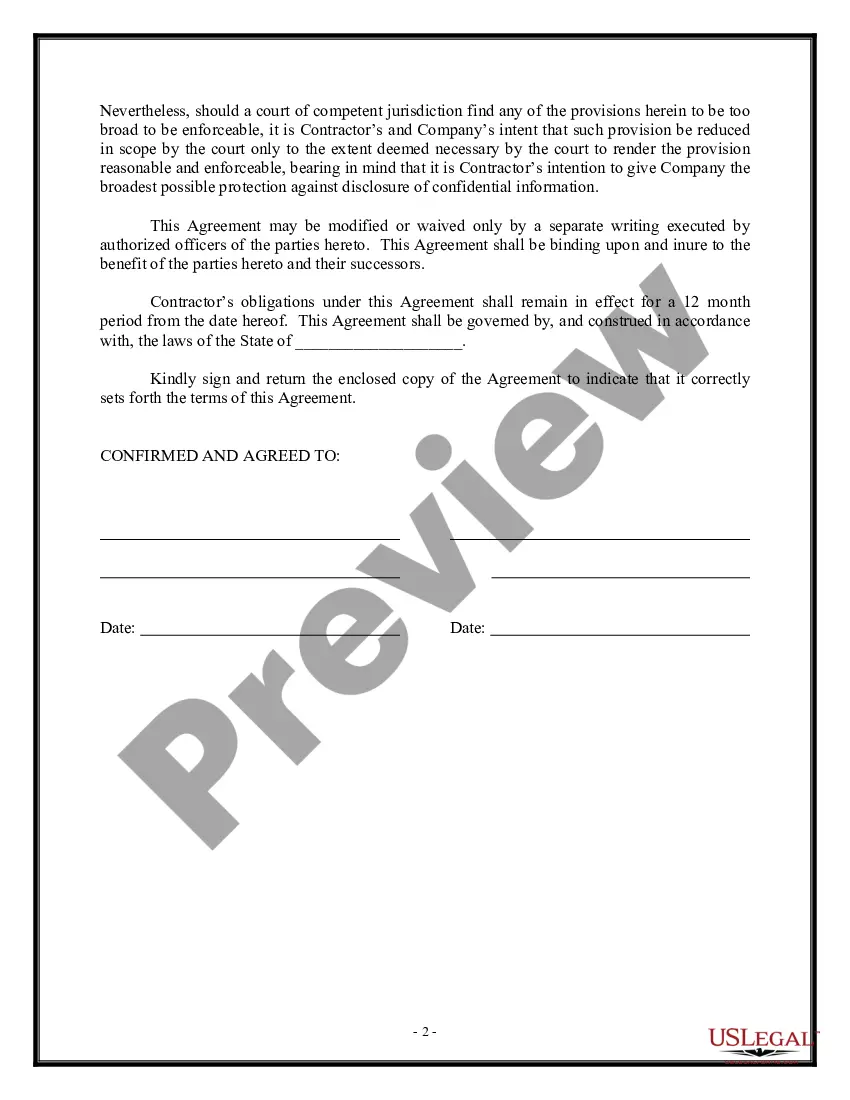
Get your form ready online
Our built-in tools help you complete, sign, share, and store your documents in one place.
Make edits, fill in missing information, and update formatting in US Legal Forms—just like you would in MS Word.
Download a copy, print it, send it by email, or mail it via USPS—whatever works best for your next step.
Sign and collect signatures with our SignNow integration. Send to multiple recipients, set reminders, and more. Go Premium to unlock E-Sign.
If this form requires notarization, complete it online through a secure video call—no need to meet a notary in person or wait for an appointment.
We protect your documents and personal data by following strict security and privacy standards.

Make edits, fill in missing information, and update formatting in US Legal Forms—just like you would in MS Word.

Download a copy, print it, send it by email, or mail it via USPS—whatever works best for your next step.

Sign and collect signatures with our SignNow integration. Send to multiple recipients, set reminders, and more. Go Premium to unlock E-Sign.

If this form requires notarization, complete it online through a secure video call—no need to meet a notary in person or wait for an appointment.

We protect your documents and personal data by following strict security and privacy standards.
Looking for another form?









Form popularity
FAQ
A Confidential Disclosure Agreement (CDA), also referred to as non-disclosure agreement (NDA) or secrecy agreement, is a legal agreement between a minimum of two parties which outlines information the parties wish to share with one another for certain evaluation purposes, but wish to restrict from wider use and ...
Limitations of NDAs Public interest: In some cases, there may be a public interest in disclosing certain information, such as in cases of illegal activity, public health and safety, or government transparency. NDAs cannot be used to prevent the disclosure of information that is in the public interest.
No matter its title, an NDA is a binding contract, commonly used when two or more parties wish to enter into initial discussions about specific confidential processes, methods or technology, to consider a potential, future relationship, and to agree to restrict the usage and additional disclosure of the shared ...
At the top, there are three types, unilateral, bilateral, and multilateral NDAs. The rest of the specific NDA types fall under these three categories. Most are based on who has to sign the NDA. Not all NDAs are created equally, and they can only demand so much secrecy from strangers when compared to their employees.
In order to minimize the risk of information falling into the wrong hands, make sure to avoid the four common NDA traps below. Typos and Clerical Errors. Poorly Defining "Confidentiality" ... Not Defining Enforcement and Penalties. Having the Wrong Person Sign.
Definition: An NDA allows a party to communicate nonpublic information to another. A CDA allows multiple parties to handle information with utmost secrecy.
An NDA could be unenforceable if it is too broad, is not for a defined time period, covers information that is not confidential, or asks for illegal conduct.
The red flag of misuse is when you ask for an NDA for a pitch meeting, a meet and greet, or a job interview. If your idea can be stolen after meeting someone for an hour for the first time, causing you irreparable harm in market, it's probably not a very good idea, or you're a terrible business person.
Typically, a legal professional writing the NDA will complete these steps: Step 1 - Describe the scope. Which information is considered confidential? ... Step 2 - Detail party obligations. Step 3 - Note potential exclusions. Step 4 - Set the term. Step 5 - Spell out consequences.
I hereby undertake to treat as confidential all and any information that I receive while participating in the work of evaluating project proposals, to use this information solely for the purpose of evaluation of the proposals, not to disclose it to any third party and not to make it publicly available or accessible ...
