Confidentiality Disclosure Agreement In Clinical Research In Nevada
Description

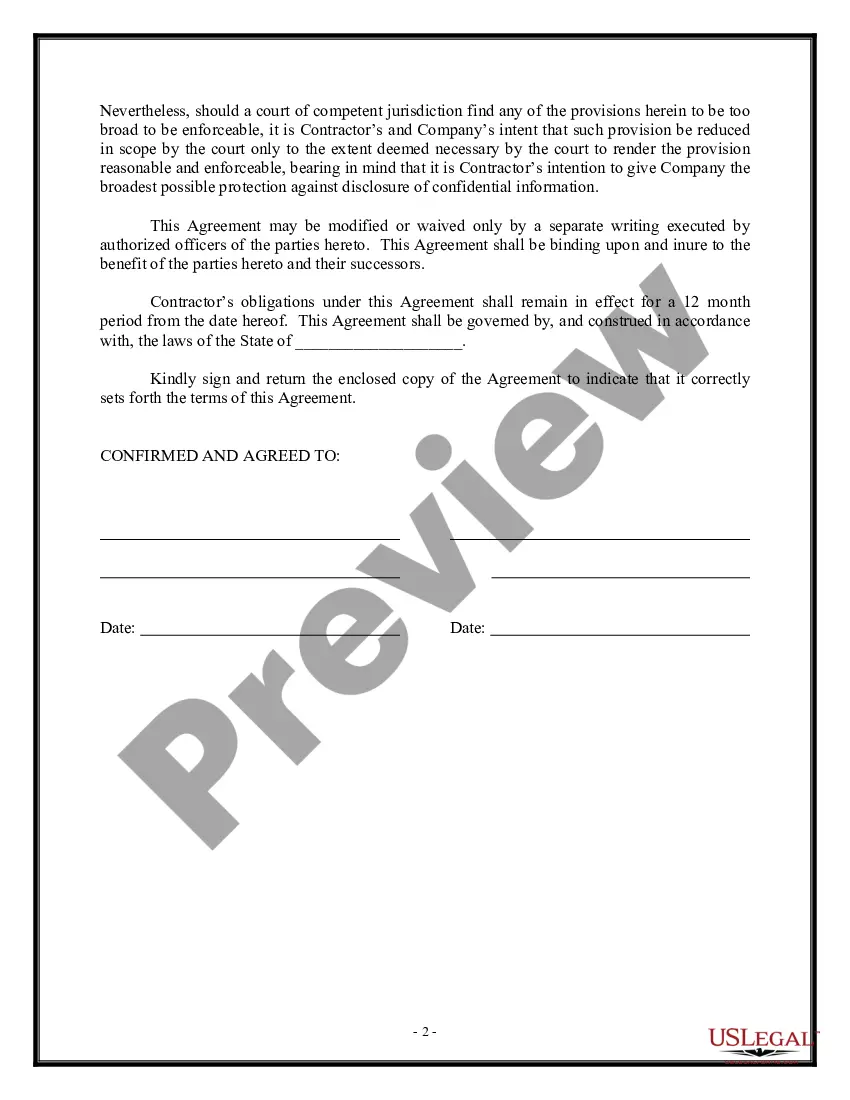
Get your form ready online
Our built-in tools help you complete, sign, share, and store your documents in one place.
Make edits, fill in missing information, and update formatting in US Legal Forms—just like you would in MS Word.
Download a copy, print it, send it by email, or mail it via USPS—whatever works best for your next step.
Sign and collect signatures with our SignNow integration. Send to multiple recipients, set reminders, and more. Go Premium to unlock E-Sign.
If this form requires notarization, complete it online through a secure video call—no need to meet a notary in person or wait for an appointment.
We protect your documents and personal data by following strict security and privacy standards.

Make edits, fill in missing information, and update formatting in US Legal Forms—just like you would in MS Word.

Download a copy, print it, send it by email, or mail it via USPS—whatever works best for your next step.

Sign and collect signatures with our SignNow integration. Send to multiple recipients, set reminders, and more. Go Premium to unlock E-Sign.

If this form requires notarization, complete it online through a secure video call—no need to meet a notary in person or wait for an appointment.

We protect your documents and personal data by following strict security and privacy standards.
Looking for another form?





Form popularity
FAQ
Ensure compliance with the six Data Protection Act Principles. This will include limiting any personal data collected to that which is genuinely required and taking positive steps to make sure that all personal data are held securely. Anonymise the results so that individual research participants cannot be identified.
Ensure that you cannot be overheard when discussing confidential matters. Challenge and verify where necessary the identity of any person who is making a request for person-identifiable or confidential information and ensure they have a need to know. Share only the minimum information necessary to achieve the purpose.
Methods for keeping data confidential range from using routine precautions, such as substituting codes for participant identifiers and storing data in locked cabinets, to more elaborate procedures involving statistical methods (e.g., error inoculation) or data encryption.
Researchers employ a number of methods to keep their subjects' identity confidential. Foremost, they keep their records secure through the use of password protected files, encryption when sending information over the internet, and even old-fashioned locked doors and drawers.
A client has a privilege to refuse to disclose, and to prevent any other person from disclosing, confidential communications among the client, the client's clinical professional counselor or any other person who is participating in the diagnosis or treatment under the direction of the clinical professional counselor.
Rule 1.6. Confidentiality of Information. (a) A lawyer shall not reveal information relating to representation of a client unless the client gives informed consent, the disclosure is impliedly authorized in order to carry out the representation, or the disclosure is permitted by paragraphs (b) and (d).
Confidentiality refers to mechanisms that ensure that only authorized individuals may access secure information. Cryptography and Encryption are examples of methods used to ensure confidentiality of data.
In academic research confidentiality agreements are frequently used between researchers and members of their research team (e.g. translators, transcribers, student employees) who may be privy to confidential and/or sensitive information as part of their role in a research project.
7 Tips To Keeping Your Confidential Information Safe Establishing Data Security Protocols. Training Employees on Best Practices. Ensuring Third Parties Align with Data Security. Password Protection and Multifactor Authentication. Encryption Software. Electronic Document Signing. Restricting Access to Data.
Methods for keeping data confidential range from using routine precautions, such as substituting codes for participant identifiers and storing data in locked cabinets, to more elaborate procedures involving statistical methods (e.g., error inoculation) or data encryption.
