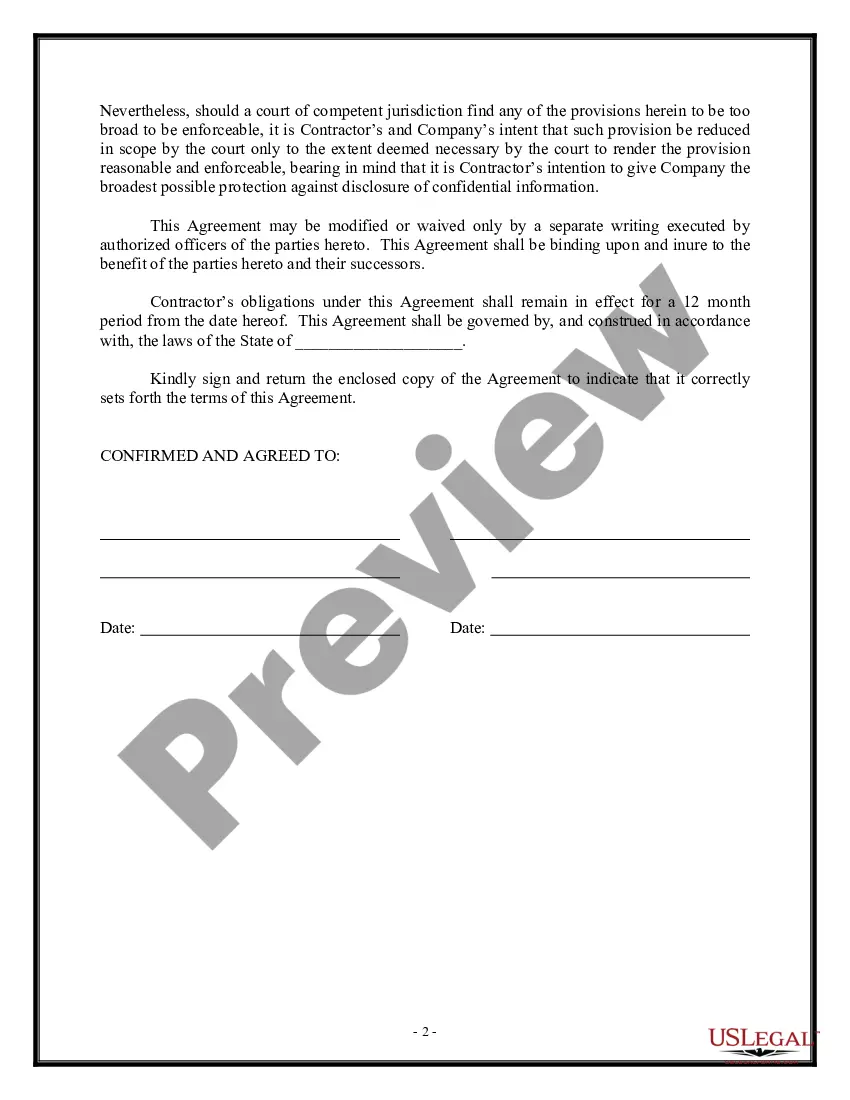
Non-disclosure Agreement Sample For Due Diligence In Maryland
Description

Get your form ready online
Our built-in tools help you complete, sign, share, and store your documents in one place.
Make edits, fill in missing information, and update formatting in US Legal Forms—just like you would in MS Word.
Download a copy, print it, send it by email, or mail it via USPS—whatever works best for your next step.
Sign and collect signatures with our SignNow integration. Send to multiple recipients, set reminders, and more. Go Premium to unlock E-Sign.
If this form requires notarization, complete it online through a secure video call—no need to meet a notary in person or wait for an appointment.
We protect your documents and personal data by following strict security and privacy standards.

Make edits, fill in missing information, and update formatting in US Legal Forms—just like you would in MS Word.

Download a copy, print it, send it by email, or mail it via USPS—whatever works best for your next step.

Sign and collect signatures with our SignNow integration. Send to multiple recipients, set reminders, and more. Go Premium to unlock E-Sign.

If this form requires notarization, complete it online through a secure video call—no need to meet a notary in person or wait for an appointment.

We protect your documents and personal data by following strict security and privacy standards.
Looking for another form?








Form popularity
FAQ
The primary purpose of an NDA is to ensure that proprietary information exchanged during the M&A due diligence process, such as financial information, business strategies, and customer, supplier and employee lists, remains confidential and is not disclosed to third parties.
Due diligence is the ability to demonstrate that a person did what could reasonably be expected under their circumstances, in order to satisfy a legal requirement. A due diligence defence depends on your ability to demonstrate the actions taken before an incident occurs, not after.
The key elements of Non-Disclosure Agreements: Identification of the parties. Definition of what is deemed to be confidential. The scope of the confidentiality obligation by the receiving party. The exclusions from confidential treatment. The term of the agreement.
Typically, a legal professional writing the NDA will complete these steps: Step 1 - Describe the scope. Which information is considered confidential? ... Step 2 - Detail party obligations. Step 3 - Note potential exclusions. Step 4 - Set the term. Step 5 - Spell out consequences.
At the top, there are three types, unilateral, bilateral, and multilateral NDAs. The rest of the specific NDA types fall under these three categories. Most are based on who has to sign the NDA. Not all NDAs are created equally, and they can only demand so much secrecy from strangers when compared to their employees.
What is the difference between a DPA and a NDA? A DPA (Data Processing Agreement) outlines terms for data processing, focusing on ensuring data protection and privacy compliance. An NDA (Non-Disclosure Agreement) is a contract where parties agree not to disclose confidential information they've shared with each other.
Non-Disclosure Agreements: Maryland In Maryland, courts determine the validity of NDAs under the same general principles used for other restrictive covenants, such as non-compete agreements and non-solicitation agreements.
To create a Non-Disclosure Agreement, include the following information: The parties' names and contact information. The length of the non-disclosure period. The scope and definition of the confidential information. The obligations of the Non-Disclosure Agreement. The ownership and return information.
