Non Disclosure Agreement Vs Confidentiality Agreement In Dallas
Description

Get your form ready online
Our built-in tools help you complete, sign, share, and store your documents in one place.
Make edits, fill in missing information, and update formatting in US Legal Forms—just like you would in MS Word.
Download a copy, print it, send it by email, or mail it via USPS—whatever works best for your next step.
Sign and collect signatures with our SignNow integration. Send to multiple recipients, set reminders, and more. Go Premium to unlock E-Sign.
If this form requires notarization, complete it online through a secure video call—no need to meet a notary in person or wait for an appointment.
We protect your documents and personal data by following strict security and privacy standards.

Make edits, fill in missing information, and update formatting in US Legal Forms—just like you would in MS Word.

Download a copy, print it, send it by email, or mail it via USPS—whatever works best for your next step.

Sign and collect signatures with our SignNow integration. Send to multiple recipients, set reminders, and more. Go Premium to unlock E-Sign.

If this form requires notarization, complete it online through a secure video call—no need to meet a notary in person or wait for an appointment.

We protect your documents and personal data by following strict security and privacy standards.
Looking for another form?







Form popularity
FAQ
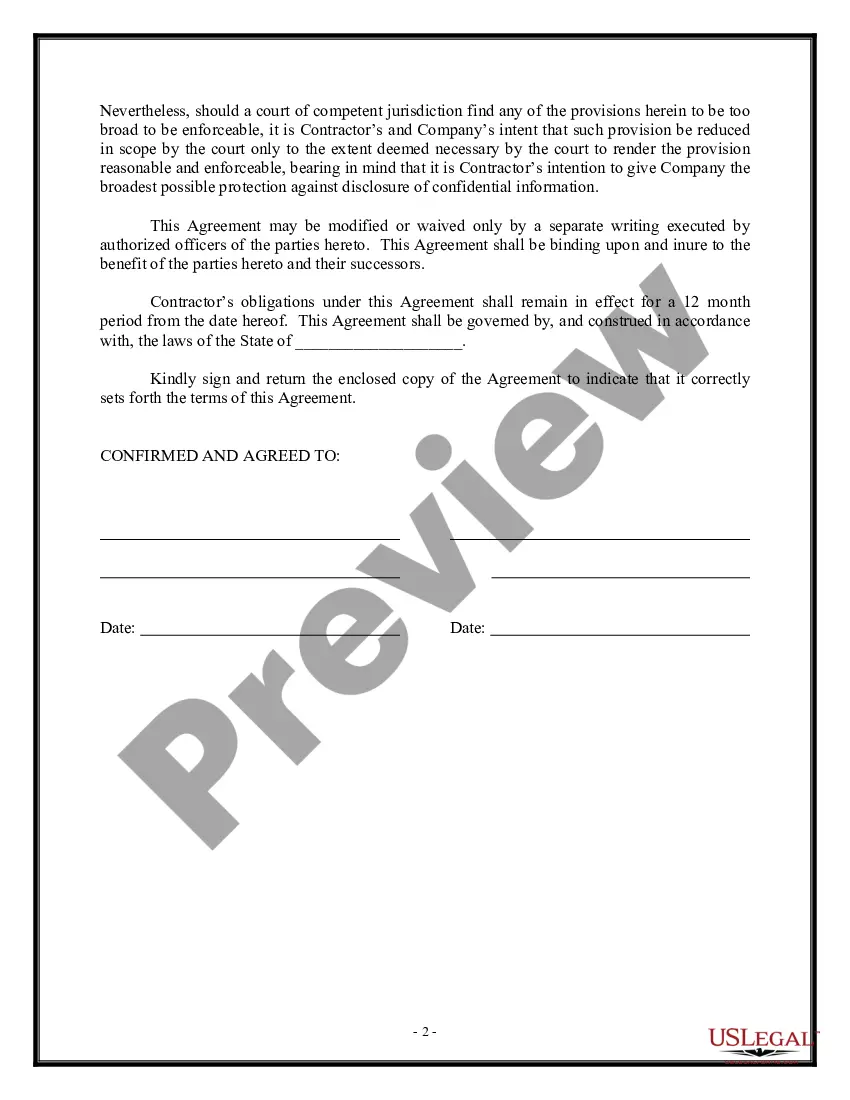
Completing the Confidentiality Agreement The "Receiving Party" is the person or company who receives the confidential information and is obligated to keep it secret. You'll need to fill in information specific to your circumstances in the spaces provided, such as the parties' names and addresses.
What is a nondisclosure agreement? Whereas confidentiality agreements are typically devised in employment or personal situations to protect sensitive information, NDAs are often used in business and legal settings to protect trade secrets, client lists, and financial data.
Under Texas law, a non-disclosure agreement is enforceable even if it is coupled with an unenforceable non compete agreement or invalid non-solicitation provision.
A confidentiality agreement (CA) (also known as Nondisclosure Agreement) is used when the owner of confidential information plans to disclose that information to another party and wishes the information to remain confidential.
As a general concept, non-disclosure agreements, often referred to as NDAs, are agreements between parties that are used to ensure that certain information will remain confidential.
Confidentiality Agreement is used when more secrecy is required. Non-disclosure implies you must not disclose personal or private information. However, keeping confidential implies you should be more proactive in making sure information is kept secret.
What is the difference between a DPA and a NDA? A DPA (Data Processing Agreement) outlines terms for data processing, focusing on ensuring data protection and privacy compliance. An NDA (Non-Disclosure Agreement) is a contract where parties agree not to disclose confidential information they've shared with each other.
Depending upon person and method of execution, a witness signature may be required for a deed to be valid. A deed, rather than a contract, should be used where there is a want of consideration (i.e. no quid pro quo). In the case of NDAs, even unilateral NDAs, consideration isn't usually a problem.
Generally, the types of documents that require a notary are those that have legal or financial significance. Some common types of documents that require notarization are as follows: Legal documents: Like affidavits and power of attorney forms.
