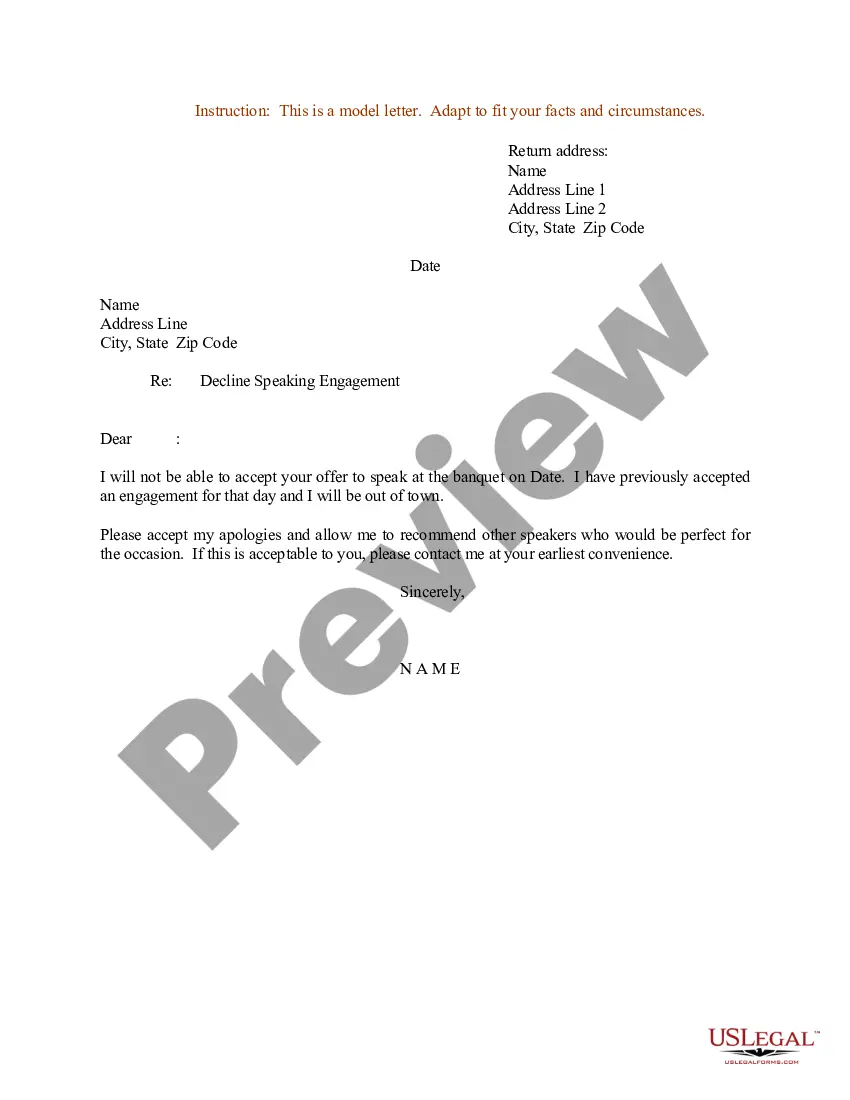
Letter Speaking Engagement With Meaning In Nevada
Description
Get your form ready online
Our built-in tools help you complete, sign, share, and store your documents in one place.
Make edits, fill in missing information, and update formatting in US Legal Forms—just like you would in MS Word.
Download a copy, print it, send it by email, or mail it via USPS—whatever works best for your next step.
Sign and collect signatures with our SignNow integration. Send to multiple recipients, set reminders, and more. Go Premium to unlock E-Sign.
If this form requires notarization, complete it online through a secure video call—no need to meet a notary in person or wait for an appointment.
We protect your documents and personal data by following strict security and privacy standards.

Make edits, fill in missing information, and update formatting in US Legal Forms—just like you would in MS Word.

Download a copy, print it, send it by email, or mail it via USPS—whatever works best for your next step.

Sign and collect signatures with our SignNow integration. Send to multiple recipients, set reminders, and more. Go Premium to unlock E-Sign.

If this form requires notarization, complete it online through a secure video call—no need to meet a notary in person or wait for an appointment.

We protect your documents and personal data by following strict security and privacy standards.
Looking for another form?









Form popularity
FAQ
Rule 1.10 - Imputation of Conflicts of Interest (a) While lawyers are associated in a firm, none of them shall knowingly represent a client when any one of them practicing alone would be prohibited from doing so by Rules 1.7, 1.9, or 2.2, unless the prohibition is based on a personal interest of the prohibited lawyer ...
Rule 3.3 requires candor toward the tribunal, and so prohibits making “a false statement of fact … to a tribunal ….” and offering “evidence that the lawyer knows to be false.” NRPC 3.3(a)(1), (a)(3).
Rule 7.1. Communications Concerning a Lawyer's Services. A communication is false or misleading if it contains a material misrepresentation of fact or law, or omits a fact necessary to make the statement considered as a whole not materially misleading.
In representing a client, a lawyer shall not communicate about the subject of the representation with a person the lawyer knows to be represented by another lawyer in the matter, unless the lawyer has the consent of the other lawyer or is authorized to do so by law or a court order.
Rule 1.4. Communication. (5) Consult with the client about any relevant limitation on the lawyer's conduct when the lawyer knows that the client expects assistance not permitted by the Rules of Professional Conduct or other law.
Rule 1.10 - Imputation of Conflicts of Interest (a) While lawyers are associated in a firm, none of them shall knowingly represent a client when any one of them practicing alone would be prohibited from doing so by Rules 1.7, 1.9, or 2.2, unless the prohibition is based on a personal interest of the prohibited lawyer ...
Rule 5.5 - Unauthorized Practice of Law (a)General rule. A lawyer shall not: (1) Practice law in a jurisdiction where doing so violates the regulation of the legal profession in that jurisdiction; or (2) Assist another person in the unauthorized practice of law.
Rule 5.5 - Unauthorized Practice of Law (a)General rule. A lawyer shall not: (1) Practice law in a jurisdiction where doing so violates the regulation of the legal profession in that jurisdiction; or (2) Assist another person in the unauthorized practice of law.

