Letter Speaking Engagement With Meaning In Franklin
Description
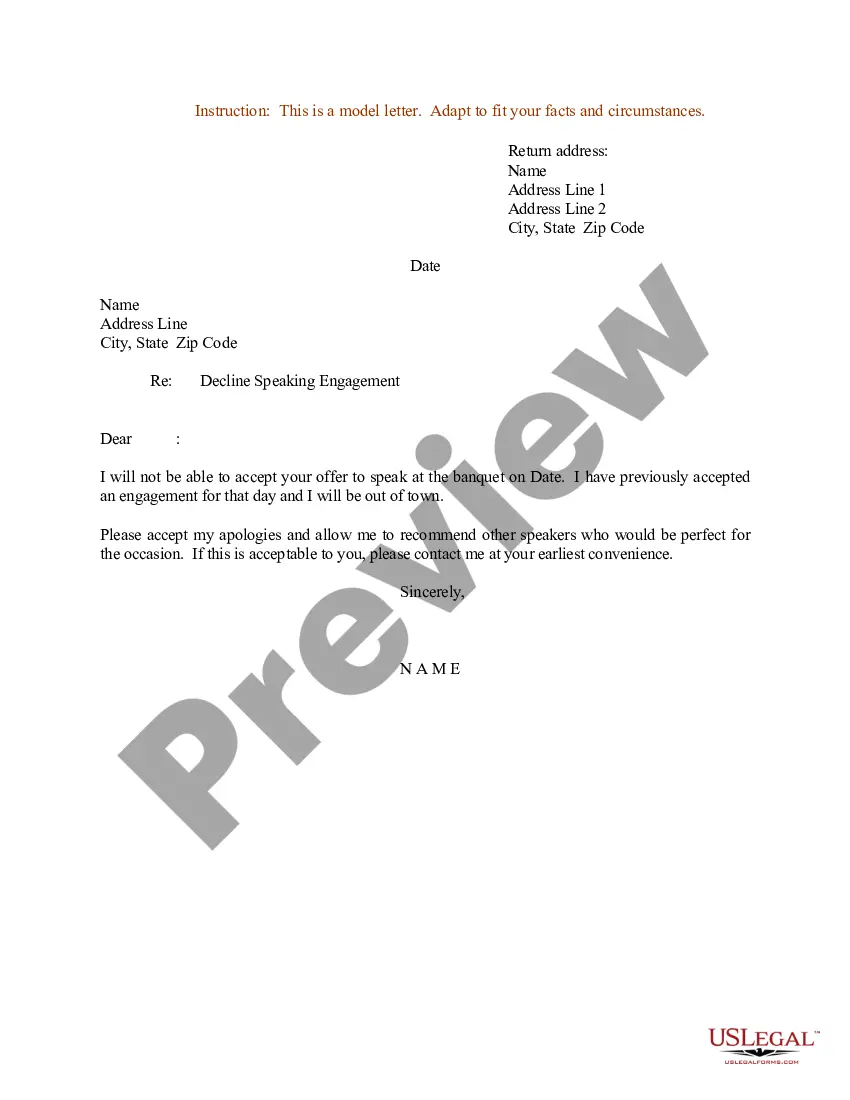
Get your form ready online
Our built-in tools help you complete, sign, share, and store your documents in one place.
Make edits, fill in missing information, and update formatting in US Legal Forms—just like you would in MS Word.
Download a copy, print it, send it by email, or mail it via USPS—whatever works best for your next step.
Sign and collect signatures with our SignNow integration. Send to multiple recipients, set reminders, and more. Go Premium to unlock E-Sign.
If this form requires notarization, complete it online through a secure video call—no need to meet a notary in person or wait for an appointment.
We protect your documents and personal data by following strict security and privacy standards.

Make edits, fill in missing information, and update formatting in US Legal Forms—just like you would in MS Word.

Download a copy, print it, send it by email, or mail it via USPS—whatever works best for your next step.

Sign and collect signatures with our SignNow integration. Send to multiple recipients, set reminders, and more. Go Premium to unlock E-Sign.

If this form requires notarization, complete it online through a secure video call—no need to meet a notary in person or wait for an appointment.

We protect your documents and personal data by following strict security and privacy standards.
Looking for another form?









Form popularity
FAQ
Fact #2: Franklin proposed the Albany Plan of Union in 1754, an early proposal to unite the American colonies. Ahead of his time, Franklin was looking to find a way to unite the disparate American colonies as early as the French and Indian War.
In these Sentiments, Sir, I agree to this Constitution, with all its Faults, if they are such: because I think a General Government necessary for us, and there is no Form of Government but what may be a Blessing to the People if well administred; and I believe farther that this is likely to be well administred for a ...
Explanation: The central idea of Benjamin Franklin's speech on the Constitutional Convention of September 17, 1787, is essentially his pragmatic acceptance of the Constitution, despite its possible flaws, because he believes it to be the best possible option given the circumstances.
Roosevelt, in his speech, attempted to convince the American people and Congress to follow his plan for the Great Depression. To do so he first compared the Great Depression to a war.
The "Day of Infamy" speech, sometimes referred to as the Infamy speech, was a speech delivered by Franklin D. Roosevelt, the 32nd president of the United States, to a joint session of Congress on December 8, 1941.
The motto of war is: "Let the strong survive; let the weak die." The motto of peace is: "Let the strong help the weak to survive." "The test of our progress is not whether we add more to the abundance of those who have much; it is whether we provide enough for those who have too little."
Thus that first historic sentence—the one that is usually quoted from the speech—was born: "Yesterday, December 7, 1941—a date which will live in infamy—the United States of America was suddenly and deliberately attacked by the naval and air forces of the Empire of Japan."
How to get speaking engagements Get clear on why you want to speak. Listen to a lot of talks from speakers that you admire. Come up with 3-5 talk ideas. Prepare an outline for each talk idea. Build your event list. Slide into event organizers' DMs. Email your pitch. Turn your outline into a speaker proposal.
Franklin Covey Co. (NYSE: FC), a global performance improvement company that creates, and on a subscription basis, distributes world-class content, training, processes, and tools that organizations and individuals use to achieve systemic changes in human behavior.
Franklin Covey Co., trading as FranklinCovey and based in Salt Lake City, Utah, is a coaching company which provides training and assessment services in the areas of leadership, individual effectiveness, and business execution for organizations and individuals.

