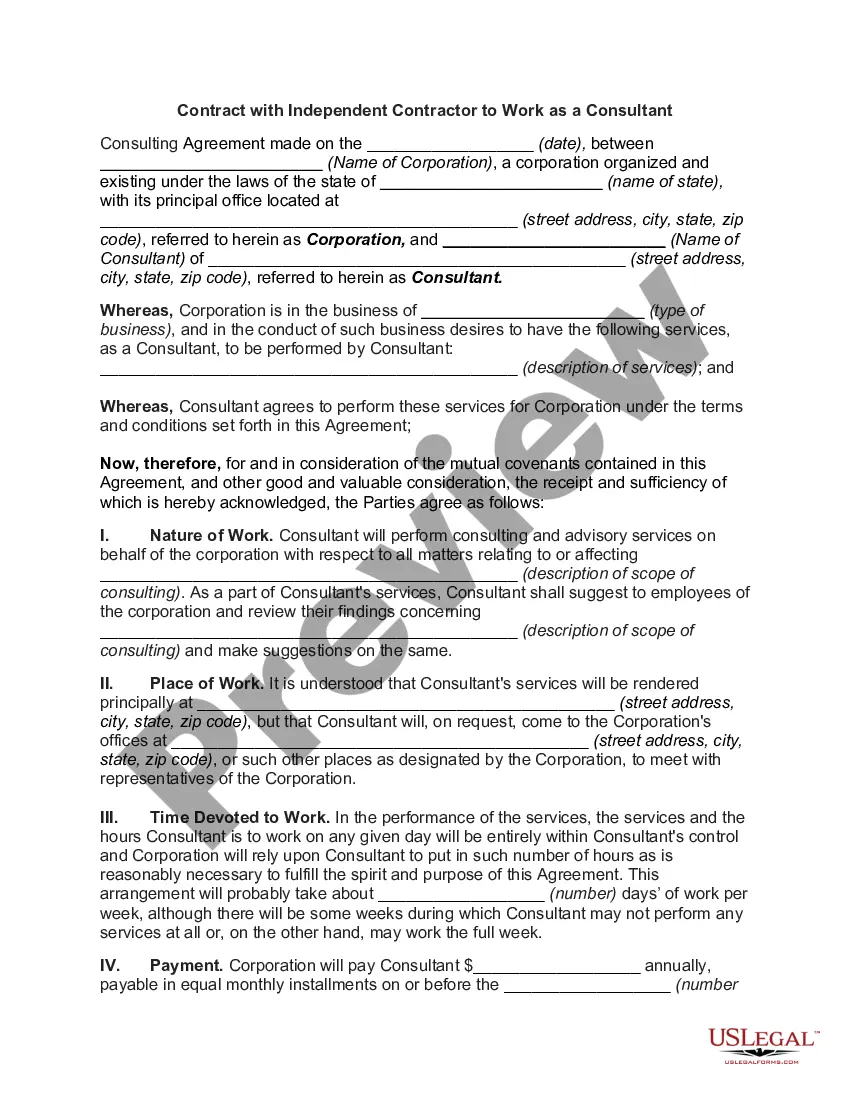
Consultant Work Contract For Accounting In Chicago
Description


Get your form ready online
Our built-in tools help you complete, sign, share, and store your documents in one place.
Make edits, fill in missing information, and update formatting in US Legal Forms—just like you would in MS Word.
Download a copy, print it, send it by email, or mail it via USPS—whatever works best for your next step.
Sign and collect signatures with our SignNow integration. Send to multiple recipients, set reminders, and more. Go Premium to unlock E-Sign.
If this form requires notarization, complete it online through a secure video call—no need to meet a notary in person or wait for an appointment.
We protect your documents and personal data by following strict security and privacy standards.

Make edits, fill in missing information, and update formatting in US Legal Forms—just like you would in MS Word.

Download a copy, print it, send it by email, or mail it via USPS—whatever works best for your next step.

Sign and collect signatures with our SignNow integration. Send to multiple recipients, set reminders, and more. Go Premium to unlock E-Sign.

If this form requires notarization, complete it online through a secure video call—no need to meet a notary in person or wait for an appointment.

We protect your documents and personal data by following strict security and privacy standards.
Looking for another form?









Form popularity
FAQ
It's fairly common for CPAs to become part-time or full-time consultants just prior to retirement, while others enjoy the benefits of greater flexibility and control over their schedules earlier in their careers. Another option is to consult on the side, or in between permanent jobs.
It's becoming increasing popular for many CPAs to offer their services in an accounting consultant capacity, which is a bridge to becoming the holistic trusted advisor consumers are looking for in today's economic climate.
The Contract Accountant performs the accounting and financial service functions for the organization's programs funded by grants or contracts. These functions include: preparing financial projections and budgets; actual vs.
In our research over 39% of the experienced professional hires at McKinsey, BCG and Bain had joined from another consulting firm. The majority of these candidates came from the strategy units of the Big 4: EY Parthenon, Monitor Deloitte, Strategy & at PWC, and KPMG's Global Strategy Group (GSG).
Accounting Consultant Salary in Chicago, IL Annual SalaryHourly Wage Top Earners $158,252 $76 75th Percentile $128,400 $62 Average $102,856 $49 25th Percentile $72,700 $35
The big 4 refer to the top 4 accounting firms. These firms can have strategy arms that compete with MBB firms, but the bulk of their business is related to accounting. So let's do a little comparison between the top 3 and big 4 consulting firms and learn what some of the difference are.
You can pursue a career in management consultancy with a degree in any subject, but disciplines that involve a high level of analytical and problem-solving work such as economics, business, finance and engineering are particularly useful.
Consultants typically set their business consultant fees one of three ways: Hourly rates. Project-based fees. Monthly retainers. Your knowledge and experience. Industry standards. The estimated time you'll spend on the project. Your overhead costs. Project size and complexity.
Consulting fees can have a significant impact on the profitability of a business. They are typically considered to be non-operating expenses, meaning that they do not directly contribute to revenue. As such, they are reported as an expense on the income statement, and their presence can affect the bottom line.
