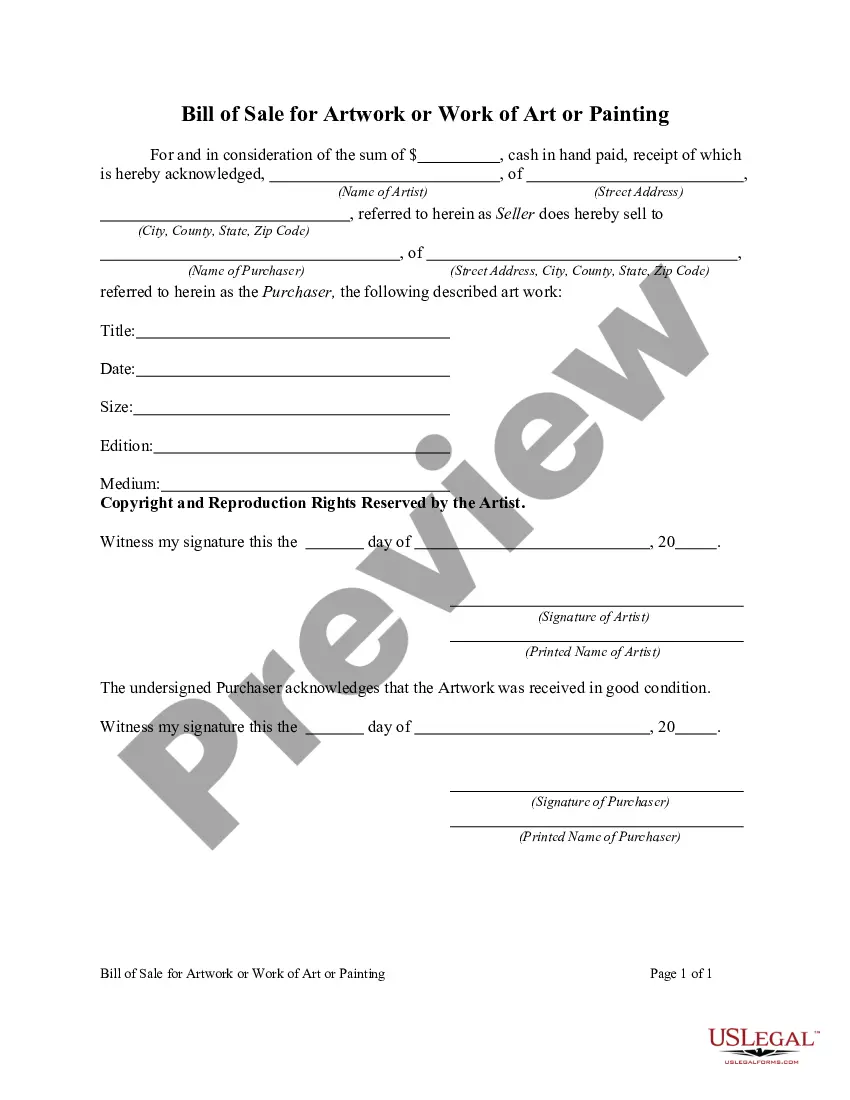
Bill Of Sale For Artwork With Signature In Minnesota
Description




Form popularity
FAQ
Under settled Minnesota law, the purpose of an offer of proof is to provide a basis on which the trial court can make an evidentiary ruling and to create a record for any appeal of that ruling.
After completing all the necessary steps and paying the fees, you will receive your registration documents, including license plates and stickers. It's essential to always keep these documents in your vehicle as proof of registration.
A horse bill of sale is not legally required for all horse sales, but it is strongly recommended for both the buyer and the seller. It provides legal protection and clarity in any disputes or issues.
If the title has a lien holder listed on it, the original signed lien release card or a notarized lien release from the lending institution listed on the title is required.
Notarization isn't always required for a bill of sale in Minnesota. However, for certain transactions, such as the sale of a motor vehicle, notarizing the document can provide additional legal protection.
Is a journal required? While Minnesota law does not require a journal, it is prudent of a notary public to keep one.
Typically the buyer pays their trusted mechanic for this service, but the two parties must agree on when and where the inspection will take place. Bill of Sale: While a Bill of Sale is optional in Minnesota, many buyers and sellers prefer to create one for additional protection and peace of mind.
What documents are needed for an out-of-state title transfer in Minnesota? For an out-of-state title transfer, you typically need the current title, a title application, proof of identity, a bill of sale, an odometer disclosure statement, and any required inspection documentation.
Notarization: Notarization of the bill of sale may not be required in Minnesota, but having the document notarized can add an extra layer of authenticity and credibility to the transaction. Title Transfer and Reporting: The Minnesota vehicle bill of sale supports the transfer of ownership.