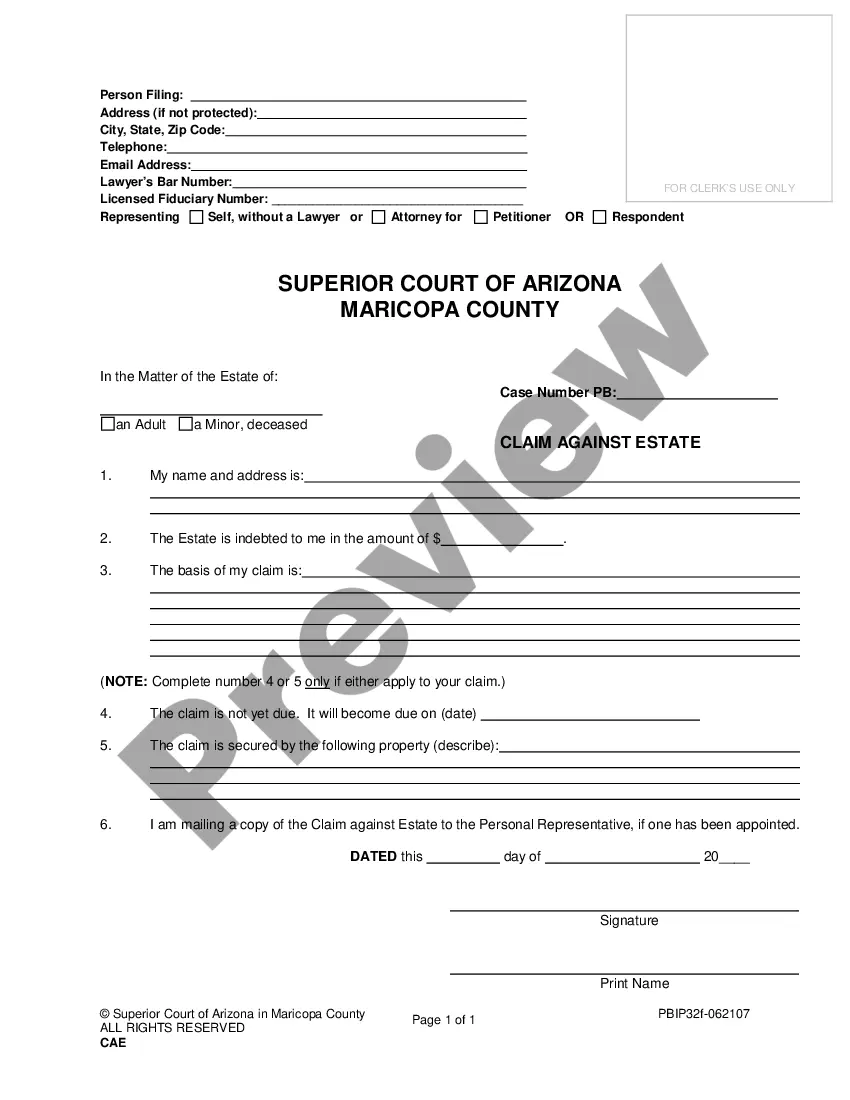
Suing An Estate Executor For An Estate In Phoenix
Description


Get your form ready online
Our built-in tools help you complete, sign, share, and store your documents in one place.
Make edits, fill in missing information, and update formatting in US Legal Forms—just like you would in MS Word.
Download a copy, print it, send it by email, or mail it via USPS—whatever works best for your next step.
Sign and collect signatures with our SignNow integration. Send to multiple recipients, set reminders, and more. Go Premium to unlock E-Sign.
If this form requires notarization, complete it online through a secure video call—no need to meet a notary in person or wait for an appointment.
We protect your documents and personal data by following strict security and privacy standards.

Make edits, fill in missing information, and update formatting in US Legal Forms—just like you would in MS Word.

Download a copy, print it, send it by email, or mail it via USPS—whatever works best for your next step.

Sign and collect signatures with our SignNow integration. Send to multiple recipients, set reminders, and more. Go Premium to unlock E-Sign.

If this form requires notarization, complete it online through a secure video call—no need to meet a notary in person or wait for an appointment.

We protect your documents and personal data by following strict security and privacy standards.
Looking for another form?








Form popularity
FAQ
As long as there aren't any contests to the will or objections to the executor's actions, the executor will be allowed to settle the estate at the conclusion of the four-month waiting period. That means an executor who is on top of their responsibilities could theoretically wrap up probate in as little as four months.
3: Financial Assets Bank accounts and brokerage accounts, business ownership interests, stocks, bonds, and other financial assets are also subject to probate. However, bank accounts, life insurance policies, and retirement accounts that have a designated beneficiary are not considered probate assets.
Personal representatives (i.e., executors and administrators of the estate) are required to provide beneficiaries and other interested parties (i.e., persons or entities with a financial stake in the estate) with financial information about the estate they are overseeing.
Probate procedures can be complex and time-consuming, but there are ways to avoid or bypass this process for certain assets in Arizona. Properties such as those held in a living trust are exempt from probate. Similarly, community property and jointly-held property with a right of survivorship do not require probate.
It details every transaction that occurred during the executor's administration of the estate as well as all the estate's assets. Before the executor can finalize probate and close the estate, they must provide a final accounting that includes: An itemized list of the estate's assets.
As long as there aren't any contests to the will or objections to the executor's actions, the executor will be allowed to settle the estate at the conclusion of the four-month waiting period. That means an executor who is on top of their responsibilities could theoretically wrap up probate in as little as four months.
Each situation is different and some estates may be more complex than others, such as estates where real estate and other assets were bought or sold before distribution to the beneficiaries. However, the average trust should be fully distributed within 12 to 18 months once the trust administration has begun.
That is accomplished by filing with the local Probate Court a pleading called an Application for Informal Probate of Will and Appointment of Personal Representative. Alternatively, in the case of an intestate decedent, the pleading is called an Application for Informal Appointment of Personal Representative.
When someone dies, their beneficiaries have up to two years to open probate. Once probate is opened, there aren't any time limits that will cause the case to expire.

