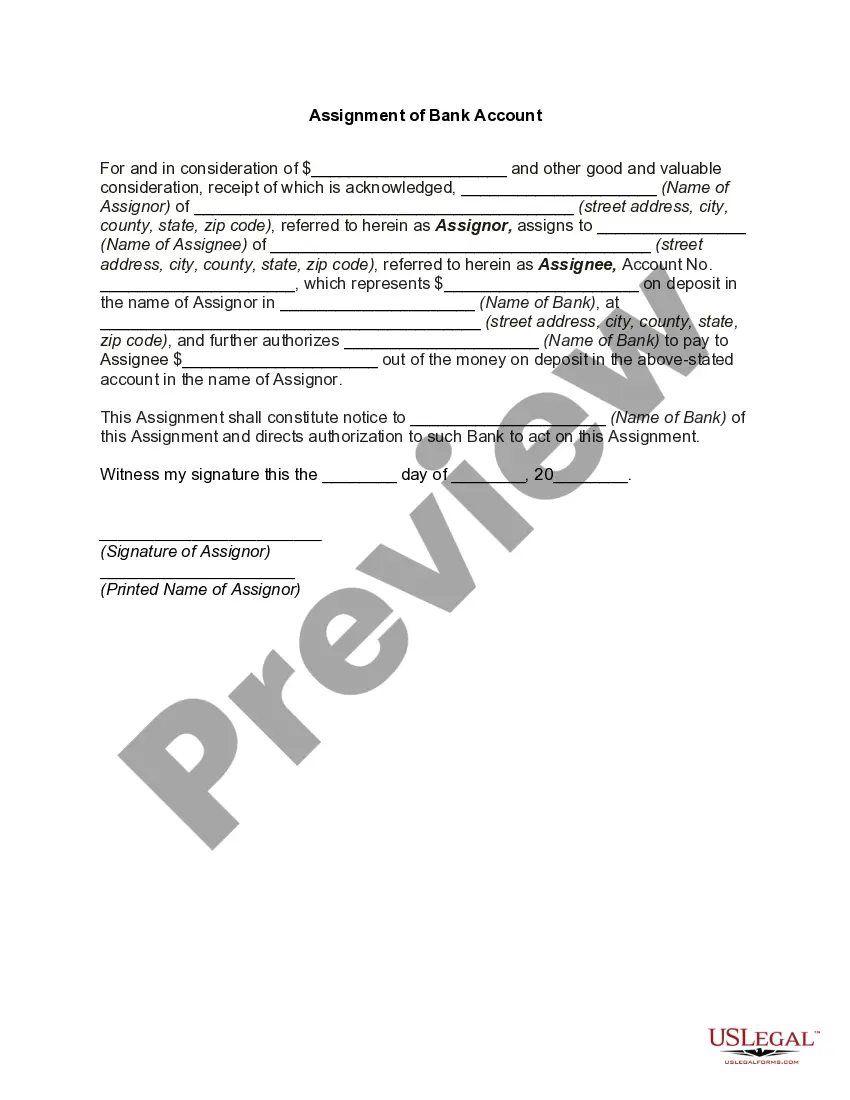
Assignment On Money
Description
Get your form ready online
Our built-in tools help you complete, sign, share, and store your documents in one place.
Make edits, fill in missing information, and update formatting in US Legal Forms—just like you would in MS Word.
Download a copy, print it, send it by email, or mail it via USPS—whatever works best for your next step.
Sign and collect signatures with our SignNow integration. Send to multiple recipients, set reminders, and more. Go Premium to unlock E-Sign.
If this form requires notarization, complete it online through a secure video call—no need to meet a notary in person or wait for an appointment.
We protect your documents and personal data by following strict security and privacy standards.

Make edits, fill in missing information, and update formatting in US Legal Forms—just like you would in MS Word.

Download a copy, print it, send it by email, or mail it via USPS—whatever works best for your next step.

Sign and collect signatures with our SignNow integration. Send to multiple recipients, set reminders, and more. Go Premium to unlock E-Sign.

If this form requires notarization, complete it online through a secure video call—no need to meet a notary in person or wait for an appointment.

We protect your documents and personal data by following strict security and privacy standards.
Looking for another form?





How to fill out Assignment Of Money Due?
Utilizing legal document examples that adhere to federal and local regulations is essential, and the internet provides numerous choices to select from.
However, what’s the benefit of spending time searching for the appropriate Assignment On Money example online when the US Legal Forms digital library already has such templates amassed in one location.
US Legal Forms is the premier online legal repository boasting over 85,000 customizable templates created by attorneys for any business and personal scenario.
Examine the template using the Preview feature or via the text outline to ensure it suits your requirements. Seek another example using the search tool located at the top of the page if necessary. Click Buy Now when you've found the correct form and select a subscription plan. Establish an account or sign in and complete the payment using PayPal or a credit card. Select the appropriate format for your Assignment On Money and download it. All documents you discover through US Legal Forms are reusable. To re-download and complete forms previously acquired, access the My documents tab in your profile. Take advantage of the most comprehensive and user-friendly legal documentation service!
- They are simple to navigate with all documents categorized by state and intended use.
- Our experts keep pace with legislative developments, ensuring your forms are current and compliant when acquiring an Assignment On Money from our platform.
- Acquiring an Assignment On Money is swift and straightforward for both existing and new users.
- If you already possess an account with an active subscription, sign in and retrieve the document example you require in the preferred format.
- If you are visiting our website for the first time, follow the guidelines outlined below.
Form popularity
FAQ
The key difference between assignment and transfer lies in the intention behind the action. Assignment on money typically involves a conscious decision to trade rights, while transfer can encompass a broader range of situations, such as involuntary changes in ownership. Understanding these distinctions is vital to ensure correct legal compliance, and tools offered by uslegalforms can simplify this process.
A lease assignment refers to the process where the original tenant transfers their rights and obligations under a lease to a new tenant. In contrast, a lease transfer may involve giving up the lease entirely, which can release the original tenant from future obligations. Knowing these distinctions can help in managing property and responsibilities effectively, and using platforms like uslegalforms can provide templates and guidance for these agreements.
Transmission generally refers to the act of passing on rights or obligations due to legal reasons, such as a death or incapacity, while assignment on money involves a voluntary transfer of rights from one party to another. In assignment, the assignor explicitly agrees to transfer rights, making it a more proactive process. Understanding this difference is crucial when handling financial transactions, and using platforms like uslegalforms can provide added clarity.
Creating a notice of assignment is an essential step in formalizing the assignment on money process. Start by clearly identifying the parties involved, the specific assignment terms, and the effective date. You must ensure that the notice is signed by both the assignor and the assignee, which reinforces the legitimacy of the agreement. A well-crafted notice can prevent future disputes, and using reputable sources like uslegalforms can streamline this task.
A parent must obtain court permission or the other parent's written consent before relocating with a child outside of Nevada or to a place within Nevada that would substantially impair the other parent's ability to maintain a meaningful relationship with the child.
It is the legal transfer of custody to someone other than a parent. Guardianship does not terminate parental rights, but it does suspend them. The advantage to guardianship is control.
A court in Nevada may grant visitation rights to a parent who does not have custody. The court will order visitation if it is in the best interest of the child (NRS 125C. 0035). The court's order will set forth the specific time and conditions of the visits.
There are three types of guardianship: (1) Guardianship of the Person, (2) Guardianship of the Estate, (3) Guardianship of the Person and the Estate. A Guardian of the Person only has authority to make personal and medical decisions. A Guardian of the Estate has the authority to make financial decisions only.
A guardian is entitled to ?reasonable? compensation for his or her services. These fees must be related to the guardian's duties and must be reviewed and approved by the Court overseeing the guardianship.
Guardians in Nevada must be adults at least 18 years of age. If the ward is a minor child, the court will give preference to a relative. If the ward is an adult, the ward's choice for a guardian will receive preference. If the ward has not stated a preference, courts will give preference to a close relative.
