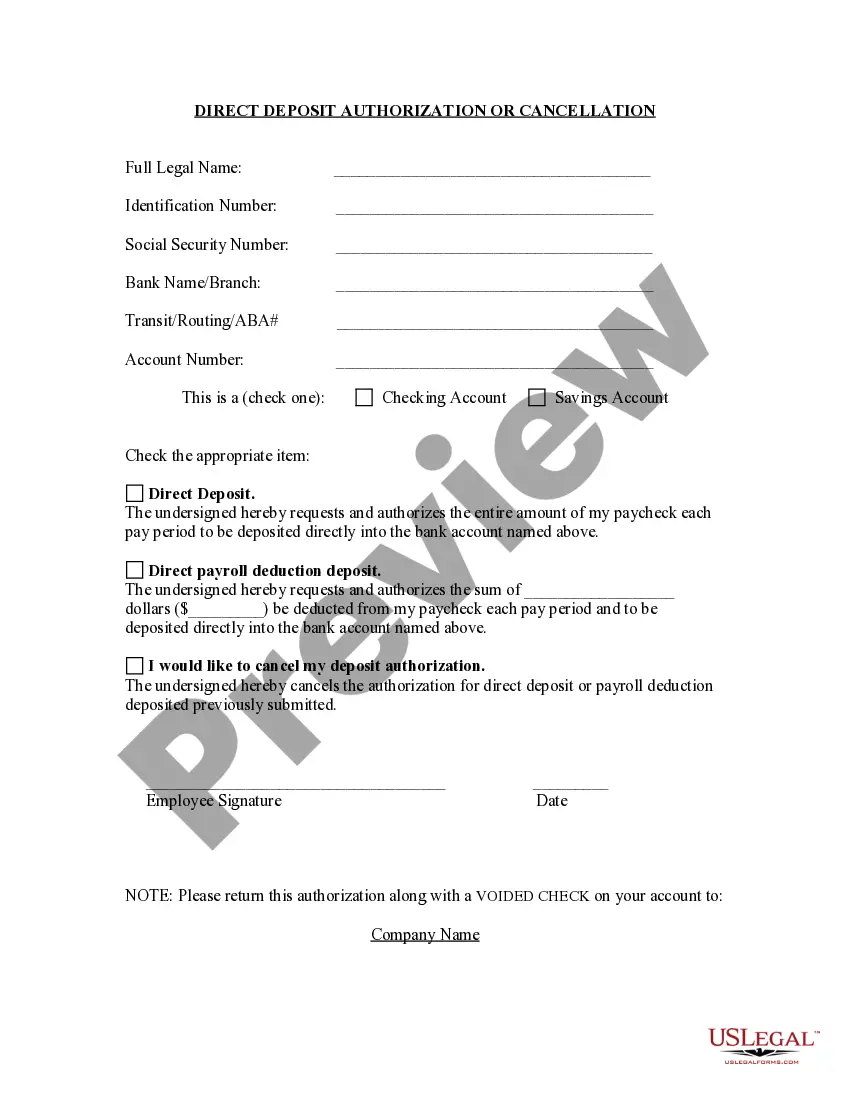
Direct Deposit Form Blank With Blank Phosphates
Description
Get your form ready online
Our built-in tools help you complete, sign, share, and store your documents in one place.
Make edits, fill in missing information, and update formatting in US Legal Forms—just like you would in MS Word.
Download a copy, print it, send it by email, or mail it via USPS—whatever works best for your next step.
Sign and collect signatures with our SignNow integration. Send to multiple recipients, set reminders, and more. Go Premium to unlock E-Sign.
If this form requires notarization, complete it online through a secure video call—no need to meet a notary in person or wait for an appointment.
We protect your documents and personal data by following strict security and privacy standards.

Make edits, fill in missing information, and update formatting in US Legal Forms—just like you would in MS Word.

Download a copy, print it, send it by email, or mail it via USPS—whatever works best for your next step.

Sign and collect signatures with our SignNow integration. Send to multiple recipients, set reminders, and more. Go Premium to unlock E-Sign.

If this form requires notarization, complete it online through a secure video call—no need to meet a notary in person or wait for an appointment.

We protect your documents and personal data by following strict security and privacy standards.
Looking for another form?


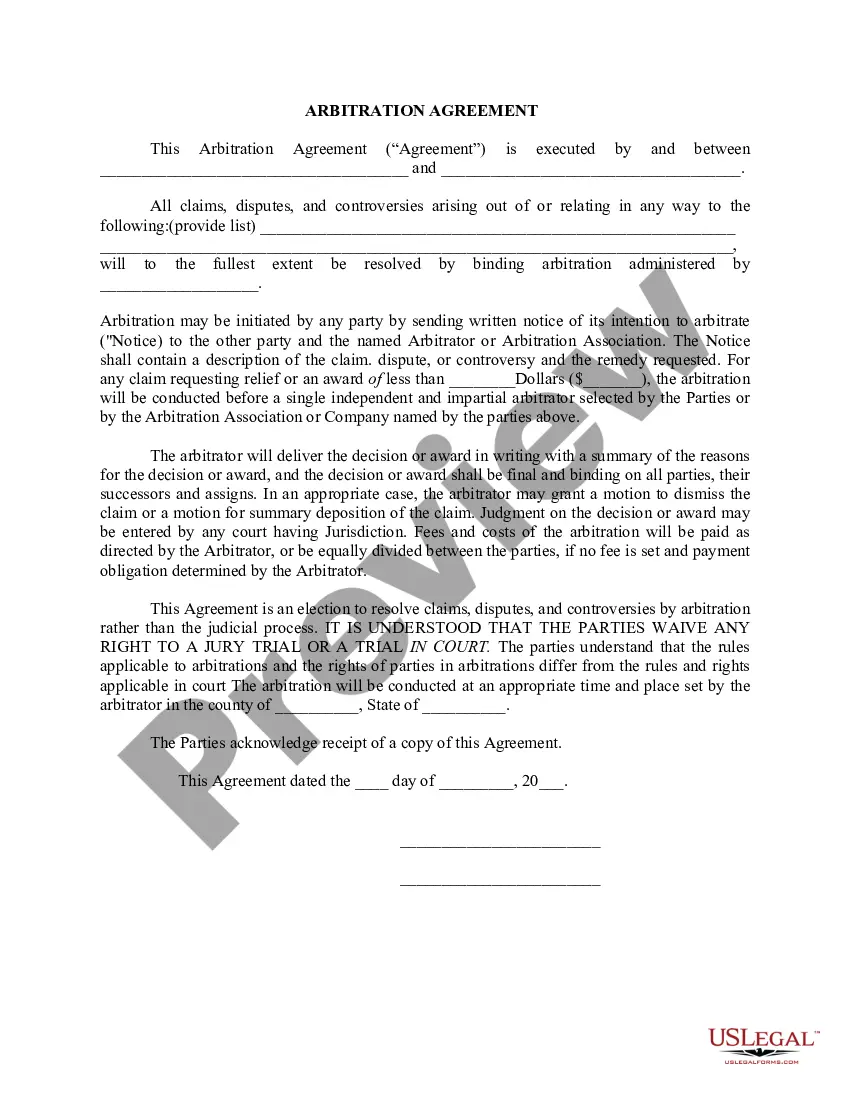


How to fill out Direct Deposit Agreement?
It’s obvious that you can’t become a law expert immediately, nor can you figure out how to quickly draft Direct Deposit Form Blank With Blank Phosphates without the need of a specialized set of skills. Putting together legal documents is a time-consuming venture requiring a specific training and skills. So why not leave the creation of the Direct Deposit Form Blank With Blank Phosphates to the professionals?
With US Legal Forms, one of the most extensive legal document libraries, you can find anything from court papers to templates for in-office communication. We understand how crucial compliance and adherence to federal and local laws and regulations are. That’s why, on our platform, all forms are location specific and up to date.
Here’s how you can get started with our website and get the document you need in mere minutes:
- Discover the document you need by using the search bar at the top of the page.
- Preview it (if this option provided) and check the supporting description to figure out whether Direct Deposit Form Blank With Blank Phosphates is what you’re looking for.
- Begin your search again if you need any other template.
- Register for a free account and choose a subscription option to buy the template.
- Pick Buy now. As soon as the transaction is through, you can get the Direct Deposit Form Blank With Blank Phosphates, complete it, print it, and send or send it by post to the designated people or entities.
You can re-access your documents from the My Forms tab at any time. If you’re an existing client, you can simply log in, and locate and download the template from the same tab.
No matter the purpose of your paperwork-be it financial and legal, or personal-our website has you covered. Try US Legal Forms now!
Form popularity
FAQ
In serum, phosphate exists in two forms, dihydrogen phosphate (H2PO4) and its salt, mono-hydrogen phosphate (HPO4). The relationship between these two can be determined by the Henderson-Hasselbalch equation. At the physiologic pH of 7.40, the pK of H2PO4 is 6.8 and the ratio of HPO4 to H2PO4 is .
The phosphate comes from sediment that was deposited in layers on the sea floor. The phosphate rich sediments are believed to have formed from precipitation of phosphate from seawater along with the skeletons and waste products of creatures living in the seas.
There are two forms of phosphate present in the serum, dihydrogen phosphate( H2PO4) and mono hydrogen phosphate (HPO4); the balance between these two forms depends on the acid-base status of the body.[1][2]
There are two types of phosphate deposit: igneous and sedimentary (Fig. 1). Igneous ores are typically carbonatite, which is an igneous rock with over 50 vol % carbonate minerals (Woolley and Kempe, 1989; Le Maitre, 2002).
Phosphates exist in three forms: orthophosphate, metaphosphate (or polyphosphate) and organically-bound phosphate; each compound contains phosphorous in a different chemical arrangement.
