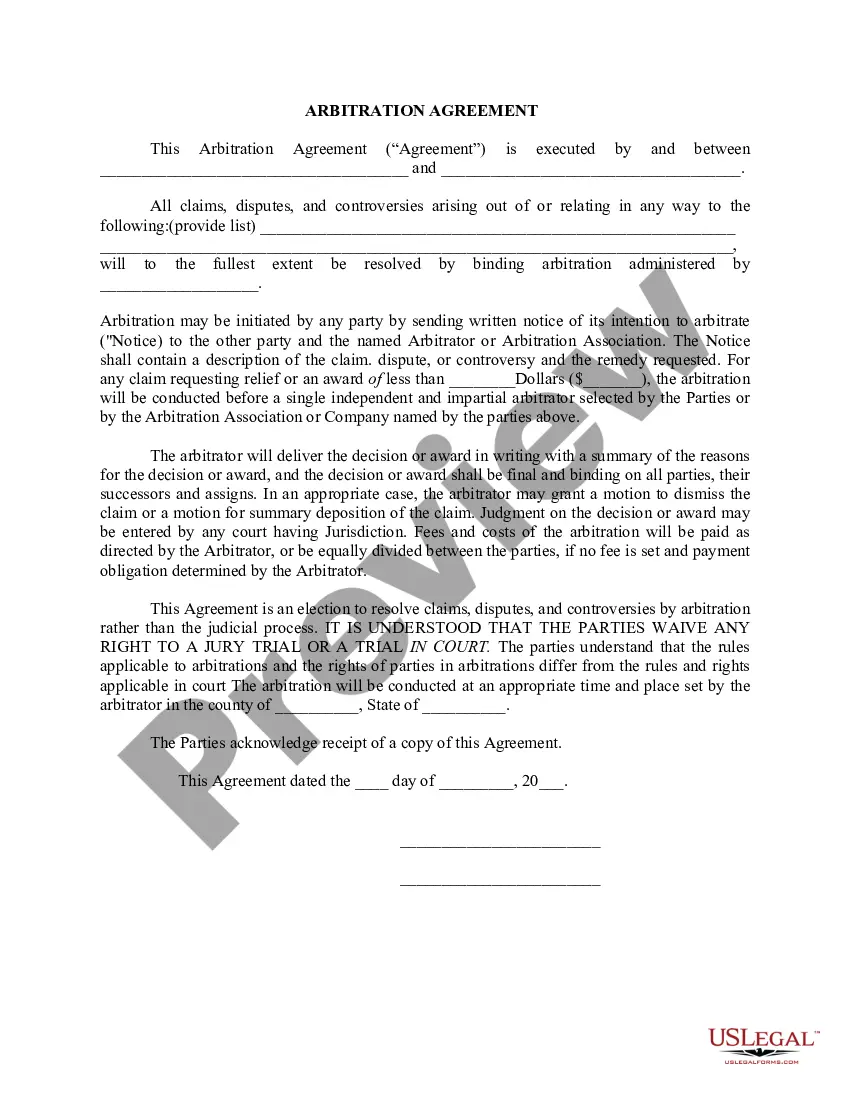
Arbitration Process For Dispute Resolution In Maricopa
Description

Get your form ready online
Our built-in tools help you complete, sign, share, and store your documents in one place.
Make edits, fill in missing information, and update formatting in US Legal Forms—just like you would in MS Word.
Download a copy, print it, send it by email, or mail it via USPS—whatever works best for your next step.
Sign and collect signatures with our SignNow integration. Send to multiple recipients, set reminders, and more. Go Premium to unlock E-Sign.
If this form requires notarization, complete it online through a secure video call—no need to meet a notary in person or wait for an appointment.
We protect your documents and personal data by following strict security and privacy standards.

Make edits, fill in missing information, and update formatting in US Legal Forms—just like you would in MS Word.

Download a copy, print it, send it by email, or mail it via USPS—whatever works best for your next step.

Sign and collect signatures with our SignNow integration. Send to multiple recipients, set reminders, and more. Go Premium to unlock E-Sign.

If this form requires notarization, complete it online through a secure video call—no need to meet a notary in person or wait for an appointment.

We protect your documents and personal data by following strict security and privacy standards.
Looking for another form?



Form popularity
FAQ
An arbitration is a hearing where a commissioner gives both parties an opportunity to present their cases regarding the issue in dispute by leading evidence, presenting documents, cross examination of witnesses, and even conducting of inspection of premises, where that is necessary.
A claimant will typically start arbitration by sending a document known as a “request for arbitration” or a “notice to arbitrate” to its opponent.
Compulsory Arbitration is a mandatory program for disputes valued under $50,000. A court-appointed arbitrator reviews the case to decide a just resolution and award.
How to prepare and present a labor arbitration case Conduct a comprehensive investigation. Collect relevant documents. Study the contract to find clauses that directly or indirectly affect the dispute. Talk to anyone who might be able to help provide a full picture of the case, providing a strong factual foundation.
If you don't know the answer to a question, don't guess; simply say, “I don't know the answer but will get it for you promptly.” Acknowledging that you don't know everything is credibility-enhancing (provided it does not happen frequently), as is acknowledging some of your oppo- nent's (non-critical) contentions.
Hearing Stage: Parties present their case through a process that may be in-person, over the phone, or document-based, depending on the arbitration rules and agreement. Additional written arguments may also be submitted post-hearing. Award Stage: The arbitrator closes the hearing once all evidence is submitted.
Witnesses are usually asked to swear or affirm to the truthfulness of their testimony. After a witness has given direct testimony, the other side has the opportunity to cross examine the witness. After all those witnesses have testified, then the union puts on their case. You are expected to be a witness.
Always get straight to the merits without berating the other side or whining about how badly it has treated you. Another threat to your credibility is the “kitchen sink” arbitration demand or a response that includes numerous claims or defenses that have little chance of succeeding.
Arbitration is a procedure in which a dispute is submitted, by agreement of the parties, to one or more arbitrators who make a binding decision on the dispute. In choosing arbitration, the parties opt for a private dispute resolution procedure instead of going to court.
Typically, the parties elect arbitration in an arbitration clause included in their original contract, signed well before any dispute arises. In other cases, after a dispute arises, the parties may agree to seek arbitration by signing a post-dispute referral to arbitration.