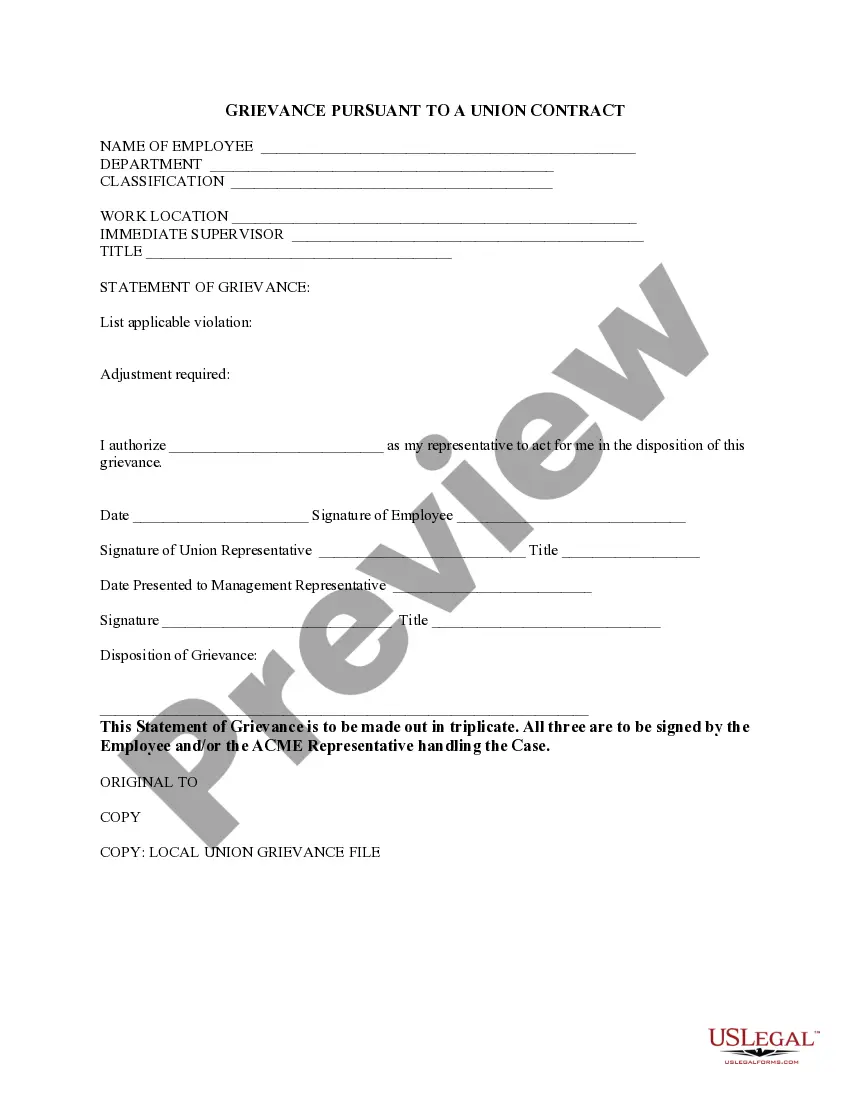
Grievance With Employer In Sacramento
Description

Get your form ready online
Our built-in tools help you complete, sign, share, and store your documents in one place.
Make edits, fill in missing information, and update formatting in US Legal Forms—just like you would in MS Word.
Download a copy, print it, send it by email, or mail it via USPS—whatever works best for your next step.
Sign and collect signatures with our SignNow integration. Send to multiple recipients, set reminders, and more. Go Premium to unlock E-Sign.
If this form requires notarization, complete it online through a secure video call—no need to meet a notary in person or wait for an appointment.
We protect your documents and personal data by following strict security and privacy standards.

Make edits, fill in missing information, and update formatting in US Legal Forms—just like you would in MS Word.

Download a copy, print it, send it by email, or mail it via USPS—whatever works best for your next step.

Sign and collect signatures with our SignNow integration. Send to multiple recipients, set reminders, and more. Go Premium to unlock E-Sign.

If this form requires notarization, complete it online through a secure video call—no need to meet a notary in person or wait for an appointment.

We protect your documents and personal data by following strict security and privacy standards.
Looking for another form?









Form popularity
FAQ
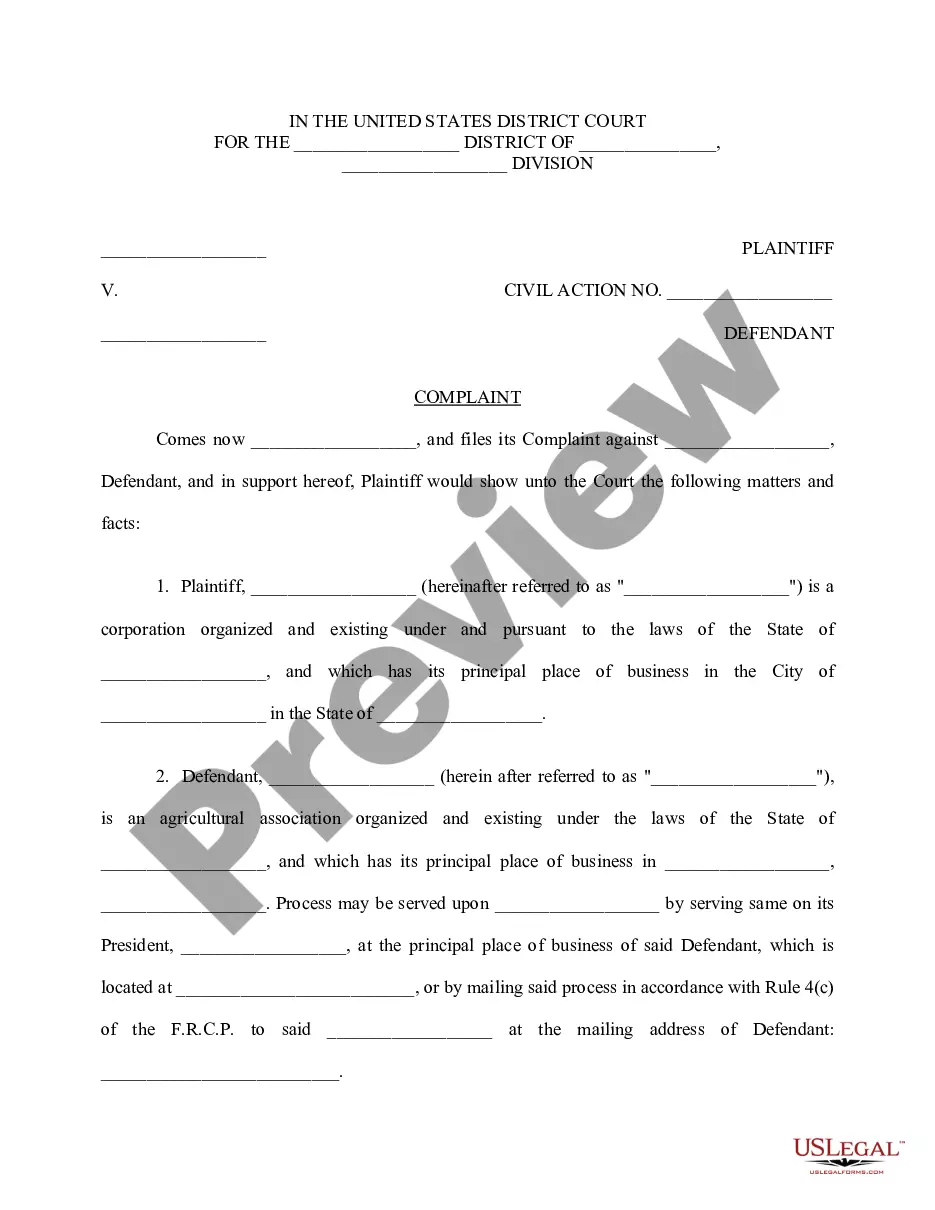
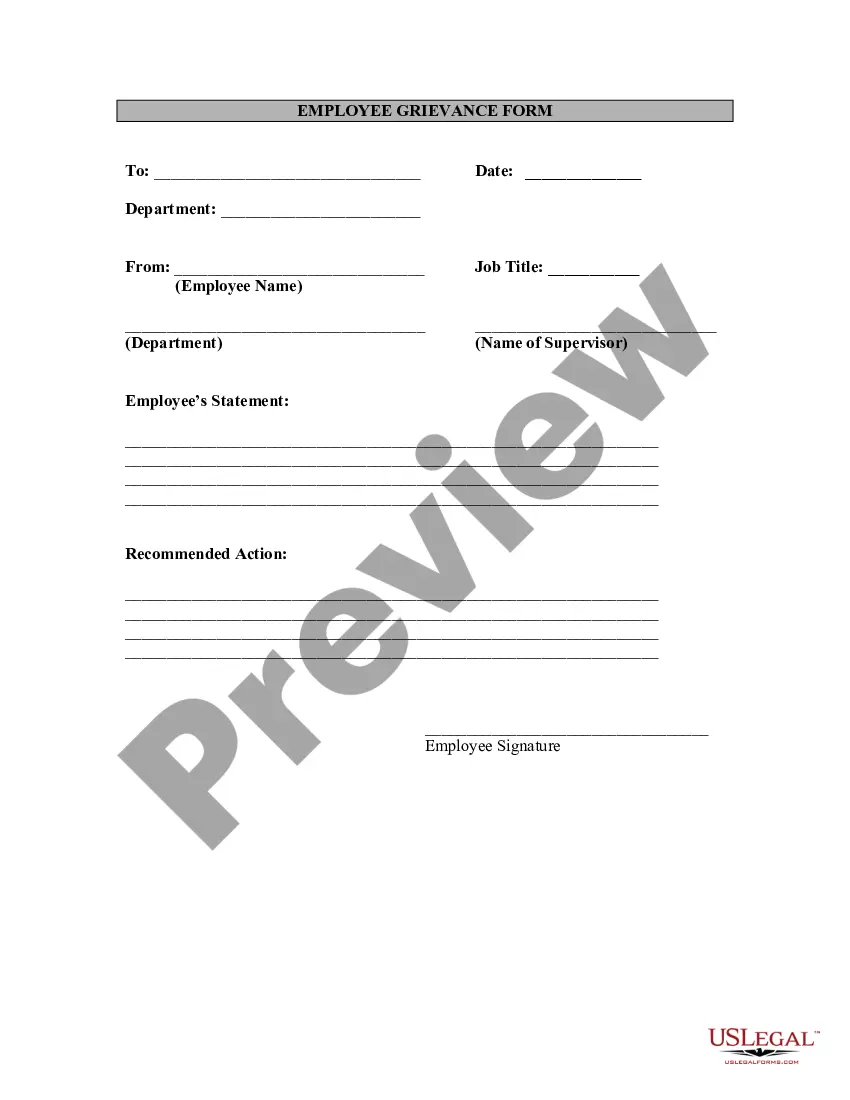
Pursuant to the laws and rules of the State, an employee shall use an Employee Contract Grievance (Std. 630) form or an Excluded Employee Grievance (Std. 631) form. Either form shall be filled out in its entirety and clearly and concisely explain the nature of the grievance.
Filing Your Complaint File a retaliation complaint online. In person at any location of the Labor Commissioner's Offices. By mail at: LABOR COMMISSIONER'S OFFICE. By email to: oshaRetaliation@dir.ca. By phone at: (714) 558-4913. By fax at: (714) 662-6058.
Workplace grievances generally fall into a few key categories: Work conditions. When employees aren't provided with a safe, healthy environment to do their job, they may file a grievance about work conditions. Compensation. Personnel policy. Harassment.
Short answer: In California, workplace retaliation is when an employer punishes you for reporting something illegal, unsafe, or discriminatory at work by doing things like firing you, cutting your hours, giving you bad reviews, or making your job harder.
The retaliation complaint form can be completed and filed on-line at: .dir.ca/dlse/Filing_your_complaint.htm, or a paper form (RCI 1) may be used to prepare a retaliation complaint. The paper form may be obtained by calling or visiting any Labor Commissioner's Office or it can be downloaded.
The 5-Step Workplace Grievance Process Step 1: Informal meeting. Step 2: Supervisor meeting and documentation. Step 3: Escalation to management. Step 4: Escalation to top company representatives. Step 5: Referral to arbitration.
Step 1 – raise the issue informally with the employer. Step 2 – raise the issue formally with a grievance letter. Step 3 – grievance investigation should take place. Step 4 – a grievance hearing may be required to review the evidence and for a decision to be made.
Steps to address grievances Evaluate solutions. Clearly state the grievance. Present the grievance. Seek a response. Further action. Declare a dispute. Tactics for resolution. Discuss potential strategies, including mediation, arbitration, or industrial action and involve workers in decision-making. Formalise agreements.
The 5-Step Workplace Grievance Process Step 1: Informal meeting. Step 2: Supervisor meeting and documentation. Step 3: Escalation to management. Step 4: Escalation to top company representatives. Step 5: Referral to arbitration.
Holding a grievance investigation meeting You might need to get information from the employee, their colleagues, and any witnesses. So, you may need to hold multiple meetings to gather evidence. for investigation hearings. However, it's good business practice to allow your employee to have this option.