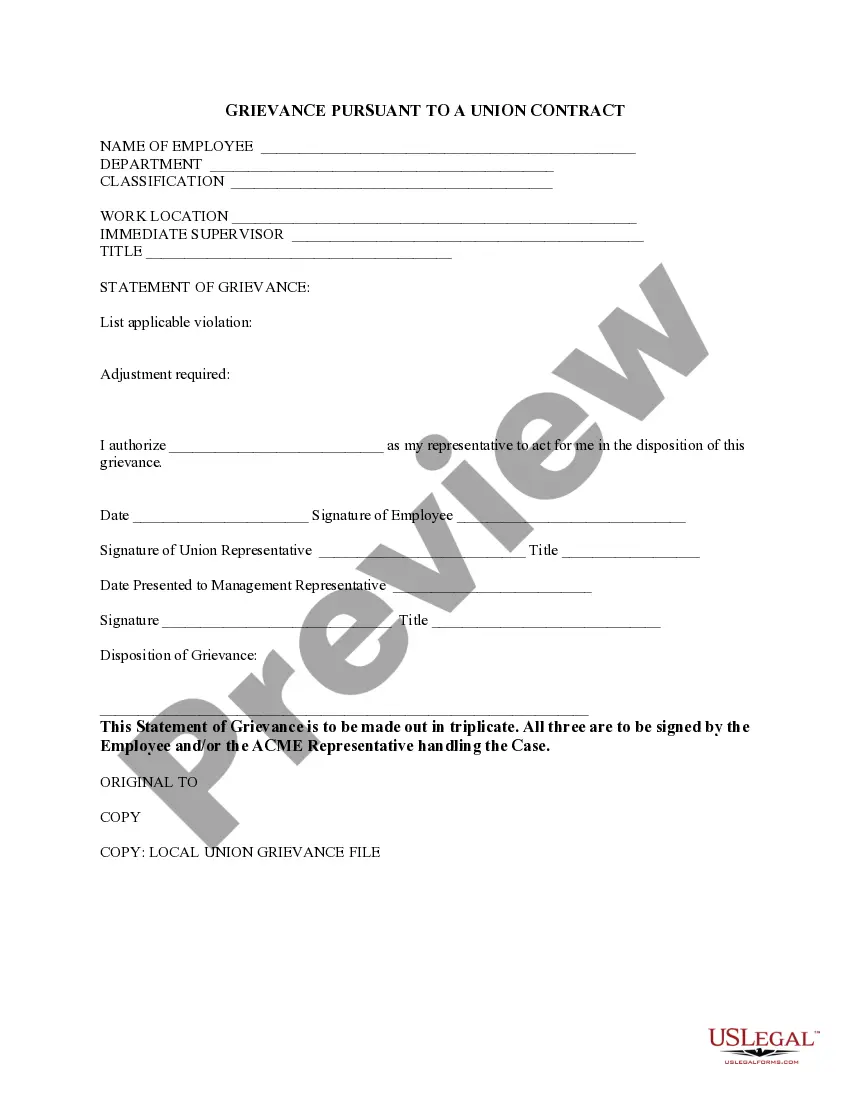
Grievance With Employer In King
Description

Get your form ready online
Our built-in tools help you complete, sign, share, and store your documents in one place.
Make edits, fill in missing information, and update formatting in US Legal Forms—just like you would in MS Word.
Download a copy, print it, send it by email, or mail it via USPS—whatever works best for your next step.
Sign and collect signatures with our SignNow integration. Send to multiple recipients, set reminders, and more. Go Premium to unlock E-Sign.
If this form requires notarization, complete it online through a secure video call—no need to meet a notary in person or wait for an appointment.
We protect your documents and personal data by following strict security and privacy standards.

Make edits, fill in missing information, and update formatting in US Legal Forms—just like you would in MS Word.

Download a copy, print it, send it by email, or mail it via USPS—whatever works best for your next step.

Sign and collect signatures with our SignNow integration. Send to multiple recipients, set reminders, and more. Go Premium to unlock E-Sign.

If this form requires notarization, complete it online through a secure video call—no need to meet a notary in person or wait for an appointment.

We protect your documents and personal data by following strict security and privacy standards.
Looking for another form?










Form popularity
FAQ
When an employee raises a formal grievance, the employer should hold a meeting with them. A grievance meeting is sometimes called a 'hearing'. The employer should hold the meeting 'without unreasonable delay' – ideally within 5 working days.
A grievance is a complaint against an employer by an employee for a contractual violation. Simply, it means an employee has a problem with his/her employer and feels the problem is legitimate based on the contract he/she has with the employer.
Grievance refers to the employee's dissatisfaction with company's work policy and conditions because of an alleged violation of law. They may or may not be justified and usually represent the gap between what the employee expects and gets from the company.
The 5-Step Workplace Grievance Process Step 1: Informal meeting. Step 2: Supervisor meeting and documentation. Step 3: Escalation to management. Step 4: Escalation to top company representatives. Step 5: Referral to arbitration.
Workplace grievances generally fall into a few key categories: Work conditions. When employees aren't provided with a safe, healthy environment to do their job, they may file a grievance about work conditions. Compensation. Personnel policy. Harassment.
Some common examples that employees may file grievances about include: Verbal Abuse: This includes insults, derogatory comments, or offensive jokes aimed at an individual's race, gender, religion, or any other protected characteristic.
A grievance is a formal complaint that is raised by an employee towards an employer within the workplace.
Expert-Verified Answer. The three worst grievances in history are taxation without representation, the imposition of martial law, and restrictions on civil liberties. Each of these has caused significant social upheaval and has been crucial in shaping modern concepts of democracy and rights.
Explaining Examples of Colonial Grievances. As seen above the list of grievances are numerous, but four central topics stand above the rest: taxes, violations of the rights of the accused, forcibly quartering British soldiers in the homes of the colonists, and taking undue powers onto himself.
To accomplish that, Jefferson and the Continental Congress compiled a laundry list of grievances—27 in total—meant to prove to the world that King George was a “tyrant” and a lawbreaker.