Covenant Agreement Meaning In Pennsylvania
Description

Get your form ready online
Our built-in tools help you complete, sign, share, and store your documents in one place.
Make edits, fill in missing information, and update formatting in US Legal Forms—just like you would in MS Word.
Download a copy, print it, send it by email, or mail it via USPS—whatever works best for your next step.
Sign and collect signatures with our SignNow integration. Send to multiple recipients, set reminders, and more. Go Premium to unlock E-Sign.
If this form requires notarization, complete it online through a secure video call—no need to meet a notary in person or wait for an appointment.
We protect your documents and personal data by following strict security and privacy standards.

Make edits, fill in missing information, and update formatting in US Legal Forms—just like you would in MS Word.

Download a copy, print it, send it by email, or mail it via USPS—whatever works best for your next step.

Sign and collect signatures with our SignNow integration. Send to multiple recipients, set reminders, and more. Go Premium to unlock E-Sign.

If this form requires notarization, complete it online through a secure video call—no need to meet a notary in person or wait for an appointment.

We protect your documents and personal data by following strict security and privacy standards.
Looking for another form?








Form popularity
FAQ
The following are the most common ways to get out of a non-compete agreement: Determine that the terms of the contract do not in fact prevent you from a desired course of action. Recognize when a non-compete contradicts the law. Negotiate a release agreement with the involved parties. Ignore the agreement.
A covenant is a chosen relationship or partnership in which two parties make binding promises to each other and work together to reach a common goal. They're often accompanied by oaths, signs, and ceremonies.
Pennsylvania courts blue-pencil when “a covenant imposes restrictions broader than necessary to protect the employer” (Pharmethod, Inc.
Yes, they are enforceable if they are reasonable as to scope, duration and geographic limitation. PAMED has supported previous legislation on restrictive covenants that aims to prohibit their use in health care practitioner employment contracts, with limited exceptions.
Nevertheless, the Pennsylvania Supreme Court has made it clear that non-compete agreements and restrictive covenants are not favored in Pennsylvania and are viewed as a trade restraint that prevents a former employee from earning a living.
The ordinance prohibited Black individuals from buying homes on majority White blocks and vice versa. The ordinance was created in response to middle class Black families moving out of crowded, predominantly Black neighborhoods into more affluent, less crowded White neighborhoods.
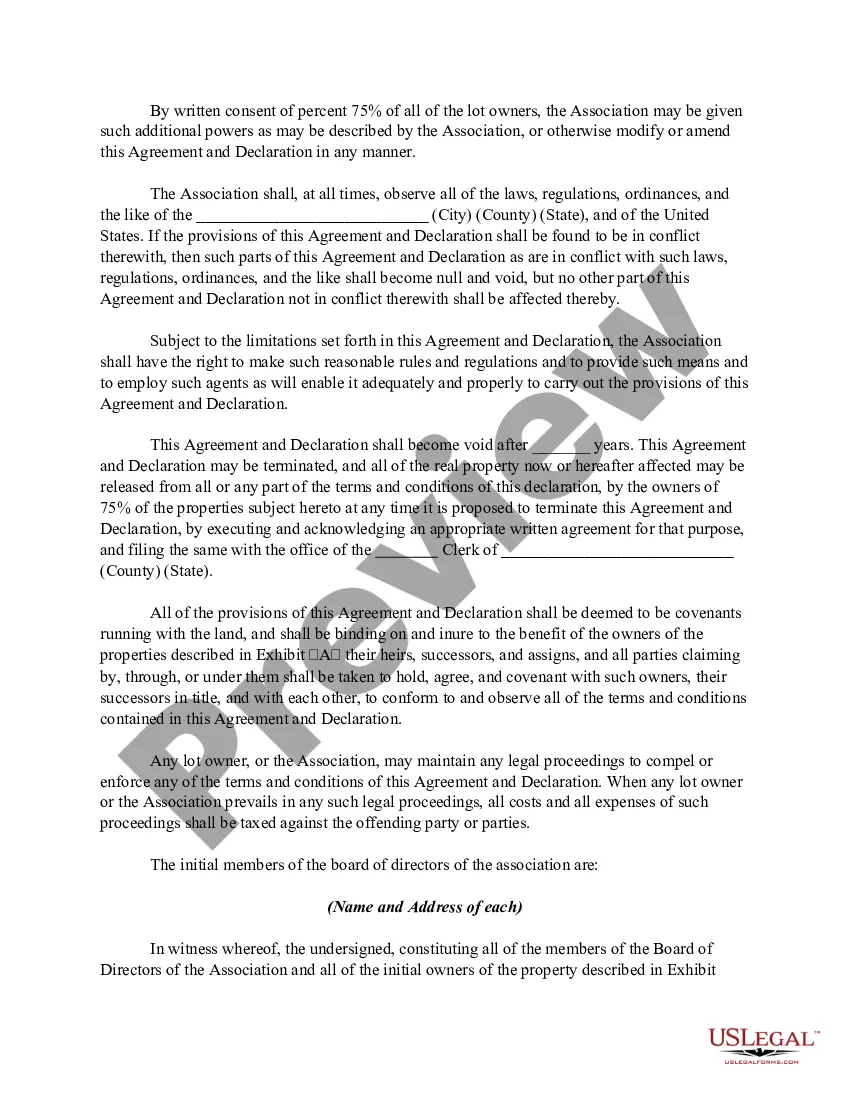
A covenant agreement is akin to a contractual agreement between parties. It often outlines terms and conditions where a party will perform a certain action or refrain from performing a certain action. Covenants are legally binding and enforceable.
A real covenant is only enforceable if it was created intentionally, it relates to the property in question, and two kinds of privity are established. Additionally, a real covenant must be in writing. The party capable of enforcing the covenant depends on whether the burden or the benefit runs with the land.
This includes following your budget and paying on time and in full. When a breach of covenant occurs, you risk paying penalties, a higher interest rate or even having the contract terminated altogether.
A contract is an agreement between parties while a covenant is a pledge. A contract is an agreement you can break while a covenant is a perpetual promise. You seal a covenant while you sign a contract. A contract is a mutually beneficial relationship while a covenant is something you fulfill.
