Restrictive Covenant For A Subdivision Can Be Enforced By In Arizona
Description

Get your form ready online
Our built-in tools help you complete, sign, share, and store your documents in one place.
Make edits, fill in missing information, and update formatting in US Legal Forms—just like you would in MS Word.
Download a copy, print it, send it by email, or mail it via USPS—whatever works best for your next step.
Sign and collect signatures with our SignNow integration. Send to multiple recipients, set reminders, and more. Go Premium to unlock E-Sign.
If this form requires notarization, complete it online through a secure video call—no need to meet a notary in person or wait for an appointment.
We protect your documents and personal data by following strict security and privacy standards.

Make edits, fill in missing information, and update formatting in US Legal Forms—just like you would in MS Word.

Download a copy, print it, send it by email, or mail it via USPS—whatever works best for your next step.

Sign and collect signatures with our SignNow integration. Send to multiple recipients, set reminders, and more. Go Premium to unlock E-Sign.

If this form requires notarization, complete it online through a secure video call—no need to meet a notary in person or wait for an appointment.

We protect your documents and personal data by following strict security and privacy standards.
Looking for another form?









Form popularity
FAQ
In Arizona, CC&Rs are usually enforced by homeowners associations (HOAs). In many cases, however, they may also be enforced by individual homeowners.
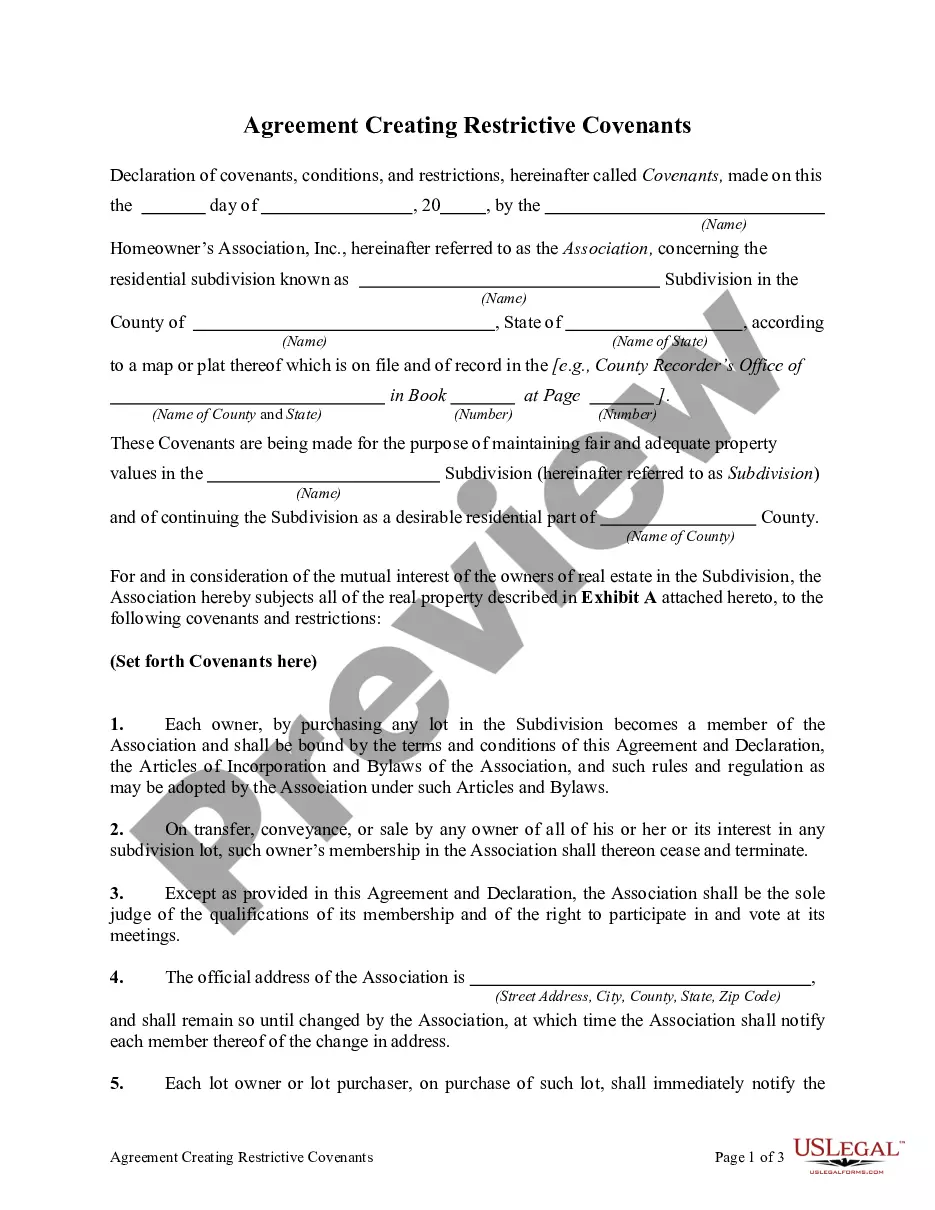
Restrictive covenants are usually enforced by the association's board. These agreements are also called Declarations of Covenants, Conditions, and Restrictions (CC&Rs).
The Supreme Court held that an HOA may not rely on a general amendment power provision in its covenants, conditions, and restrictions to place restrictions on landowners' use of their land only as to those restrictions for which the HOA's original declaration has provided sufficient notice.
My limited understanding is, restrictive covenants are only enforceable by a home owners association created among them. A local government isn't going to swoop in and enforce, or defend, a covenant that you created on your property. The local government is only concerned with land use ordinance's and state laws.
The ARS grants the board specific powers such as the ability to foreclose on a house for unpaid liens and establish rules concerning the exterior appearance of homes and other community-related restrictions. HOAs in Arizona are also bound by rules set forth in their own governing documents.
Arizona courts have found restrictive covenants to be reasonable and enforceable when they protect some legitimate interest of the employer beyond simply protection from competition.
Under Arizona law, an HOA may not issue a fine until it first offers you a hearing before the board of directors. If the HOA fails to provide you an opportunity for a hearing before the fine is imposed, the fine is illegal and not enforceable. Arizona law also requires that fines be reasonable.
2) Are non-compete agreements enforceable in Arizona? Answer: While the Courts do not favor non-compete agreements, they are enforceable so long as they are 1) reasonable as to geographic scope, 2) reasonable as to duration of time, and 3) narrowly defined to limit activities that you performed for the employer.
