Patent Application For Prosecution In Texas
Description



Get your form ready online
Our built-in tools help you complete, sign, share, and store your documents in one place.
Make edits, fill in missing information, and update formatting in US Legal Forms—just like you would in MS Word.
Download a copy, print it, send it by email, or mail it via USPS—whatever works best for your next step.
Sign and collect signatures with our SignNow integration. Send to multiple recipients, set reminders, and more. Go Premium to unlock E-Sign.
If this form requires notarization, complete it online through a secure video call—no need to meet a notary in person or wait for an appointment.
We protect your documents and personal data by following strict security and privacy standards.

Make edits, fill in missing information, and update formatting in US Legal Forms—just like you would in MS Word.

Download a copy, print it, send it by email, or mail it via USPS—whatever works best for your next step.

Sign and collect signatures with our SignNow integration. Send to multiple recipients, set reminders, and more. Go Premium to unlock E-Sign.

If this form requires notarization, complete it online through a secure video call—no need to meet a notary in person or wait for an appointment.

We protect your documents and personal data by following strict security and privacy standards.
Looking for another form?





Form popularity
FAQ
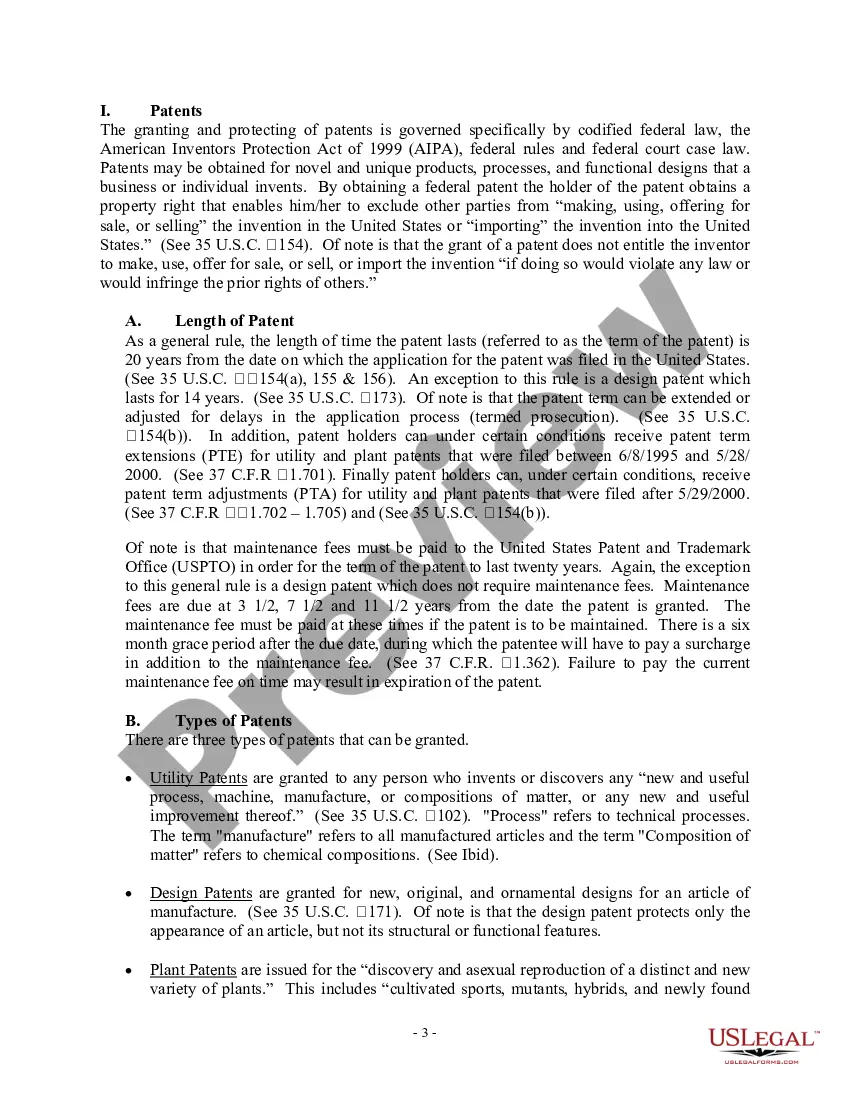
The five primary requirements for patentability are: (1) patentable subject matter; (2) utility; (3) novelty; (4) non-obviousness; and (5) enablement. Like trademarks, patents are territorial, meaning they are enforceable in a specific geographic area.
Types of patents. There are three types of patents: utility, design and plant. Utility and plant patent applications can be provisional and nonprovisional. Provisional applications may not be filed for design inventions.
Under the “first to file” system, there exists no value in obtaining a Poor Man's Patent since it now only matters who filed for the patent first and not who came up with the idea first. Essentially, a Poor Man's Patent has about as much value today as the postage affixed to the envelope.
Patent prosecution is the interaction between applicants and a patent office with regard to a patent application or a patent. The prosecution process is broadly divided into two phases: pre-grant and post-grant prosecution.
Patent application forms can be found on the USPTO website. All of the forms related to patent applications can be found on the link here, or by navigating to the USPTO website and clicking on the “Forms” link under the “Apply for a Patent” section on the “Patents” page.
Patent effectiveness If your patent is granted by INPI, it shall be valid in Brazil for 20 year if it is an Invention Patent (PI), or 15 years, if it is a Utility Model (MU).
The timing of patent prosecution can vary significantly depending on the number of communications with the examiner. The goal of the USPTO is to issue the first Office Action within 14 months of the application filing date, and subsequent Office Actions within four months of each response submitted by the applicant.
How to File a Patent in Texas Do You Have an Idea or Invention? Every invention begins as an idea. Perform Market Research. Verify Patent Eligibility. Conduct a Patent Search. Determine Inventorship & Ownership. Choose the Type of Patent. Prepare the Patent Application. Submit the Patent Application.
What is the term of a patent in the Indian system? The term of every patent granted is 20 years from the date of filing of application. However, for application filed under national phase under Patent Cooperation Treaty (PCT), the term of patent will be 20 years from the international filing date ed under PCT.
