Patent Trademark Law For Dummies In Allegheny
Description




Get your form ready online
Our built-in tools help you complete, sign, share, and store your documents in one place.
Make edits, fill in missing information, and update formatting in US Legal Forms—just like you would in MS Word.
Download a copy, print it, send it by email, or mail it via USPS—whatever works best for your next step.
Sign and collect signatures with our SignNow integration. Send to multiple recipients, set reminders, and more. Go Premium to unlock E-Sign.
If this form requires notarization, complete it online through a secure video call—no need to meet a notary in person or wait for an appointment.
We protect your documents and personal data by following strict security and privacy standards.

Make edits, fill in missing information, and update formatting in US Legal Forms—just like you would in MS Word.

Download a copy, print it, send it by email, or mail it via USPS—whatever works best for your next step.

Sign and collect signatures with our SignNow integration. Send to multiple recipients, set reminders, and more. Go Premium to unlock E-Sign.

If this form requires notarization, complete it online through a secure video call—no need to meet a notary in person or wait for an appointment.

We protect your documents and personal data by following strict security and privacy standards.
Looking for another form?




Form popularity
FAQ
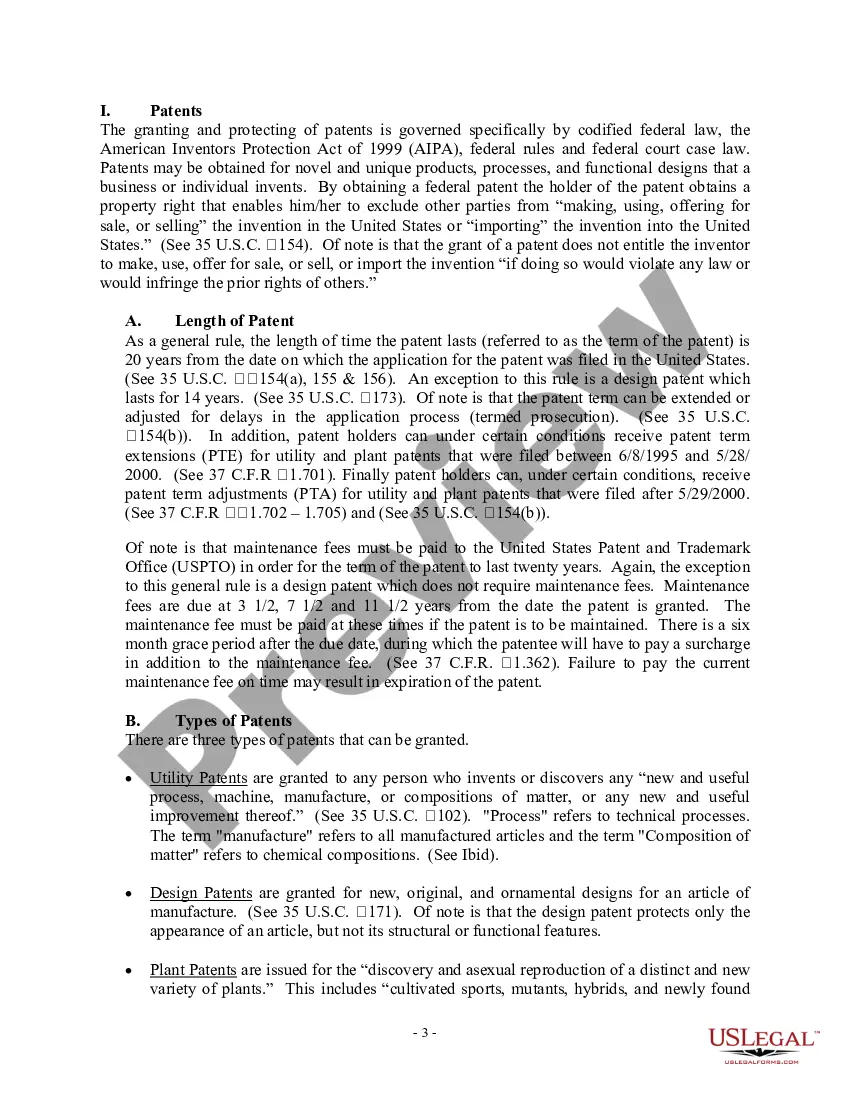
The patent grant confers “the right to exclude others from making, using, offering for sale, or selling the invention throughout the United States or importing the invention into the United States.” The term of a utility or plant patent generally lasts 20 years from the date the application was filed in the United ...
Instead, patent attorneys aim to settle IP disputes outside of court through means such as cease and desist letters, opposition proceedings and revocation actions. Conversely, IP lawyers specialise in the legal and commercial issues that are associated with IP.
The five primary requirements for patentability are: (1) patentable subject matter; (2) utility; (3) novelty; (4) non-obviousness; and (5) enablement. Like trademarks, patents are territorial, meaning they are enforceable in a specific geographic area.
So, for a patent to be issued, your invention must meet four conditions: Able to be used (the invention must work and cannot just be a theory) A clear description of how to make and use the invention. New, or “novel” (something not done before) “Not obvious,” as related to a change to something already invented.
The five primary requirements for patentability are: (1) patentable subject matter, (2) utility, (3) novelty, (4) nonobviousness , and (5) enablement.
These five steps will help you plan out the patent process as you seek to protect your invention. Understand your invention. The first step in how to get a patent is to understand your invention. Research your invention. Choose the type of protection. Draft your patent application. Wait for a formal response.
So, let's get started. Step 1: Idea incubation phase. Step 2: Patentability search (optional step) ... Step 3: Patent drafting/writing. Step 4: Filing patent application. Step 5: Publication of application. Step 6: Request for examination (RFE) ... Step 7: Response to objections. Step 8: Grant of patent.
Length of Protection: Patents are granted for a limited time (typically 20 years), while trademarks can last indefinitely if used continuously and maintained properly. Who They Protect: Patents protect the rights of inventors, while trademarks protect the reputation and goodwill of a business.
The five primary requirements for patentability are: (1) patentable subject matter; (2) utility; (3) novelty; (4) non-obviousness; and (5) enablement. Like trademarks, patents are territorial, meaning they are enforceable in a specific geographic area.
A patent allows the creator of certain kinds of inventions that contain new ideas to keep others from making commercial use of those ideas without the creator's permission. Trademarks, on the other hand, are not concerned with how a new technology is used.
