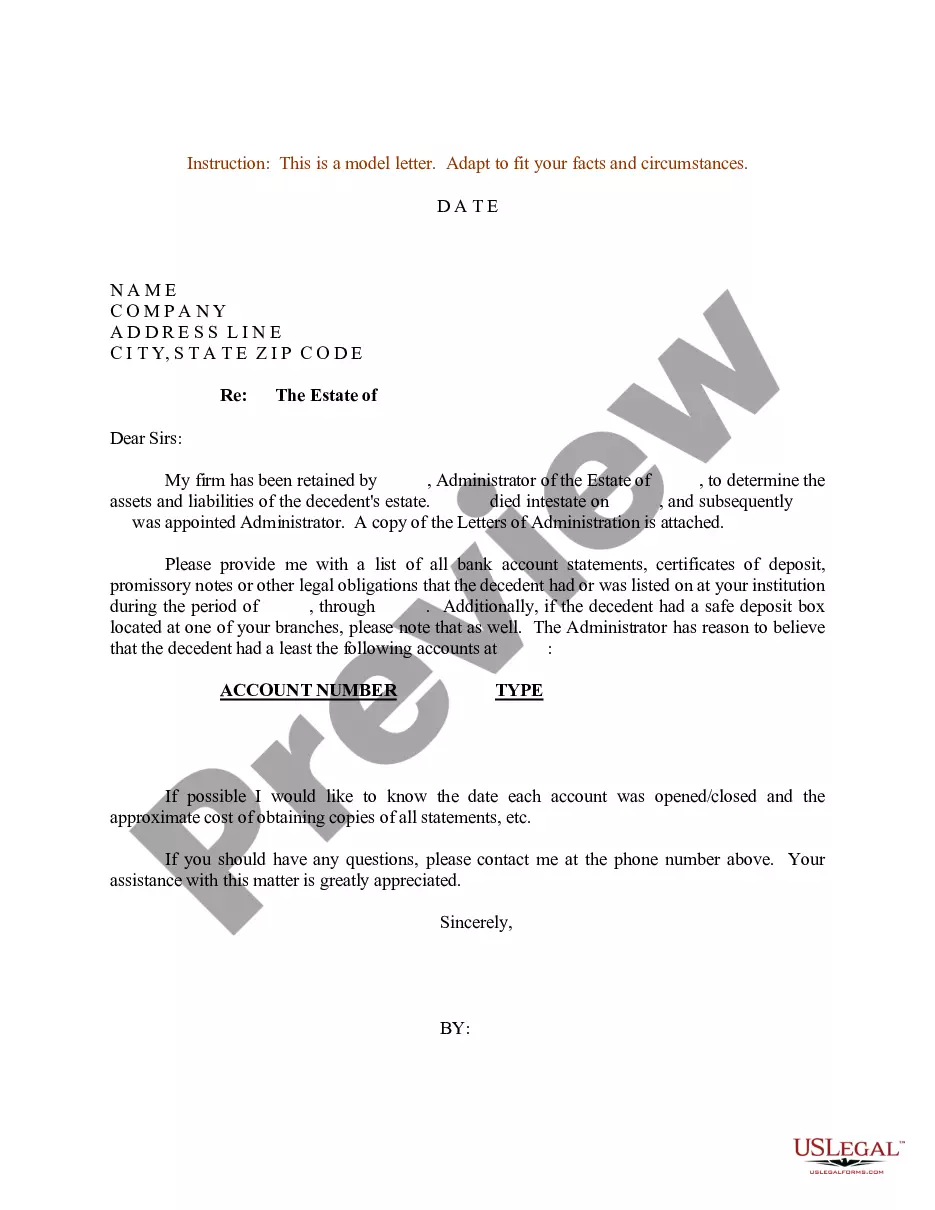
Decedent Account Bank For Taxes In Wayne
Description




Get your form ready online
Our built-in tools help you complete, sign, share, and store your documents in one place.
Make edits, fill in missing information, and update formatting in US Legal Forms—just like you would in MS Word.
Download a copy, print it, send it by email, or mail it via USPS—whatever works best for your next step.
Sign and collect signatures with our SignNow integration. Send to multiple recipients, set reminders, and more. Go Premium to unlock E-Sign.
If this form requires notarization, complete it online through a secure video call—no need to meet a notary in person or wait for an appointment.
We protect your documents and personal data by following strict security and privacy standards.

Make edits, fill in missing information, and update formatting in US Legal Forms—just like you would in MS Word.

Download a copy, print it, send it by email, or mail it via USPS—whatever works best for your next step.

Sign and collect signatures with our SignNow integration. Send to multiple recipients, set reminders, and more. Go Premium to unlock E-Sign.

If this form requires notarization, complete it online through a secure video call—no need to meet a notary in person or wait for an appointment.

We protect your documents and personal data by following strict security and privacy standards.
Looking for another form?








Form popularity
FAQ
If you file a return and claim a refund for a deceased taxpayer, you must be: A surviving spouse/RDP. A surviving relative. The sole beneficiary.
Steps to Become a Personal Representative of an Estate Understand Your Priority for Appointment. Determine the Proper Probate Court. Research the County's Filing Requirements. File the Petition for Administration. Notice of Petition to Administer Estate. File a Bond. Attend the Probate Hearing.
For paper returns, the filer should write the word deceased, the deceased person's name and the date of death across the top. Here's who should sign the return: Any appointed representative must sign the return. If it's a joint return, the surviving spouse must also sign it.
In general, file and prepare the final individual income tax return of a deceased person the same way you would if the person were alive. Report all income up to the date of death and claim all eligible credits and deductions.
In Michigan, you can make a living trust to avoid probate for virtually any asset you own—real estate, bank accounts, vehicles, and so on. You need to create a trust document (similar to a will), naming someone to take over as trustee after your death (called a "successor trustee").
The executor of the estate needs to follow these basic steps. Step 1: Begin the probate process. Step 2: Obtain a tax ID number for the estate account. Step 3: Bring all required documents to the bank. Step 4: Open the estate account.
Assets that pass directly to beneficiaries without having to go through probate include: Any property jointly owned by the decedent and a survivor. Any property held in a trust. Life insurance policies with named beneficiaries. Retirement accounts with named beneficiaries. Bank accounts with named beneficiaries.
(g) That, if the estate is not settled within 1 year after the personal representative's appointment, within 28 days after the anniversary of the appointment, the personal representative must file with the court and send to each interested person a notice that the estate remains under administration and must specify ...
Estate OVER $24,000: If a Wayne County resident has died leaving property in their name only and the property is over $24,000, the closest relative or person named in the will may file a petition to have the estate probated.
Estate OVER $24,000: If a Wayne County resident has died leaving property in their name only and the property is over $24,000, the closest relative or person named in the will may file a petition to have the estate probated.
