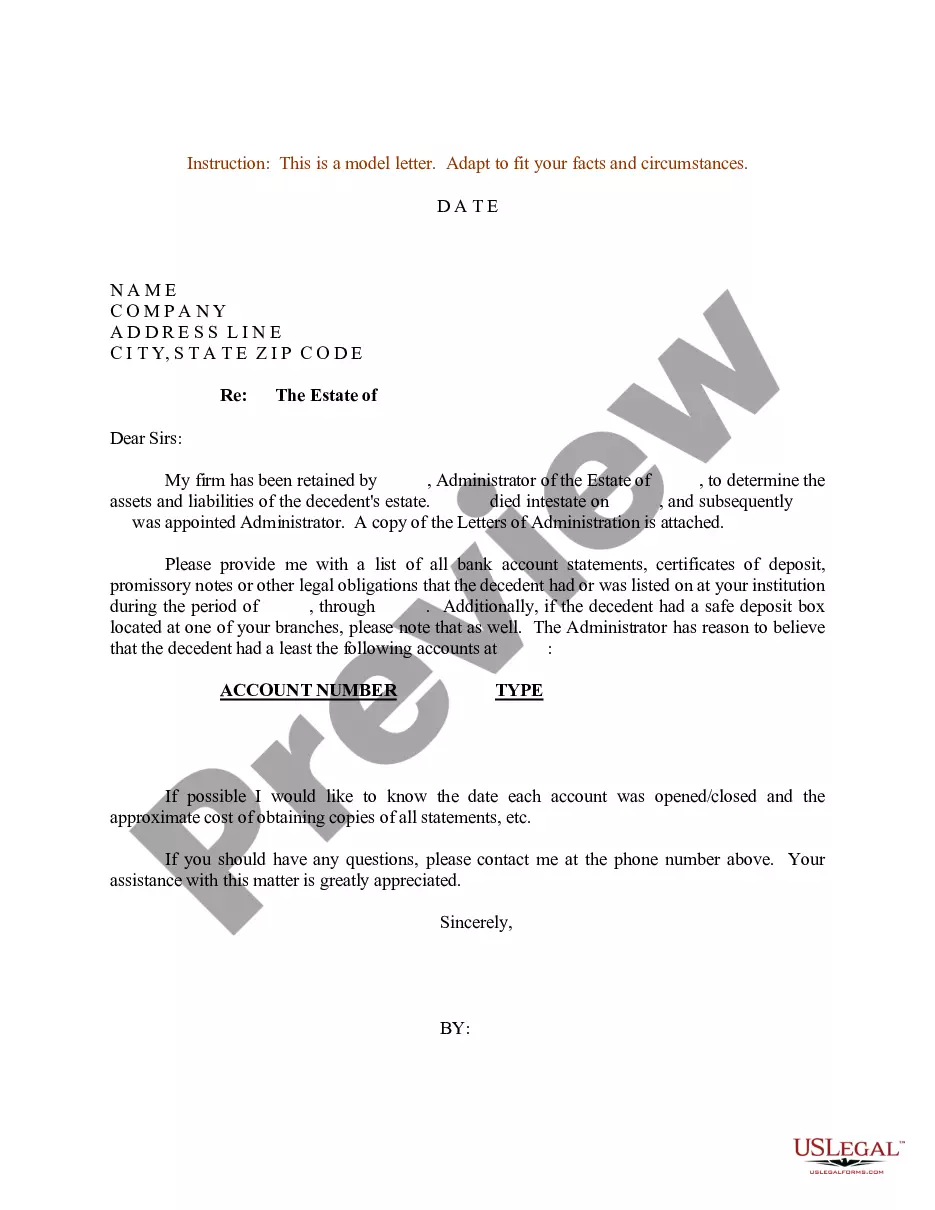
Sample Letter To Close Trust Account With Bank In Michigan
Description




Get your form ready online
Our built-in tools help you complete, sign, share, and store your documents in one place.
Make edits, fill in missing information, and update formatting in US Legal Forms—just like you would in MS Word.
Download a copy, print it, send it by email, or mail it via USPS—whatever works best for your next step.
Sign and collect signatures with our SignNow integration. Send to multiple recipients, set reminders, and more. Go Premium to unlock E-Sign.
If this form requires notarization, complete it online through a secure video call—no need to meet a notary in person or wait for an appointment.
We protect your documents and personal data by following strict security and privacy standards.

Make edits, fill in missing information, and update formatting in US Legal Forms—just like you would in MS Word.

Download a copy, print it, send it by email, or mail it via USPS—whatever works best for your next step.

Sign and collect signatures with our SignNow integration. Send to multiple recipients, set reminders, and more. Go Premium to unlock E-Sign.

If this form requires notarization, complete it online through a secure video call—no need to meet a notary in person or wait for an appointment.

We protect your documents and personal data by following strict security and privacy standards.
Looking for another form?







Form popularity
FAQ
Dissolving an irrevocable trust can be a complex process, usually requiring consent from all beneficiaries, filing the necessary paperwork and potentially getting court approval. For instance, in states such as California, a petition to terminate the trust needs to be filed with the probate court.
Seeking Legal Counsel The trustee should have a trust lawyer to guide them through how to dissolve a trust after the grantor's death. Your trust lawyer can help to identify any dissolving trust tax implications. A trust lawyer can help you understand can a trustee revoke a revocable trust.
Respected Sir/Madam, I am writing to you with a heavy heart to inform you of the demise of my husband, Mr. Rajeev Singh, who had a savings account in your esteemed bank. It is a difficult time for our family, and I need to settle his financial affairs.
A court may terminate the trust when the trustee and settlor agree. Fredricks v Near, 260 Mich 627, 245 NW 537 (1932). However, Michigan law does not permit the trustee and beneficiaries to agree to terminate trusts if to do so would violate a material purpose of the trust.
To close a trust after death, the successor trustee must settle and terminate the trust by diligently distributing its assets as per the trust's terms. This involves inventorying assets, paying debts, and ensuring beneficiaries receive their rightful shares, effectively bringing the trust to a timely conclusion.
Trusts and the 5-Year Rule Irrevocable trusts, such as Medicaid Asset Protection Trusts (MAPTs), are designed to shield assets from Medicaid spend-down requirements. Yet, to avoid penalties, these trusts must be established a minimum of five years before the individual applies for Medicaid.
