Employer Withholding Severance Pay In San Diego
Description

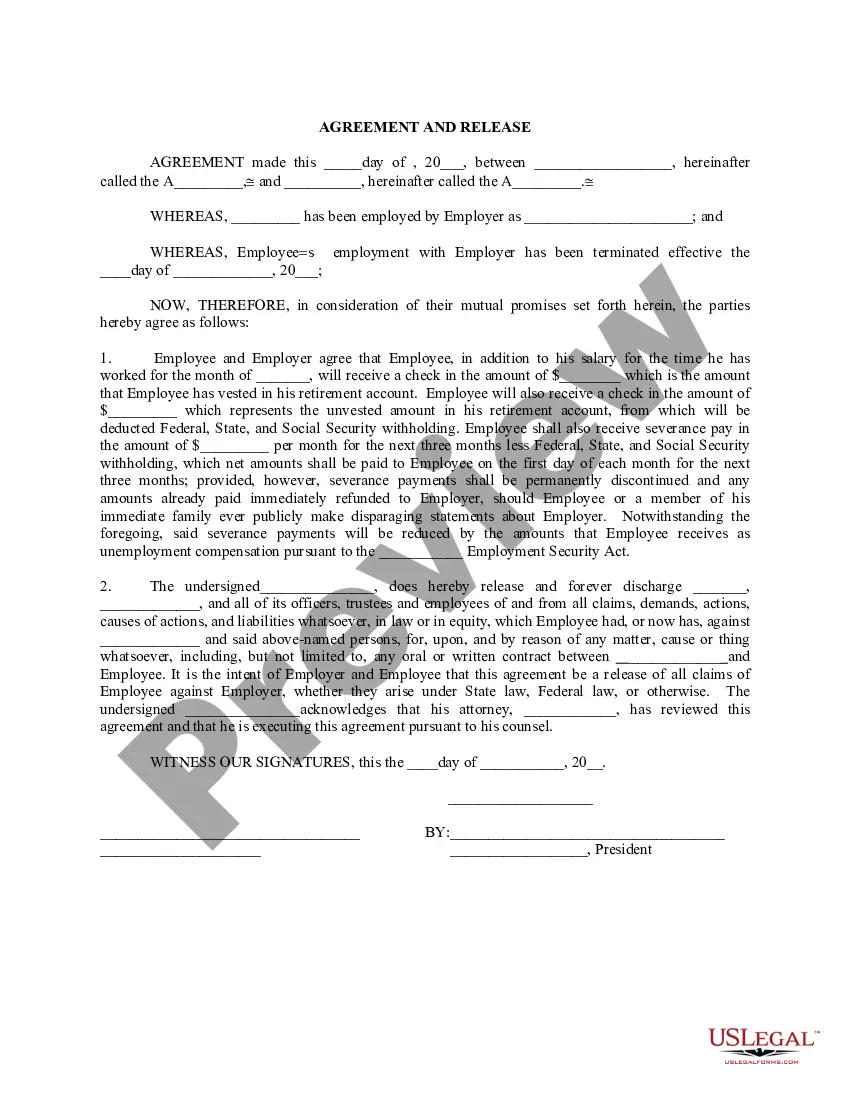
Get your form ready online
Our built-in tools help you complete, sign, share, and store your documents in one place.
Make edits, fill in missing information, and update formatting in US Legal Forms—just like you would in MS Word.
Download a copy, print it, send it by email, or mail it via USPS—whatever works best for your next step.
Sign and collect signatures with our SignNow integration. Send to multiple recipients, set reminders, and more. Go Premium to unlock E-Sign.
If this form requires notarization, complete it online through a secure video call—no need to meet a notary in person or wait for an appointment.
We protect your documents and personal data by following strict security and privacy standards.

Make edits, fill in missing information, and update formatting in US Legal Forms—just like you would in MS Word.

Download a copy, print it, send it by email, or mail it via USPS—whatever works best for your next step.

Sign and collect signatures with our SignNow integration. Send to multiple recipients, set reminders, and more. Go Premium to unlock E-Sign.

If this form requires notarization, complete it online through a secure video call—no need to meet a notary in person or wait for an appointment.

We protect your documents and personal data by following strict security and privacy standards.
Looking for another form?




Form popularity
FAQ
Severance tax is a state tax imposed on the extraction of non-renewable natural resources intended for consumption by other states. Severance tax is intended to compensate states for the loss of the non-renewable resources.
Let's understand this better through an example: imagine an employee in California receiving a severance of $100,000. In addition to the 22% federal withholding, California's state tax rate could be up to 12.3%, depending on the employee's total income.
The new rule mandates that businesses inform their employees that they have at least five days to review any separation or severance arrangements.
This allows for the “7 minute rule,” where: the first 7 minutes to the increment, 1 through 7, are rounded down, and. the final 7 minutes, or 8-15, are rounded up.
Under Labor Code Section 202, when an employee not having a written contact for a definite period quits his or her employment and gives 72 hours prior notice of his or her intention to quit, and quits on the day given in the notice, the employee is entitled to his or her wages at the time of quitting.
Extension of Benefits Under Rule of 70 To be eligible to retire, you must be at least age 55 with 10 years of service or age 65. Years of service for the “Rule of 70” eligibility purposes, means total years of employment from date of hire to date of termination.
Eligibility for Retiree Health and Life Insurance Benefits Rule of 70: the employee's age plus years of continuous, full-time service equal 70 or more, and the employee is at least age 55, with at least ten years of continuous, full-time service.
Employers. Employers are required by law to withhold employment taxes from their employees. Employment taxes include federal income tax withholding and Social Security and Medicare Taxes.