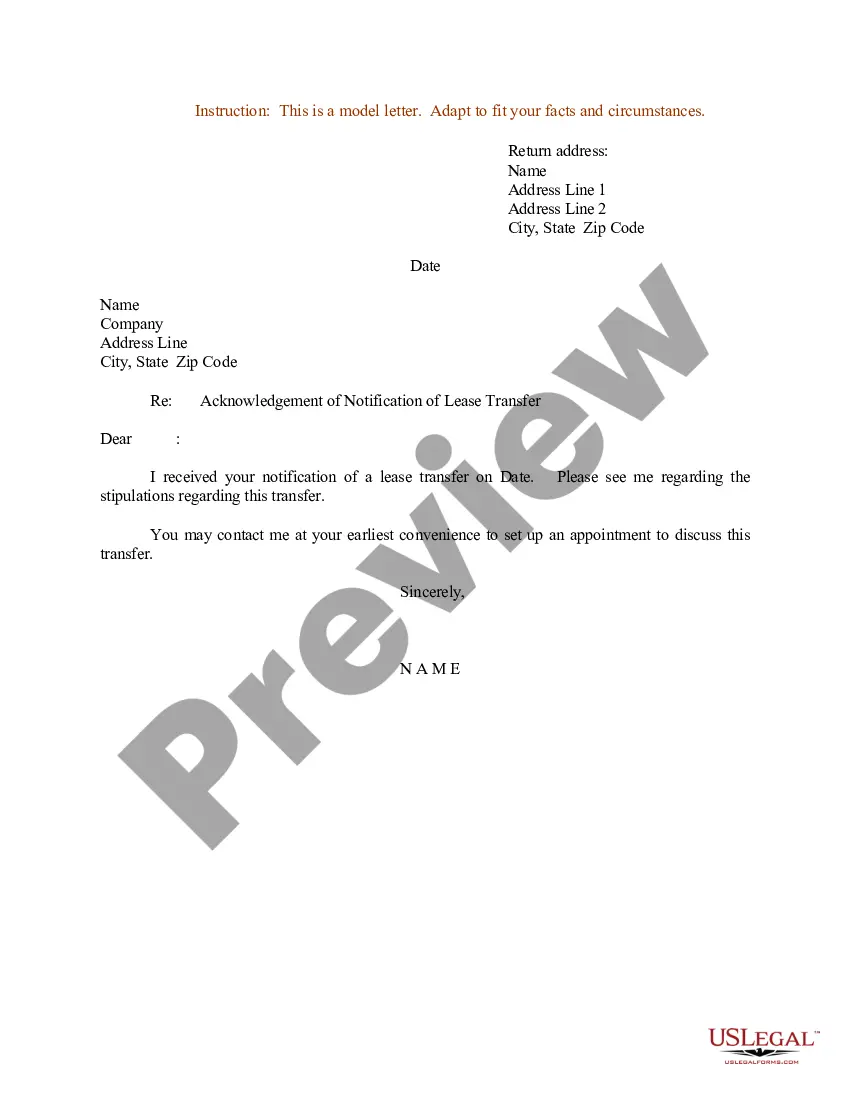
Letter Notification Transfer Without Cheque In Florida
Description



Get your form ready online
Our built-in tools help you complete, sign, share, and store your documents in one place.
Make edits, fill in missing information, and update formatting in US Legal Forms—just like you would in MS Word.
Download a copy, print it, send it by email, or mail it via USPS—whatever works best for your next step.
Sign and collect signatures with our SignNow integration. Send to multiple recipients, set reminders, and more. Go Premium to unlock E-Sign.
If this form requires notarization, complete it online through a secure video call—no need to meet a notary in person or wait for an appointment.
We protect your documents and personal data by following strict security and privacy standards.

Make edits, fill in missing information, and update formatting in US Legal Forms—just like you would in MS Word.

Download a copy, print it, send it by email, or mail it via USPS—whatever works best for your next step.

Sign and collect signatures with our SignNow integration. Send to multiple recipients, set reminders, and more. Go Premium to unlock E-Sign.

If this form requires notarization, complete it online through a secure video call—no need to meet a notary in person or wait for an appointment.

We protect your documents and personal data by following strict security and privacy standards.
Looking for another form?






Form popularity
FAQ
Where the check issued is in an amount less than $150.00, the offense is classified as a first degree misdemeanor, punishable by up to 1 year in jail. Where the check is in an amount of $150.00 or more, the offense is a third degree felony, punishable by up to 5 years imprisonment.
If the check amount was under $150, the crime is a first-degree misdemeanor which is punishable up to 365 days in jail and a $1,000 fine. If the value is $150 or more, the crime is a third-degree felony which is punishable up to 5 years in prison and a $5,000 fine.
If the check amount was under $150, the crime is a first-degree misdemeanor which is punishable up to 365 days in jail and a $1,000 fine. If the value is $150 or more, the crime is a third-degree felony which is punishable up to 5 years in prison and a $5,000 fine.
While a bill of sale isn't legally required, and doesn't replace a title transfer, it is highly recommended and protects both the buyer and seller from fraud, theft, or mistakes.
Notarization is NOT required in the “Transfer of Title by Seller” section on the Florida title even if there is a place for notarization. Federal rule specifies that Odometer Disclosures for all non-exempt vehicles are to be made in the “Transfer of Title by Seller” section of the Florida Certificate of Title.
Think of the two documents as complementary. While a bill of sale certifies a transfer of ownership between two parties, a title certifies the buyer's legal ownership. It's the final step in the process and proves that the buyer is the legal owner.
While it is common to present a bill of sale in a digital format, you can also create this type of contractual agreement as a handwritten document on paper. What's most important is to include all of the pertinent details in the bill of sale in order to protect both parties.
While a bill of sale isn't legally required, and doesn't replace a title transfer, it is highly recommended and protects both the buyer and seller from fraud, theft, or mistakes.
If the title is held electronically, the seller and buyer must visit a motor vehicle service center to complete a secure title reassignment (HSMV 82994 or 82092) and disclose the odometer reading. The buyer and seller must both be present and provide photo identification.