Federal Habeas Corpus Form 2241 In Clark
Description

Get your form ready online
Our built-in tools help you complete, sign, share, and store your documents in one place.
Make edits, fill in missing information, and update formatting in US Legal Forms—just like you would in MS Word.
Download a copy, print it, send it by email, or mail it via USPS—whatever works best for your next step.
Sign and collect signatures with our SignNow integration. Send to multiple recipients, set reminders, and more. Go Premium to unlock E-Sign.
If this form requires notarization, complete it online through a secure video call—no need to meet a notary in person or wait for an appointment.
We protect your documents and personal data by following strict security and privacy standards.

Make edits, fill in missing information, and update formatting in US Legal Forms—just like you would in MS Word.

Download a copy, print it, send it by email, or mail it via USPS—whatever works best for your next step.

Sign and collect signatures with our SignNow integration. Send to multiple recipients, set reminders, and more. Go Premium to unlock E-Sign.

If this form requires notarization, complete it online through a secure video call—no need to meet a notary in person or wait for an appointment.

We protect your documents and personal data by following strict security and privacy standards.
Looking for another form?





Form popularity
FAQ
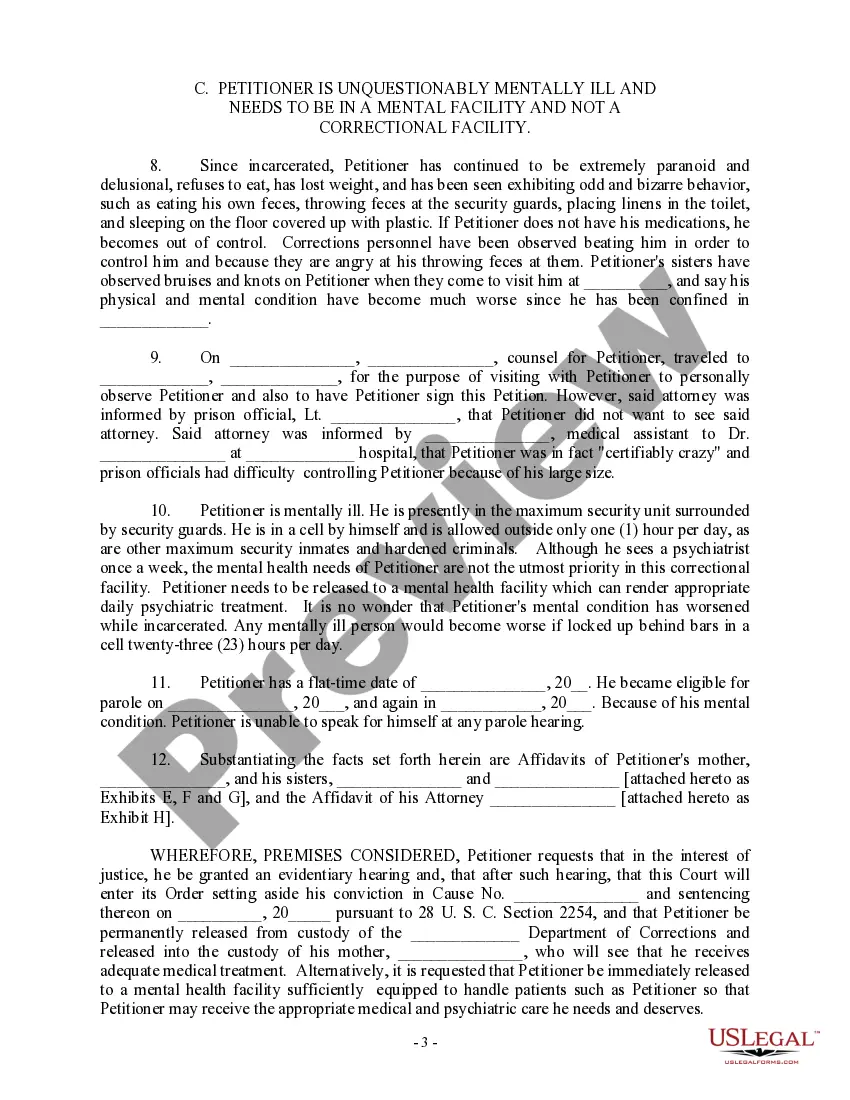
A Writ of Habeas Corpus is usually filed by submitting a Petition, a Memorandum of Points and Authorities, a Declaration from the defendant, and other evidence which supports the Writ of Habeas Corpus. The Memorandum of Points of Authorities is a legal memorandum, which contains the legal arguments of the defendant.
Section 2241 of Title 28 of the United States Code (“28 U.S.C. § 2241”) permits courts to issue writs of habeas corpus where a prisoner establishes that he is in custody in violation of the Constitution or laws or treaties of the United States.
You should use this form if • you are a federal prisoner and you wish to challenge the way your sentence is being carried out (for example, you claim that the Bureau of Prisons miscalculated your sentence or failed to properly award good time credits); • you are in federal or state custody because of something other ...
PETITION FOR WRIT OF HABEAS CORPUS BY A PERSON IN FEDERAL CUSTODY UNDER 28 U.S.C.
The court must rule on a petition for writ of habeas corpus within 60 days after the petition is filed. (B) If the court fails to rule on the petition within 60 days of its filing, the petitioner may file a notice and request for ruling.
TWO TYPES OF WRITS: WRIT OF HABEAS CORPUS AD PROSEQUENDUM - An order commanding the presence of a defendant to appear in court to answer charges on pending case. WRIT OF HABEAS CORPUS AD TESTIFICANDUM – An order commanding the presence of a witness to appear in court to testify in court proceedings.