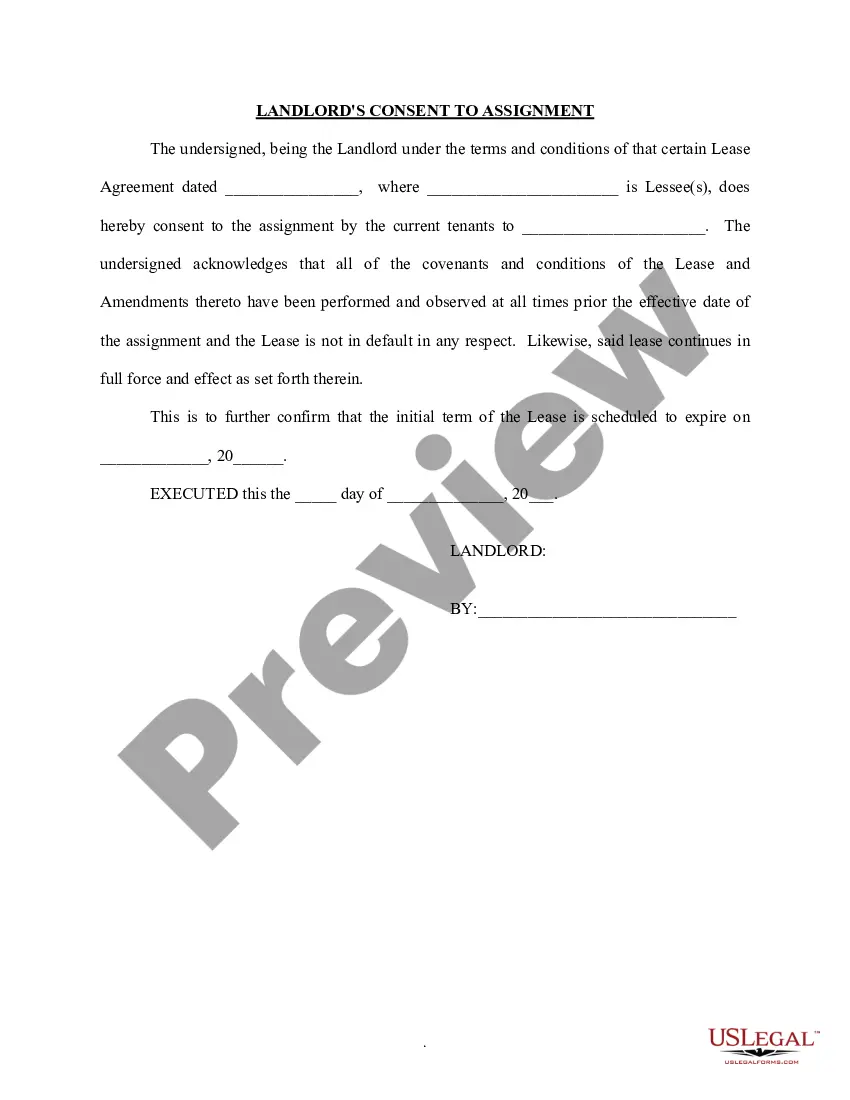
Assignment Without Landlord's Consent In Tarrant
Description
Get your form ready online
Our built-in tools help you complete, sign, share, and store your documents in one place.
Make edits, fill in missing information, and update formatting in US Legal Forms—just like you would in MS Word.
Download a copy, print it, send it by email, or mail it via USPS—whatever works best for your next step.
Sign and collect signatures with our SignNow integration. Send to multiple recipients, set reminders, and more. Go Premium to unlock E-Sign.
If this form requires notarization, complete it online through a secure video call—no need to meet a notary in person or wait for an appointment.
We protect your documents and personal data by following strict security and privacy standards.

Make edits, fill in missing information, and update formatting in US Legal Forms—just like you would in MS Word.

Download a copy, print it, send it by email, or mail it via USPS—whatever works best for your next step.

Sign and collect signatures with our SignNow integration. Send to multiple recipients, set reminders, and more. Go Premium to unlock E-Sign.

If this form requires notarization, complete it online through a secure video call—no need to meet a notary in person or wait for an appointment.

We protect your documents and personal data by following strict security and privacy standards.
Looking for another form?







Form popularity
FAQ
A periodic tenancy is a tenancy that will go on from one period of time to the next period of time until notice is given for its termination, such as month-to-month lease. A tenancy at sufferance exists when a tenant wrongfully stays on the real estate after the expiration of the lease.
The rental lease agreement is a formal contract between a tenant and a property owner, or a representative of the owner, like a property manager, outlining the terms and conditions for living at a rental property in exchange for rent. In order for a lease agreement to be valid, both parties must sign the contract.
In California, within the Business and Professions Code, Section 1995.260, the landlord cannot unreasonably withhold the consent of the tenant to assign or sublease the property.
A tenancy at sufferance is created when a tenant wrongfully holds over beyond the end of the duration period of the tenancy (for example, a tenant who stays past the expiration of their lease .
There are no state laws that regulate landlord's entry in Texas. However, your lease agreement may allow your landlord to enter under certain circumstances. The lease may or may not require prior notice to the tenant. It may also authorize other people to enter, like maintenance staff or prospective buyers.
Tenancy at sufferance (also called "estate at sufferance" or "holdover tenancy") arises when a tenant who has a lawful possession of a property (for example, a lease) holds over without the owner's consent.
The transfer of a right from one party to another. For example, a party to a contract (the assignor) may, as a general rule and subject to the express terms of a contract, assign its rights under the contract to a third party (the assignee) without the consent of the party against whom those rights are held.
Tenancy at sufferance is when a tenant continues to occupy a property after their lease has ended without the landlord's consent.
The transfer of a right from one party to another. For example, a party to a contract (the assignor) may, as a general rule and subject to the express terms of a contract, assign its rights under the contract to a third party (the assignee) without the consent of the party against whom those rights are held.
In California, within the Business and Professions Code, Section 1995.260, the landlord cannot unreasonably withhold the consent of the tenant to assign or sublease the property.

