Assignment Without Landlord's Consent In Middlesex
Description
Get your form ready online
Our built-in tools help you complete, sign, share, and store your documents in one place.
Make edits, fill in missing information, and update formatting in US Legal Forms—just like you would in MS Word.
Download a copy, print it, send it by email, or mail it via USPS—whatever works best for your next step.
Sign and collect signatures with our SignNow integration. Send to multiple recipients, set reminders, and more. Go Premium to unlock E-Sign.
If this form requires notarization, complete it online through a secure video call—no need to meet a notary in person or wait for an appointment.
We protect your documents and personal data by following strict security and privacy standards.

Make edits, fill in missing information, and update formatting in US Legal Forms—just like you would in MS Word.

Download a copy, print it, send it by email, or mail it via USPS—whatever works best for your next step.

Sign and collect signatures with our SignNow integration. Send to multiple recipients, set reminders, and more. Go Premium to unlock E-Sign.

If this form requires notarization, complete it online through a secure video call—no need to meet a notary in person or wait for an appointment.

We protect your documents and personal data by following strict security and privacy standards.
Looking for another form?






Form popularity
FAQ
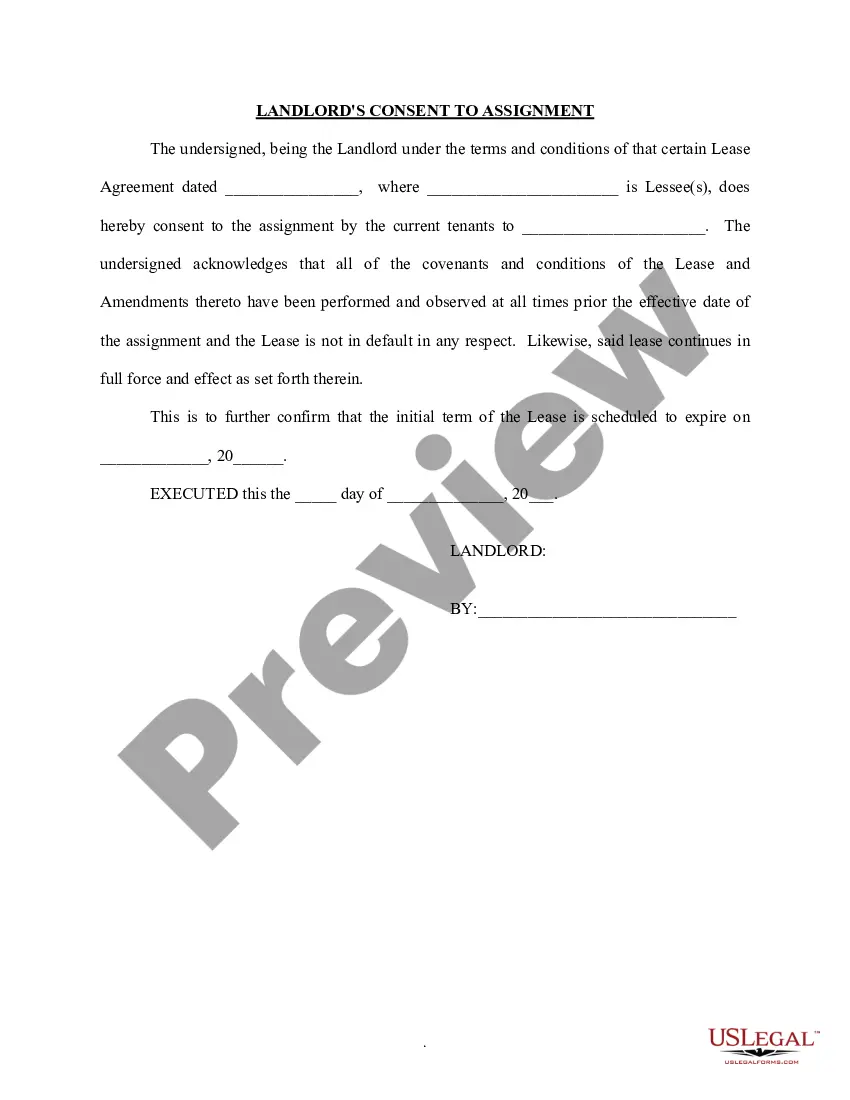
With a Landlord's Consent to Lease Assignment, landlords and property managers can give formal approval to tenants who wish to exit their lease agreement and transfer it to a new tenant before the rental term is complete.
The transfer of a right from one party to another. For example, a party to a contract (the assignor) may, as a general rule and subject to the express terms of a contract, assign its rights under the contract to a third party (the assignee) without the consent of the party against whom those rights are held.
In California, within the Business and Professions Code, Section 1995.260, the landlord cannot unreasonably withhold the consent of the tenant to assign or sublease the property.
Tenancy at sufferance is when a tenant continues to occupy a property after their lease has ended without the landlord's consent.
In California, within the Business and Professions Code, Section 1995.260, the landlord cannot unreasonably withhold the consent of the tenant to assign or sublease the property.
9 Ways to Get Approved With No Rental History Increasing The Security Deposit. Show Proof of Income. Provide Proof of Employment. Consider Renting with a Roommate. Collect References. Get a Cosigner. Get a Guarantor. Show Proof of Regular Payments.
While novation requires the consent of all parties, assignment needs no consent from other non-assigning parties. However, in the case of assignment, the consent of the non-assigning party may be required by a contractual provision.
The transfer of a right from one party to another. For example, a party to a contract (the assignor) may, as a general rule and subject to the express terms of a contract, assign its rights under the contract to a third party (the assignee) without the consent of the party against whom those rights are held.
The assignor must agree to assign their rights and duties under the contract to the assignee. The assignee must agree to accept, or "assume," those contractual rights and duties. The other party to the initial contract must consent to the transfer of rights and obligations to the assignee.
