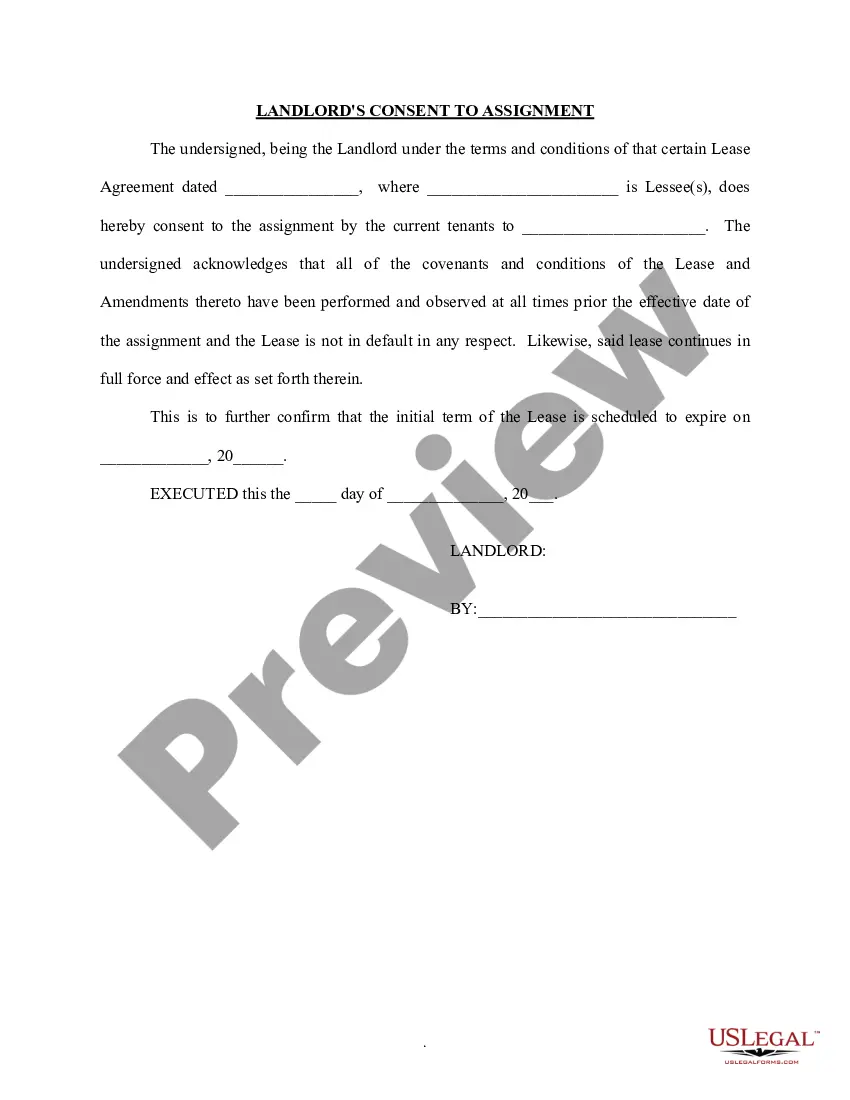
Assignment Without Landlord's Consent In Florida
Description
Get your form ready online
Our built-in tools help you complete, sign, share, and store your documents in one place.
Make edits, fill in missing information, and update formatting in US Legal Forms—just like you would in MS Word.
Download a copy, print it, send it by email, or mail it via USPS—whatever works best for your next step.
Sign and collect signatures with our SignNow integration. Send to multiple recipients, set reminders, and more. Go Premium to unlock E-Sign.
If this form requires notarization, complete it online through a secure video call—no need to meet a notary in person or wait for an appointment.
We protect your documents and personal data by following strict security and privacy standards.

Make edits, fill in missing information, and update formatting in US Legal Forms—just like you would in MS Word.

Download a copy, print it, send it by email, or mail it via USPS—whatever works best for your next step.

Sign and collect signatures with our SignNow integration. Send to multiple recipients, set reminders, and more. Go Premium to unlock E-Sign.

If this form requires notarization, complete it online through a secure video call—no need to meet a notary in person or wait for an appointment.

We protect your documents and personal data by following strict security and privacy standards.
Looking for another form?
Form popularity
FAQ
The transfer of a right from one party to another. For example, a party to a contract (the assignor) may, as a general rule and subject to the express terms of a contract, assign its rights under the contract to a third party (the assignee) without the consent of the party against whom those rights are held.
Retaliation may be presumed if it occurs after a tenant has complained about housing conditions. It is also unlawful to lock the tenant out, intercept or shut off utilities, water or electric services to the tenant, or remove doors, appliances or the tenant's property from the home.
In Florida, a contractual right is assignable unless: The assignment is prohibited by statute or on public policy grounds (see, for example, Law Office of David J. Stern, P.A.
The Landlord cannot just come to the property that you are renting unannounced. The Landlord MUST give you notice before the Landlord can come.
Access to the Premises The landlord may enter the rental unit on reasonable notice to the tenant and at a reasonable time to make repairs to the premises. “Reasonable notice” is defined as 24 hours prior to entry, and "reasonable time" is defined as between the hours of a.m. and 8 p.m.
California. In California, landlords can enter to show the property to potential buyers, renters, or repair workers. They may also enter to respond to an emergency, in case of abandonment, if they have a court order, or to make agreed-upon repairs or alterations.
Tenancy at sufferance (also called "estate at sufferance" or "holdover tenancy") arises when a tenant who has a lawful possession of a property (for example, a lease) holds over without the owner's consent.
The transfer of a right from one party to another. For example, a party to a contract (the assignor) may, as a general rule and subject to the express terms of a contract, assign its rights under the contract to a third party (the assignee) without the consent of the party against whom those rights are held.
If your landlord continues to violate your right to privacy, you could sue him or her in small claims court for infliction of emotional distress or trespassing.

